
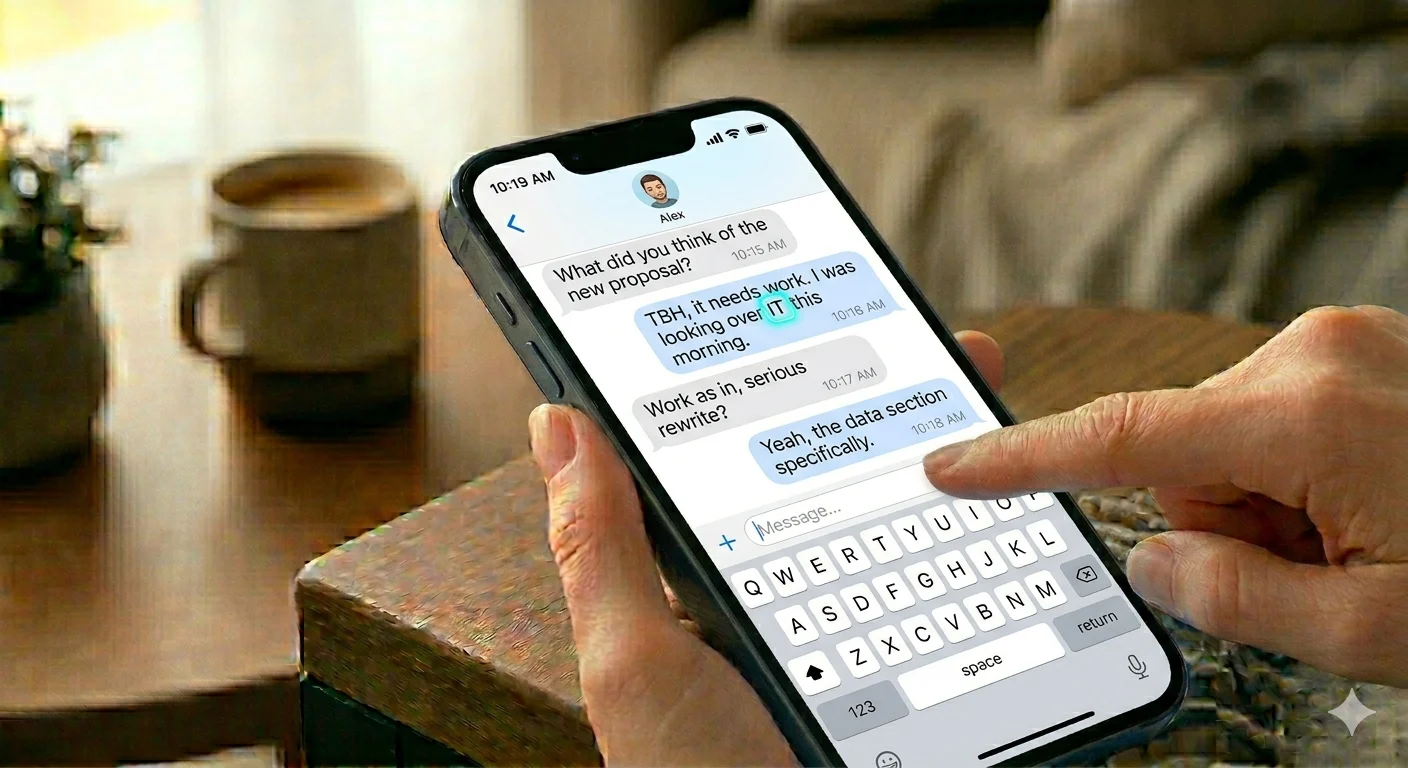
Meaning: Depends on context — usually a pronoun or short form for Information Technology.
Full Form: IT = “It” (pronoun) or “Information Technology”.
Context: Texting, everyday English, social media, professional use.
Tone: Neutral, context-based.
If you have come across the term “IT” in a message, post, or conversation, you might be surprised that such a small word can have so many meanings. Unlike most slang terms, “IT” is not just internet language. It is a common English word that also works as an abbreviation in different contexts. This is why many people search for its meaning, especially when they see it used in different ways online.
In texting, “IT” is often just the pronoun “it,” referring to a thing, idea, or situation. But in other cases, especially in professional or technical discussions, IT stands for “Information Technology.” Because of these different meanings, it can sometimes be confusing to understand what someone is referring to.
The key to understanding “IT” is context. The same word can mean something simple in a casual chat and something technical in a work conversation. In this article, you will learn the meaning of IT in texting, how it is used, its different interpretations, and how to understand it clearly in real-life situations.
What does IT mean?
The word “IT” has two main meanings. The first and most common is as a pronoun in the English language. In this case, “it” is used to refer to a thing, idea, or situation that has already been mentioned or is understood from context.
For example, in the sentence “I saw a movie and it was great,” the word “it” refers to the movie.
The second meaning of IT is as an abbreviation for “Information Technology.” This is commonly used in professional or technical environments to describe computer systems, software, and digital processes.
The meaning of IT depends entirely on how it is used. In casual conversation, it is usually just a pronoun. In formal or technical settings, it often refers to technology.
What does IT mean in texting / slang / social media?
Texting meaning
In texting, IT is usually just the word “it.” People type it in uppercase or lowercase without changing its meaning. It is used to refer to something already known in the conversation.
For example, “Did you finish it?” uses “it” to refer to a task or object.
Social media usage
On social media, IT is also used as a pronoun. However, it can sometimes take on a broader meaning. People may use “it” to refer to trends, situations, or viral content.
For example, someone might say “This is it” to highlight something important or exciting.
Gen Z context
Among Gen Z users, “it” appears in phrases like “That’s it” or “It’s giving.” These phrases use “it” to express reactions or describe a vibe. While the word itself stays the same, the meaning comes from the full phrase.
Other meanings of IT
Besides its basic and technical meanings, IT can also appear in other contexts:
- Information Technology: Refers to computers, software, and networks
- Abbreviation in different fields: IT may stand for different terms depending on the industry
However, these meanings are usually clear from the context and are not related to casual texting.
How IT is used in real conversations
IT is one of the most commonly used words in everyday language. It appears in almost every type of conversation, from casual chats to formal discussions.
In texting, it helps keep sentences short and natural. Instead of repeating a noun, people use “it” to make communication easier.
For example, instead of saying “I watched the movie and the movie was great,” people say “I watched the movie and it was great.”
In professional settings, IT is used to talk about technology systems, departments, or services.
Examples
Here are some natural examples of how IT is used:
- “I found a book and it looks interesting.”
- “Did you fix it yet?”
- “It was really fun hanging out.”
- “I don’t like it.”
- “IT is handling the system update.”
- “This is it, we’re ready.”
- “Can you send it to me?”
These examples show both casual and professional uses.
Tone and intent
The word “it” itself has a neutral tone. It does not carry any emotion on its own. The tone depends on the rest of the sentence.
For example, “I love it” sounds positive, while “I hate it” sounds negative. The word “it” simply points to something without adding emotion.
When used as “Information Technology,” the tone becomes formal and professional.
Origin or background
The word “it” comes from Old English and has been part of the language for centuries. It has always been used as a pronoun to refer to things or ideas.
The abbreviation “IT” for “Information Technology” became popular in the 20th century as computers and digital systems became more important in business and daily life.
Today, both meanings are widely used, depending on context.
Is it rude or inappropriate?
No, “it” is not rude or inappropriate. It is a neutral and essential part of the English language.
However, using “it” without clear context can sometimes confuse the listener. For example, if it is not clear what “it” refers to, the message may be hard to understand.
When NOT to use it
You should avoid using “it” when the reference is unclear. In formal writing or important communication, it is better to be specific.
For example, instead of saying “It is broken,” you can say “The phone is broken.” This makes the message clearer.
Clarity is more important than brevity in such cases.
Similar and related slang terms
There are other words that work similarly to “it”:
- “This”
- “That”
- “Thing”
These words also refer to objects or ideas, but they can be more specific.
IT vs related terms
IT vs “this”:
“This” refers to something close or immediate, while “it” is more general.
this vs “that”:
“That” refers to something more distant, while “it” is neutral.
IT vs “thing”:
“Thing” is less specific and more informal, while “it” is grammatically correct.
Comparison Table
| Term | Meaning | Usage | Key Difference |
|---|---|---|---|
| It | Refers to something | Everyday language | Neutral pronoun |
| This | Refers to something near | Speaking/writing | More specific |
| That | Refers to something distant | Conversations | Indicates distance |
| Thing | General object | Informal | Less precise |
Common misunderstandings
One common misunderstanding is thinking that “IT” always means “Information Technology.” In most casual conversations, it simply means the pronoun “it.”
Another issue is using “it” without clear context. This can make the sentence confusing.
Understanding the situation helps avoid these mistakes.
FAQ Section
1. What does IT mean in texting?
It usually means the pronoun “it,” referring to something already mentioned.
2. What does IT stand for in business?
It stands for “Information Technology.”
3. Is IT a slang term?
No, it is a standard English word, but it can also be an abbreviation.
4. Can IT have multiple meanings?
Yes, its meaning depends on context.
5. Is IT used on social media?
Yes, it is used just like in normal conversation.
6. Is IT formal or informal?
It can be both, depending on usage.
7. Why is IT confusing?
Because it has multiple meanings and depends on context.
conclusion
The term “IT” is simple but powerful. It can be a basic pronoun in everyday language or an abbreviation for Information Technology in professional settings. The key to understanding it is context.
In texting and casual conversations, it is usually just the word “it.” In work or technical discussions, it often refers to technology. Knowing the difference helps you communicate clearly and avoid confusion.
9 thoughts on “IT Meaning in Texting: Full Form, Usage, and Real-Life Examples”