
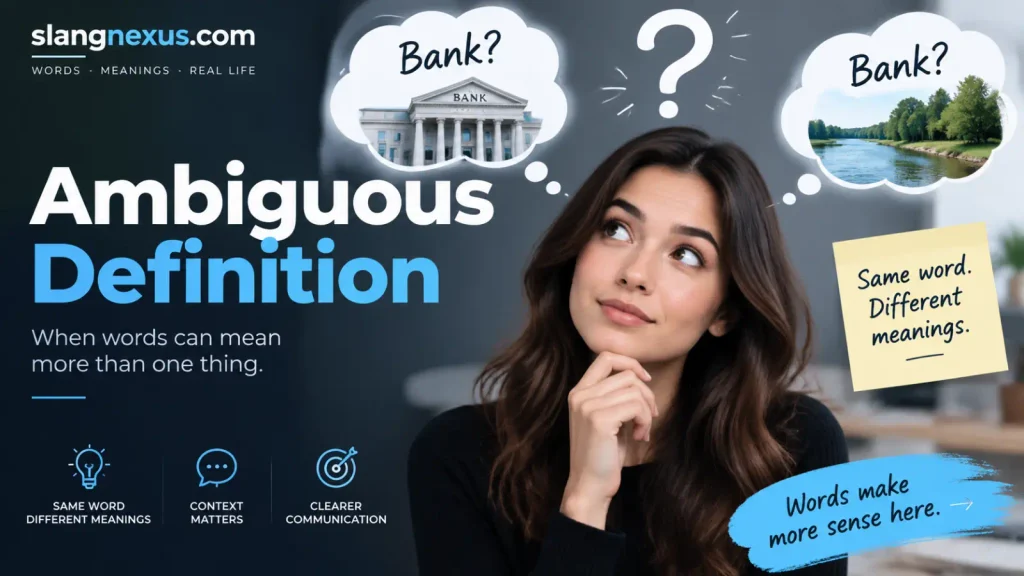
If you searched for “ambiguous definition,” you may be wondering what the word ambiguous really means and how to use it correctly. In simple English, ambiguous means unclear or open to more than one possible meaning or interpretation.
For example, if someone says, “I saw her duck,” the sentence can be understood in more than one way. It could mean that you saw the woman lower her head, or that you saw the woman’s duck. The meaning is unclear without more context.
Understanding the word ambiguous can help you communicate more clearly in everyday conversations, writing, school, work, and professional settings.
What Does Ambiguous Mean?
Ambiguous is an adjective used to describe something that has more than one possible meaning, interpretation, or explanation.
Ambiguous Definition in Simple English
Ambiguous means unclear because it can be understood in two or more different ways.
Simple Example
“The teacher told the student that she was late.”
This sentence is ambiguous because it is unclear whether the teacher was late or the student was late.
7 Powerful Meanings of Ambiguous
The word ambiguous can describe different types of unclear information.
1. Having More Than One Meaning
Something is ambiguous when it can be interpreted in different ways.
Example:
His answer was ambiguous, so nobody knew exactly what he meant.
2. Unclear or Difficult to Understand
Ambiguous language may make the intended meaning difficult to identify.
Example:
The instructions were ambiguous and confused the employees.
3. Open to Different Interpretations
An ambiguous statement can allow different people to reach different interpretations.
Example:
Her message was ambiguous enough to make me wonder what she really wanted.
4. Uncertain in Meaning
A word, sentence, image, or situation can be ambiguous when its meaning is not definite.
Example:
The politician gave an ambiguous response to the question.
5. Having an Unclear Intention
A person’s words or actions may be ambiguous when their real intention is difficult to determine.
Example:
His ambiguous comments made it difficult to understand his intentions.
6. Capable of Being Understood in Different Ways
Ambiguous information can produce multiple reasonable interpretations.
Example:
The contract included an ambiguous clause.
7. Uncertain or Indefinite
Ambiguous can also describe something that does not provide a clear answer or conclusion.
Example:
The results of the study were ambiguous.
Ambiguous Examples in Sentences
Here are some natural examples of ambiguous in American English:
- The question was too ambiguous to answer confidently.
- His response was ambiguous and left us confused.
- The sentence has an ambiguous meaning.
- The contract contains an ambiguous statement.
- Her text message was ambiguous.
- The instructions were ambiguous, so I asked for clarification.
- The ending of the movie was intentionally ambiguous.
- The word has an ambiguous meaning in this context.
- His facial expression was ambiguous.
- The evidence was ambiguous and did not clearly prove anything.
What Is an Ambiguous Sentence?
An ambiguous sentence is a sentence that can have two or more possible meanings.
Example:
“I watched the man with the telescope.”
This sentence is ambiguous because it could mean:
- I used a telescope to watch the man.
- I watched a man who had a telescope.
The words themselves do not make the intended meaning completely clear.
What Is an Ambiguous Statement?
An ambiguous statement is a statement that can reasonably be understood in more than one way.
For example:
“We will meet after lunch.”
This could be ambiguous if the speaker and listener have different ideas about what time “after lunch” means.
Ambiguous vs. Unclear
Ambiguous and unclear are related, but they are not always identical.
- Ambiguous means something has multiple possible meanings or interpretations.
- Unclear means something is difficult to understand or not expressed clearly.
Example:
“The report was unclear.”
The report may simply be poorly explained.
“The report was ambiguous.”
The report may contain wording that supports more than one interpretation.
Ambiguous vs. Vague
These words are also easy to confuse.
Ambiguous means there are two or more possible interpretations.
Vague means something lacks enough specific detail.
Example:
“I’ll see you later.”
This can be vague because “later” does not give a specific time.
“I saw the person with the camera.”
This can be ambiguous because it is unclear who had the camera.
Ambiguous vs. Obscure
Ambiguous means something can have multiple interpretations.
Obscure usually means something is difficult to understand because it is unfamiliar, hidden, complicated, or not well known.
For example:
The sentence is ambiguous.
It has more than one possible meaning.
The reference is obscure.
The reference is difficult to understand because most people may not recognize it.
Synonyms for Ambiguous
Depending on the context, useful synonyms include:
- Unclear
- Uncertain
- Vague
- Confusing
- Indefinite
- Doubtful
- Equivocal
- Open-ended
- Misleading
- Doublesided
The best synonym depends on the specific sentence.
Antonyms for Ambiguous
Common antonyms include:
- Clear
- Certain
- Definite
- Specific
- Explicit
- Unmistakable
- Precise
- Direct
Example:
Her instructions were ambiguous.
Opposite:
Her instructions were clear and specific.
Is Ambiguous a Positive or Negative Word?
Ambiguous can be either positive or negative depending on the context.
In everyday communication, ambiguous language is often viewed negatively because it can create confusion.
However, ambiguity can sometimes be intentional and useful.
For example, writers may use an ambiguous ending in a novel or movie to encourage readers to form their own interpretations.
Negative Example
The company’s ambiguous instructions caused confusion.
Neutral or Positive Example
The movie has an ambiguous ending that encourages viewers to think about its meaning.
How to Pronounce Ambiguous
Ambiguous is commonly pronounced:
am-BIG-yoo-us
Its pronunciation can be written approximately as:
/æmˈbɪɡjuəs/
The main stress falls on BIG.
Word Forms of Ambiguous
The main related forms are:
- Ambiguous: adjective
- Ambiguity: noun
- Ambiguously: adverb
Examples
Adjective:
The statement is ambiguous.
Noun:
The ambiguity of the statement caused confusion.
Adverb:
He answered the question ambiguously.
What Is Ambiguity?
Ambiguity is the state or quality of having more than one possible meaning or interpretation.
For example:
The ambiguity of the sentence made it difficult to understand.
In simple terms, ambiguous describes something, while ambiguity refers to the condition of having multiple possible meanings.
Common Phrases With Ambiguous
You may commonly see ambiguous used with:
- Ambiguous statement
- Ambiguous answer
- Ambiguous language
- Ambiguous meaning
- Ambiguous sentence
- Ambiguous message
- Ambiguous situation
- Ambiguous wording
- Ambiguous instructions
- Ambiguous ending
- Ambiguous response
- Ambiguous evidence
How to Use Ambiguous Correctly
Use ambiguous when something has more than one reasonable meaning or interpretation.
Correct:
The email was ambiguous, so I was not sure what my manager wanted.
Correct:
The wording of the agreement was ambiguous.
Correct:
The movie’s ending was intentionally ambiguous.
Avoid using ambiguous simply because something is difficult. The key idea is multiple possible interpretations.
Why Do People Use Ambiguous Language?
People may use ambiguous language for several reasons.
Sometimes the ambiguity is accidental. The speaker or writer may not realize that their words can be interpreted differently.
Other times, ambiguity is intentional. A person may want to avoid giving a direct answer, while a writer may use ambiguity to create mystery or encourage discussion.
Example:
The candidate gave an ambiguous answer instead of directly answering the question.
Here, the ambiguity may have been intentional.
Ambiguous Meaning in Everyday Life
You can encounter ambiguous language in many everyday situations.
Text Messages
“Maybe I’ll come.”
This is ambiguous because the person does not clearly say whether they will attend.
Workplace Communication
“Finish the report soon.”
The word “soon” does not give a specific deadline, so the instruction may be unclear.
Conversations
“I saw your friend at the bank.”
This could create ambiguity if the listener has more than one friend who could be meant.
Movies and Books
An author may intentionally create an ambiguous ending so readers can decide what happened.
Frequently Asked Questions About Ambiguous
What is the simple definition of ambiguous?
Ambiguous means unclear because something can have more than one possible meaning or interpretation.
What is an example of ambiguous?
An example is:
“I saw her duck.”
The sentence can mean that you saw her lower her head, or that you saw a duck belonging to her.
Is ambiguous the same as unclear?
Not exactly. Unclear means difficult to understand, while ambiguous specifically suggests that there are multiple possible meanings or interpretations.
What is the opposite of ambiguous?
Common opposites include clear, definite, specific, explicit, precise, and unmistakable.
What is the noun form of ambiguous?
The noun form is ambiguity.
Is ambiguous a negative word?
Not always. It can describe confusing language negatively, but intentional ambiguity can also be useful in literature, art, humor, and storytelling.
What is an ambiguous sentence?
An ambiguous sentence is a sentence that can reasonably be interpreted in two or more ways.
What is the difference between ambiguous and vague?
Ambiguous means there are multiple possible meanings. Vague means the information lacks specific detail.
Final Takeaway
The ambiguous definition is simple: something is ambiguous when it has more than one possible meaning or interpretation.
You can use ambiguous to describe a sentence, statement, answer, message, instruction, situation, or idea that is not clearly limited to one meaning.
Remember the key distinction:
Ambiguous = more than one possible interpretation.
Unclear = difficult to understand.
Vague = lacking specific detail.
Using these words correctly can make your writing more precise and help you communicate your ideas more effectively.