
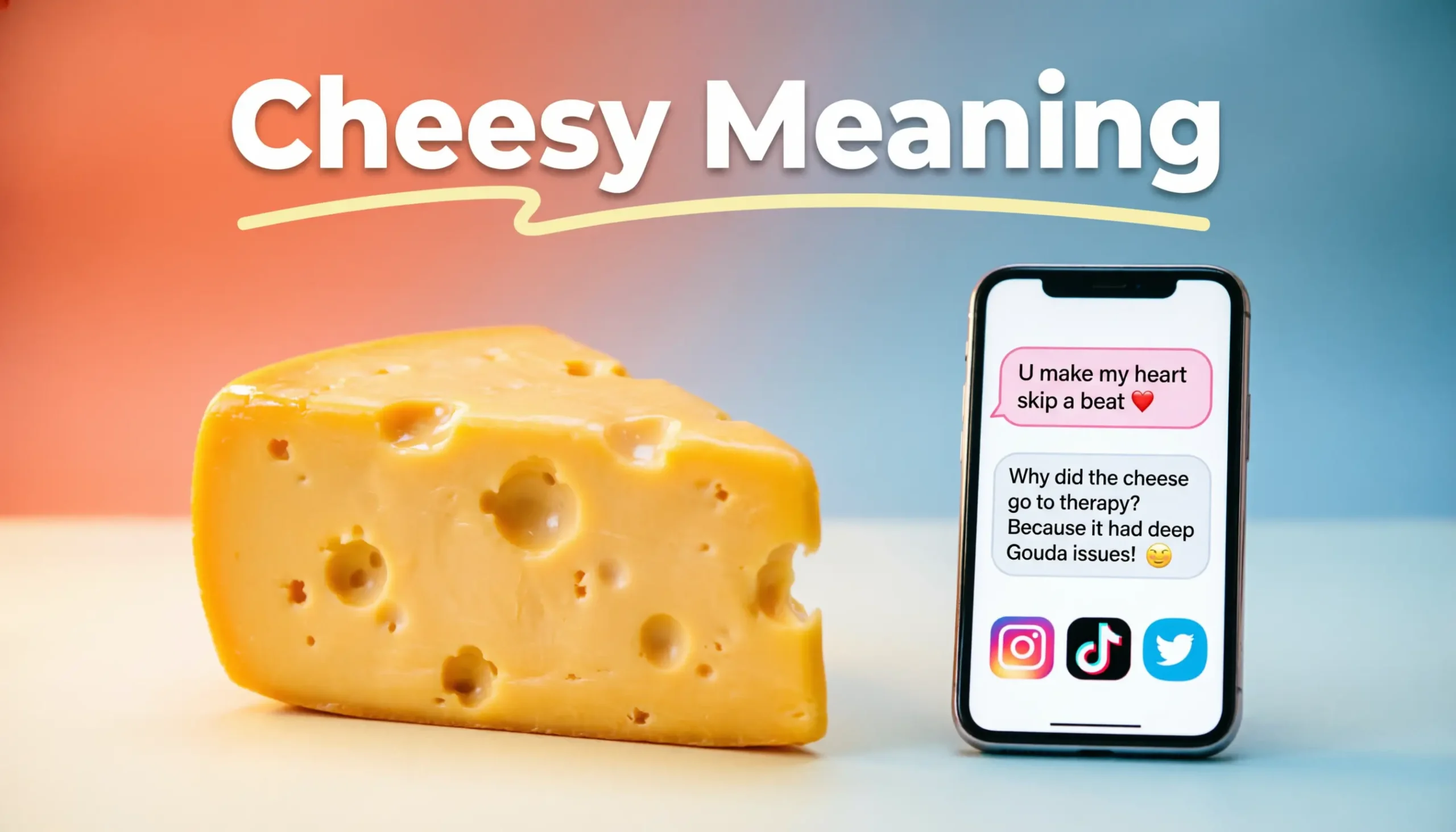
Cheesy usually describes something that is overly sentimental, predictable, corny, exaggerated, or lacking originality. It can describe a joke, romantic message, movie scene, song, social media caption, or even someone’s behavior.
The word does not always have a negative meaning. Someone might call a romantic message “cheesy” because it is extremely sweet, while still genuinely liking it. Friends may also use cheesy playfully when talking about a silly joke or an intentionally dramatic moment.
- Meaning: Overly sentimental, corny, predictable, or cliché
- Full form: Cheesy is a regular English adjective, not an abbreviation
- Context: Texting, slang, relationships, entertainment, humor, and social media
- Tone: Usually playful, teasing, mildly critical, or affectionate
If someone calls your joke, message, caption, or romantic gesture “cheesy,” you might wonder whether they are complimenting you or making fun of you. The answer depends heavily on the situation.
In everyday English, cheesy often describes something that feels too predictable, emotional, dramatic, or sentimental. A romantic movie with an obvious happy ending might be called cheesy. A joke that everyone has heard before can be described as a cheesy joke. Likewise, a partner might laugh and say, “That was so cheesy,” after receiving an extremely romantic text.
The word is also common on social media. People use it when reacting to captions, pickup lines, relationship posts, memes, motivational quotes, movies, and songs.
One reason the cheesy meaning can be confusing is that it does not always mean “bad.” Sometimes people intentionally enjoy cheesy things because they are funny, nostalgic, sweet, or entertaining.
Understanding the context, relationship between the speakers, and tone of the conversation makes the meaning much easier to identify.
What Does Cheesy Mean?
Core Definition of Cheesy
The most common figurative meaning of cheesy is something that is overly sentimental, predictable, exaggerated, or cliché.
For example:
“That was such a cheesy romantic movie.”
The speaker probably means that the movie contained predictable romance, dramatic emotions, familiar dialogue, or an unrealistic love story.
Similarly:
“You always give me the cheesiest compliments.”
This might sound negative at first, but it could actually be affectionate. The speaker may enjoy the compliments while teasing the other person for being overly romantic.
Cheesy can describe:
- Jokes
- Movies
- Songs
- Romantic messages
- Compliments
- Captions
- Advertisements
- Pickup lines
- Speeches
- Gestures
- Behavior
Simple Examples of Cheesy
Imagine someone says:
“You are the sunshine that brightens the darkest corners of my heart.”
A person might respond:
“Wow, that’s cheesy!”
They are saying the line sounds extremely romantic and sentimental.
Or consider a joke like:
“What did the cheese say to itself in the mirror? Halloumi!”
That is a cheesy joke because it relies on simple wordplay and predictable humor.
So, the exact meaning changes slightly depending on what is being described.
What Does Cheesy Mean in Texting, Slang, and Social Media?
Cheesy in Chat Messages
In texting, cheesy usually means that something sounds overly romantic, emotional, dramatic, or corny.
For example:
“I miss you more than words can explain.”
A friend might reply:
“That’s so cheesy 😂”
The response does not necessarily mean the message was bad. The laughing emoji can make the comment playful.
Similarly:
“Stop being cheesy!”
might mean:
“You’re being extremely romantic, and I’m teasing you about it.”
In a close relationship, calling someone cheesy can even be a form of affection.
Cheesy on Social Media
Social media has made the word even more common.
People may call a post cheesy when it contains:
- An overly emotional caption
- A dramatic love quote
- A predictable motivational message
- An exaggerated relationship statement
- An overly romantic photo caption
- A familiar inspirational saying
For example, someone might post:
“Together forever, two souls, one heart, endless love ❤️”
A commenter might jokingly say:
“A little cheesy, but cute.”
Here, cheesy means overly romantic, but the commenter is not necessarily criticizing the relationship.
The same word can also be used for memes and jokes:
“That joke was painfully cheesy 😂.”
Cheesy and Gen Z Usage
Younger internet users still use cheesy in casual conversation, although it is not exclusive to Gen Z.
It often overlaps with words such as corny, cringe, and sappy. However, these terms are not exact synonyms.
For example, something can be cheesy without being embarrassing. A person might intentionally watch a cheesy romantic movie because they enjoy it.
That distinction is important. Calling something cheesy can be playful rather than harsh.
Other Meanings and Uses of Cheesy
The word cheesy also has a literal meaning.
When talking about food, cheesy can simply mean containing a lot of cheese or having a strong cheese flavor.
For example:
“This pasta is incredibly cheesy.”
Here, there is nothing about sentimentality or slang. The word literally refers to cheese.
The figurative meaning developed separately and is now widely used in everyday English.
Cheesy can also describe different types of entertainment and communication.
Cheesy Romance
A romantic scene may be called cheesy if it feels excessively emotional or predictable.
Cheesy Humor
A simple pun or predictable joke may be called cheesy.
Cheesy Music
A song with overly dramatic lyrics, familiar romantic themes, or exaggerated emotion may receive this description.
Cheesy Advertising
An advertisement with exaggerated slogans, forced humor, or overly emotional messaging can also be described as cheesy.
This flexibility is one reason the word appears in so many different conversations.
How Cheesy Is Used in Real Conversations
Romantic Situations
Romance is one of the most common contexts for the figurative use of cheesy.
For example:
“I wrote you a poem.”
“Aww, that’s so cheesy!”
Depending on the speaker’s tone, this can mean the poem is overly romantic but also sweet.
Partners may even describe their own behavior as cheesy:
“I know this is cheesy, but I really wanted to tell you how much I love you.”
Here, the speaker knows the statement sounds sentimental but is comfortable expressing those feelings anyway.
Humor and Jokes
Cheesy jokes are usually simple, predictable, or based on obvious wordplay.
For example:
“I’m reading a book about anti-gravity. It’s impossible to put down.”
Someone may respond:
“That’s so cheesy.”
The joke may be predictable, but that is often part of the fun.
Movies, TV, and Music
A movie can be cheesy because its romance, dialogue, plot, or acting feels exaggerated.
Interestingly, calling a movie cheesy does not necessarily mean you dislike it.
Someone might say:
“It’s cheesy, but I love it.”
This means the person recognizes that the movie is predictable or sentimental but enjoys it anyway.
Platforms Where Cheesy Appears
You can encounter the word on almost any social platform, including:
- TikTok
- X
- YouTube
- Messaging apps
It is particularly common in comments about romantic posts, jokes, movies, music, and memes.
Examples of Cheesy in Conversations
Example 1: Romantic Text
Person A: “You are the best thing that ever happened to my heart.”
Person B: “That’s so cheesy 😂❤️”
Meaning: The message is extremely romantic or sentimental. The response is likely playful.
Example 2: A Joke
Person A: “Why did the bicycle fall over? Because it was two-tired.”
Person B: “That joke is so cheesy.”
Meaning: The joke is simple and predictable.
Example 3: Movie
“The ending was incredibly cheesy, but I still cried.”
Meaning: The ending was overly sentimental or predictable, but the person enjoyed it.
Example 4: Social Media Caption
“Our love story is written in the stars ✨❤️.”
Comment: “A little cheesy, not gonna lie.”
Meaning: The caption sounds very romantic and cliché.
Example 5: Compliment
“Your smile is brighter than a thousand suns.”
Response: “Okay, that’s cheesy!”
Meaning: The compliment is exaggerated and highly romantic.
Example 6: Self-Aware Usage
“This is going to sound cheesy, but I’m really proud of you.”
Meaning: The speaker knows the statement is sentimental but wants to express genuine emotion.
Example 7: Food
“I ordered the cheesiest pizza on the menu.”
Meaning: This is literal. The pizza contains a lot of cheese.
Example 8: Music
“The lyrics are cheesy, but somehow the song gets stuck in my head.”
Meaning: The lyrics are overly sentimental or cliché, but the song remains enjoyable.
Tone and Intent Behind Cheesy
Emotional Meaning
The emotional meaning of cheesy depends on how and where it is used.
It can suggest:
- Affection
- Amusement
- Embarrassment
- Playful teasing
- Mild criticism
- Nostalgia
If a close friend says, “You’re so cheesy,” they may simply be teasing you.
If a professional reviewer says, “The dialogue is cheesy,” the comment is more likely to be criticism.
Positive, Negative, or Neutral Usage
Cheesy can be positive:
“It’s cheesy, but incredibly sweet.”
The speaker recognizes the sentimentality but likes it.
Cheesy can be negative:
“The commercial was too cheesy for me.”
Here, the speaker dislikes the exaggerated style.
Cheesy can be neutral:
“This is a classic cheesy holiday movie.”
The speaker is simply describing the movie’s style.
Sarcasm vs. Serious Meaning
Tone is especially important in texting.
Consider:
“Wow, you’re so cheesy.”
Without context, it could sound critical.
Add a laughing emoji:
“Wow, you’re so cheesy 😂”
Now it probably sounds playful.
Add a heart:
“You’re so cheesy ❤️”
It may sound affectionate.
The relationship between the people also matters. Close friends and romantic partners often use the word more playfully than strangers.
Origin and Background of Cheesy
The literal word cheesy comes from cheese, meaning something related to or containing cheese.
Its figurative meaning developed as English speakers began using “cheesy” to describe things that seemed cheap, overly sentimental, exaggerated, or lacking sophistication.
Over time, the word became strongly associated with entertainment, humor, romance, and popular culture.
People began describing predictable jokes, exaggerated acting, sentimental songs, and cliché romantic scenes as cheesy.
The term eventually became a normal part of informal English. Today, it is common in conversations, movie reviews, social media comments, and texting.
Unlike many newer internet slang terms, cheesy is not originally an internet word. The internet simply helped spread and popularize its casual use among wider audiences.
Is Cheesy Rude or Inappropriate?
Generally, cheesy is not a rude or offensive word.
It is a mild informal adjective.
However, the way you use it matters.
Calling a stranger’s heartfelt message “cheesy” could come across as dismissive. Someone may have expressed genuine feelings, and describing them as cheesy might make them feel embarrassed.
With a close friend, the same comment can be completely harmless.
For example:
“You’re so cheesy 😂”
usually sounds playful between friends.
But:
“That was an embarrassingly cheesy thing to say.”
sounds much more critical.
The safest approach is to consider the person’s feelings and the situation before using the word.
When Not to Use Cheesy
Formal Communication
Cheesy is mainly an informal word.
In a professional report or academic essay, more precise alternatives may be better.
Instead of:
“The advertisement is cheesy.”
you could write:
“The advertisement relies heavily on sentimental and predictable messaging.”
Instead of:
“The speech was cheesy.”
you could say:
“The speech used overly sentimental language.”
These alternatives sound more professional.
Sensitive Situations
Be careful when someone is sharing genuine emotions.
If a person tells you:
“I really appreciate everything you’ve done for me.”
responding with:
“That’s cheesy.”
might make them feel uncomfortable.
In a playful relationship, it may be fine. In a serious emotional moment, it may not be.
Similar and Related Terms
Corny
Corny often describes jokes, humor, or ideas that are predictable and overly simple.
Example:
“That was such a corny joke.”
Corny and cheesy are sometimes interchangeable.
Cringe
Cringe describes something that causes embarrassment, discomfort, or secondhand embarrassment.
Something can be cheesy without being cringe.
Sappy
Sappy usually describes excessive emotionality or sentimentality.
It is especially common when discussing romantic stories, movies, songs, or messages.
Clichéd
Clichéd means something relies on an overused expression, idea, or situation.
A romantic line can be both cheesy and clichéd.
Sentimental
Sentimental refers to strong emotional feelings, especially affection, nostalgia, or tenderness.
Unlike cheesy, sentimental is not automatically negative.
Cheesy vs. Related Terms
Cheesy vs. Corny
These words are very close.
Cheesy can describe romance, emotions, jokes, entertainment, and behavior.
Corny is particularly common for jokes, humor, and predictable ideas.
For example:
“That’s a cheesy love letter.”
sounds natural.
“That’s a corny joke.”
also sounds natural.
Cheesy vs. Cringe
The difference is mainly emotional reaction.
Cheesy means overly sentimental, predictable, or corny.
Cringe means embarrassing or uncomfortable to watch.
A romantic movie can be cheesy without making you cringe.
Cheesy vs. Sappy
Both words can describe excessive emotion.
However, sappy focuses more directly on sentimental emotion.
Cheesy is broader and can also describe jokes, movies, advertising, and clichés.
Cheesy vs. Clichéd
Clichéd focuses on something being overused or unoriginal.
Cheesy often adds a judgment that the thing is overly sentimental, corny, or exaggerated.
Cheesy Comparison Table
| Term | Meaning | Usage | Key Difference |
|---|---|---|---|
| Cheesy | Overly sentimental, predictable, or corny | Romance, jokes, movies, captions | Broad and often playful |
| Corny | Predictable or overly simple | Mainly jokes and humor | Strongly associated with humor |
| Cringe | Embarrassing or uncomfortable | Social behavior and online content | Focuses on embarrassment |
| Sappy | Excessively sentimental | Romance, movies, songs | More focused on emotion |
| Clichéd | Overused or unoriginal | Writing, speech, ideas | Focuses on lack of originality |
| Sentimental | Emotionally expressive | Relationships, memories, art | Not necessarily negative |
Common Misunderstandings About Cheesy
One common misunderstanding is that cheesy always means bad.
It doesn’t.
Someone can genuinely enjoy something while calling it cheesy.
For example:
“This movie is cheesy, but it’s one of my favorites.”
The speaker is acknowledging the movie’s predictable or sentimental qualities while still enjoying it.
Another misunderstanding is treating cheesy and cringe as exact synonyms. They overlap, but they are different.
A cheesy romantic message might be sweet and funny. A cringe message is more likely to create embarrassment or discomfort.
People also sometimes assume that calling something cheesy is automatically an insult. In casual conversations, it can be affectionate teasing.
Finally, the word can be literal.
“This sandwich is cheesy.”
Here, it simply means the sandwich contains plenty of cheese.
Frequently Asked Questions About Cheesy
What does cheesy mean in slang?
In casual slang, cheesy usually means overly sentimental, corny, predictable, or cliché. It can describe jokes, romantic messages, movies, captions, and behavior.
What does cheesy mean in texting?
In texting, cheesy often means that someone’s message is very romantic, sweet, dramatic, or sentimental. The comment can be playful rather than insulting.
Is cheesy a bad word?
No. Cheesy is a mild and generally harmless word. It can be positive, negative, or playful depending on context.
What does it mean when someone calls you cheesy?
They may mean that you are being overly romantic, sentimental, dramatic, or corny. In a close relationship, it can simply be affectionate teasing.
Is cheesy the same as cringe?
No. Cheesy usually means sentimental, predictable, or corny. Cringe focuses more on embarrassment or discomfort.
What is a cheesy joke?
A cheesy joke is usually a simple, predictable, or corny joke, often based on an obvious pun or wordplay.
Can cheesy be a compliment?
Yes. Someone can call a romantic gesture cheesy while still appreciating it. For example, “That was cheesy, but really sweet” is both teasing and positive.
What is the difference between cheesy and corny?
They overlap, but corny is especially common for predictable jokes and humor. Cheesy has a broader meaning and is frequently used for romance and sentimentality.
Does cheesy mean something has cheese in it?
Sometimes. In a food context, cheesy literally means containing or tasting strongly of cheese. In most slang contexts, it has a figurative meaning.
Is cheesy used on social media?
Yes. People commonly use cheesy when commenting on romantic captions, jokes, memes, motivational quotes, movies, songs, and relationship posts.
conclusion
The word cheesy has a simple but flexible meaning. In everyday slang and texting, it usually describes something that feels overly sentimental, predictable, corny, exaggerated, or cliché.
It can describe a romantic message, a joke, a movie, a song, a social media caption, or someone’s behavior. Importantly, calling something cheesy does not always mean you dislike it. People often use the word playfully or affectionately, especially with friends and romantic partners.
The context makes the difference. Cheesy can be mildly critical, humorous, affectionate, or even positive. It is also different from words such as “cringe,” “corny,” “sappy,” and “clichéd,” even though they sometimes overlap.
And when the word is used literally, cheesy simply means containing or tasting like cheese.
So if someone says, “That’s so cheesy,” don’t immediately take it as an insult. Look at the conversation, tone, emojis, and relationship between the speakers. In many cases, they’re simply saying that something is a little too sweet, predictable, or corny—but they may secretly love it.
8 thoughts on “Cheesy Meaning 🧀: What Does Cheesy Mean in Texting, Slang, and Everyday English?”