
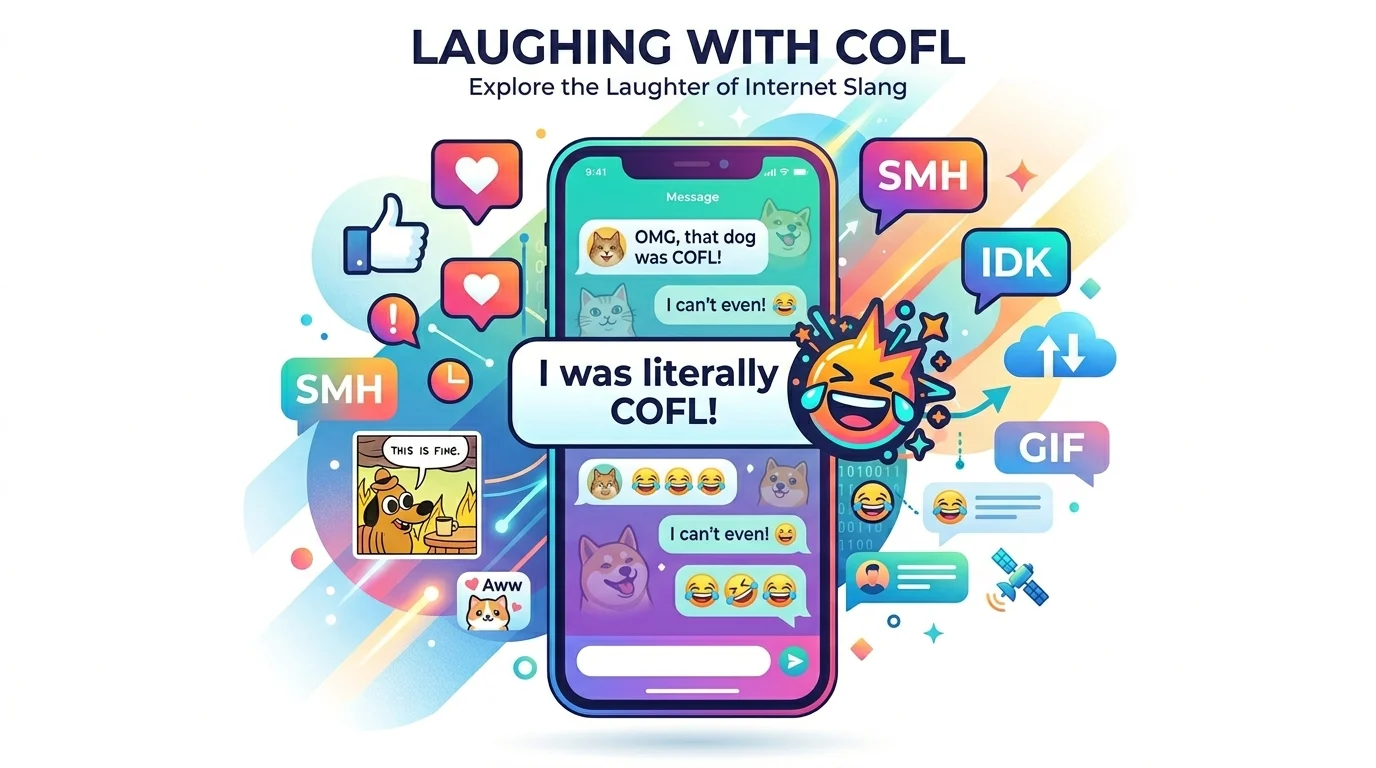
| Term | COFL |
|---|---|
| Meaning | Crying On the Floor Laughing |
| Full Form | Crying On the Floor Laughing |
| Context | Texting, social media, online chats, gaming, internet slang |
| Tone | Humorous, playful, informal |
If you’ve seen the term “COFL” in a text message, online chat, social media comment, or gaming conversation, you may be wondering what it means. Internet slang changes quickly, and many abbreviations that were once common can seem confusing to people who are unfamiliar with them. COFL is one of those acronyms that appears occasionally online, especially when someone wants to express strong laughter or amusement.
The abbreviation COFL stands for “Crying On the Floor Laughing.” It is used to show that something is extremely funny. Similar to expressions like LOL, ROFL, and LMAO, COFL exaggerates a person’s reaction to humor. The phrase does not usually mean someone is literally crying or lying on the floor. Instead, it is a playful way of saying that a joke, video, meme, or comment is very entertaining.
Although COFL is less common than some other laughter acronyms, it still appears in internet conversations and social media interactions. Understanding how and when people use it can help you better interpret online messages and communicate naturally in digital spaces. This guide explains the meaning of COFL, its usage, examples, origins, and how it compares with similar internet slang terms.
What Does COFL Mean?
COFL stands for “Crying On the Floor Laughing.”
People use this acronym to express intense laughter after reading, hearing, or watching something funny. It is an exaggerated reaction designed to emphasize amusement.
For example:
- “That video had me COFL.”
- “COFL! I can’t stop laughing at that joke.”
The phrase is not meant to be taken literally. Most users simply want to show that they found something much funnier than average.
In online communication, exaggeration is common. Since facial expressions and body language are absent in text, acronyms like COFL help communicate emotional reactions more clearly.
What Does COFL Mean in Texting, Slang, or Social Media?
In texting and social media, COFL is a reaction acronym.
People use it when responding to:
- Funny memes
- Viral videos
- Jokes
- Humorous stories
- Playful comments
- Comedy clips
For example:
Friend: “I accidentally wore two different shoes to work.”
Response: “COFL! That’s hilarious.”
On social media platforms, users may comment “COFL” under a funny post to show appreciation for the humor.
Unlike some modern Gen Z slang terms, COFL belongs to an older generation of internet acronyms that became popular in chat rooms, forums, and early messaging platforms.
Although younger users today may prefer emojis or newer slang, COFL remains recognizable to many internet users.
Other Meanings of COFL
The most widely accepted meaning of COFL is “Crying On the Floor Laughing.”
However, because it is a short acronym, some niche communities may occasionally use it for specialized phrases. These alternative meanings are relatively rare and usually require context to understand.
When people encounter COFL online, the laughter-related meaning is almost always the intended interpretation.
Unless the conversation involves a specific organization, industry, or group, you can safely assume COFL refers to laughter.
How COFL Is Used in Real Conversations
COFL is primarily used in informal online communication.
Text Messages
Friends often use COFL when sharing funny stories.
Example:
“COFL, I can’t believe that actually happened.”
Social Media Comments
Users post COFL beneath amusing content.
Example:
“COFL! This meme made my day.”
Gaming Chats
Gamers sometimes use the acronym when something unexpected happens.
Example:
“COFL, that was the funniest glitch I’ve ever seen.”
Group Chats
Friends use COFL to react to jokes and humorous conversations.
Example:
“COFL, you always come up with the funniest responses.”
The common theme is laughter and amusement.
Examples of COFL in Sentences
Here are several natural examples of how COFL is used.
- “COFL, that joke was absolutely perfect.”
- “I watched the video three times and I’m still COFL.”
- “COFL! Your reaction was funnier than the original post.”
- “That meme has everyone COFL in the comments.”
- “COFL, I almost spilled my coffee laughing.”
- “The group chat was COFL all night.”
- “COFL! I wasn’t expecting that ending.”
- “Your story has me COFL right now.”
These examples show how the acronym expresses strong amusement.
Tone and Intent
COFL is usually positive and playful.
Positive Tone
Most people use it to show enjoyment.
Example:
“COFL, that was amazing.”
Humorous Tone
The acronym naturally communicates humor.
Example:
“COFL, I can’t stop laughing.”
Exaggerated Tone
Like many internet expressions, COFL exaggerates the reaction.
Most users are not literally crying or rolling on the floor.
Sarcastic Tone
Occasionally, people use COFL sarcastically.
Example:
“Yeah, COFL… that was so funny.”
In these cases, context determines whether the reaction is genuine or sarcastic.
Origin and Background of COFL
COFL emerged during the growth of internet chat culture.
As online communication became more common, users created abbreviations to express emotions quickly. Early internet users developed acronyms such as:
- LOL (Laughing Out Loud)
- ROFL (Rolling On the Floor Laughing)
- LMAO (Laughing My Ass Off)
COFL followed a similar pattern.
The phrase “Crying On the Floor Laughing” was designed to exaggerate laughter even further. It painted a humorous image of someone laughing so hard that they ended up on the floor crying.
Although COFL never became as popular as LOL or ROFL, it gained enough recognition to become part of internet slang culture.
Today, it remains a recognizable but less frequently used laughter acronym.
Is COFL Rude or Inappropriate?
COFL is generally not considered rude or offensive.
It is a harmless expression used to communicate laughter.
However, the timing of its use matters.
Using COFL in response to:
- Serious news
- Personal struggles
- Emotional discussions
- Sensitive topics
can appear insensitive.
For example, if someone shares a personal problem, responding with COFL would likely seem disrespectful.
In humorous situations, however, the acronym is perfectly acceptable.
When NOT to Use COFL
There are situations where COFL may not be appropriate.
Professional Emails
Business communication typically requires more formal language.
Academic Writing
Internet slang is rarely suitable for school assignments or research papers.
Serious Conversations
Avoid using COFL during discussions involving sadness, grief, or important concerns.
Formal Presentations
Professional audiences may not understand or appreciate internet acronyms.
When in doubt, choose more formal language.
Similar and Related Slang Terms
COFL belongs to a larger family of laughter acronyms.
LOL
Laughing Out Loud.
ROFL
Rolling On the Floor Laughing.
LMAO
Laughing My Ass Off.
LMFAO
Laughing My Freaking Ass Off.
Haha
A simple text-based expression of laughter.
Each of these terms communicates amusement but with varying levels of intensity.
COFL vs Related Terms
Although similar, these acronyms are not identical.
COFL vs LOL
LOL indicates laughter but is less intense.
COFL vs ROFL
ROFL suggests rolling on the floor laughing, while COFL emphasizes crying from laughter.
COFL vs LMAO
LMAO is more common and often expresses stronger laughter.
COFL vs Haha
Haha is simple and universal, while COFL is more dramatic.
Choosing the right term depends on how strongly you want to express amusement.
Comparison Table
| Term | Meaning | Usage | Key Difference |
| COFL | Crying On the Floor Laughing | Texting and social media | Emphasizes intense laughter |
| LOL | Laughing Out Loud | Casual online communication | Most common laughter acronym |
| ROFL | Rolling On the Floor Laughing | Informal chats | Focuses on physical laughter |
| LMAO | Laughing My Ass Off | Online conversations | Stronger expression of laughter |
| Haha | Text-based laughter | Universal communication | Simpler and less exaggerated |
Common Misunderstandings
Many people assume COFL is the same as ROFL. While both relate to laughter, the phrases are different.
Another misunderstanding is believing COFL is widely used today. In reality, it is less common than LOL and LMAO.
Some users also mistake COFL for a technical abbreviation because it appears infrequently online.
Others assume the acronym means actual crying. In most cases, it simply exaggerates how funny something is.
Understanding internet slang conventions helps avoid these misunderstandings.
Frequently Asked Questions
What does COFL stand for?
COFL stands for Crying On the Floor Laughing.
What does COFL mean in texting?
It means something is extremely funny.
Is COFL the same as ROFL?
Not exactly. Both express strong laughter, but they use different phrases.
Is COFL still used?
Yes, although it is less common than LOL or LMAO.
Can I use COFL on social media?
Yes. It is commonly used in casual online conversations.
Is COFL rude?
No. It is generally harmless and playful.
What is stronger than LOL?
COFL, ROFL, and LMAO usually indicate stronger laughter than LOL.
Should I use COFL in professional emails?
No. It is best reserved for informal communication.
Final Takeaway
COFL means “Crying On the Floor Laughing” and is an internet slang expression used to show intense amusement. It appears most often in text messages, social media comments, gaming chats, and other casual online conversations. While it is not as popular as LOL, ROFL, or LMAO, many internet users still recognize and understand it.
Whenever you see COFL online, it usually indicates that someone found something extremely funny. As with most slang terms, context matters. Use it in casual settings, avoid it in professional communication, and remember that it is intended to express humor rather than literal crying or being on the floor. Understanding COFL can help you better navigate online conversations and internet culture.