
Last updated: September 13, 2026
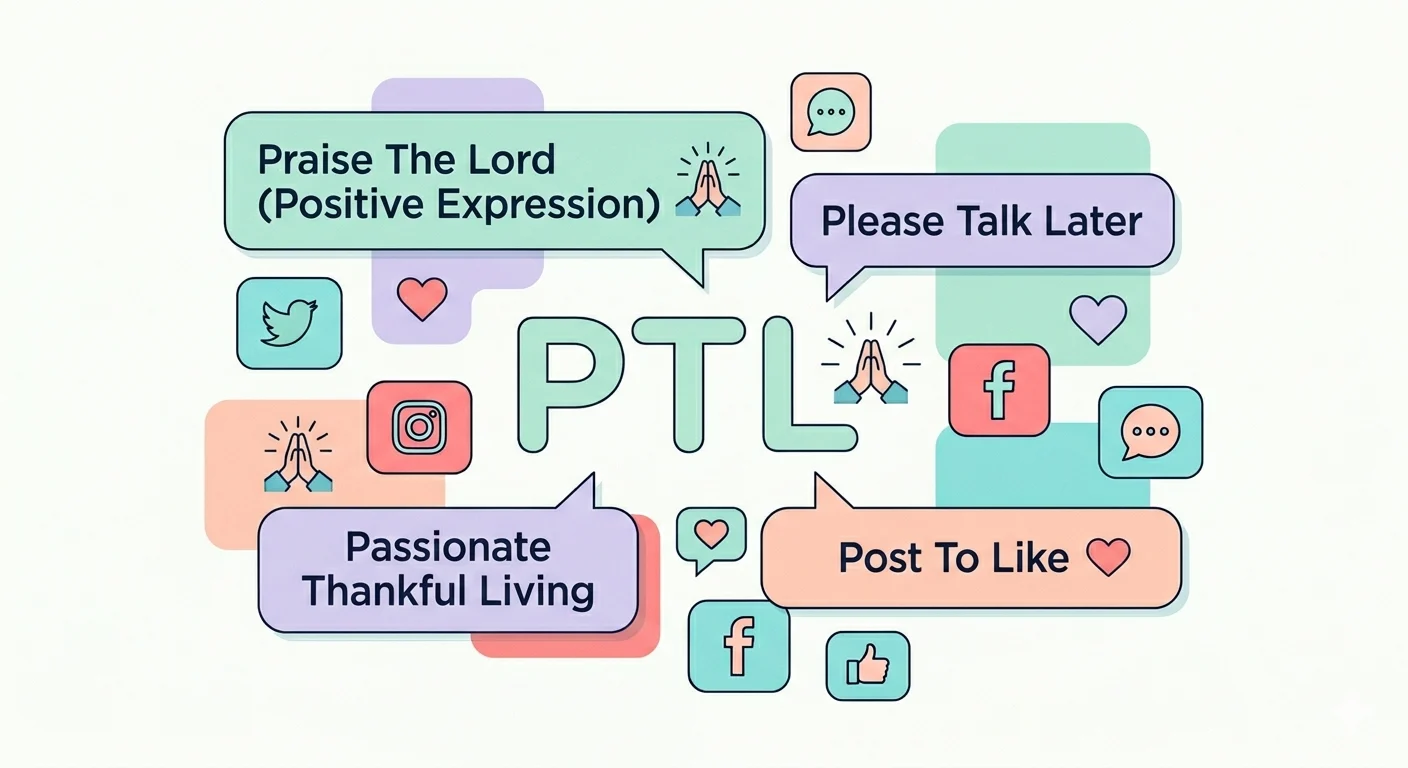
- Meaning: Praise The Lord
- Full form: Praise The Lord
- Context: Religious expression, texting, social media
- Tone: Positive, thankful, emotional
If you’ve searched for “PTL meaning,” you’ve probably seen it in a message, a caption, or a comment and wondered what it actually means. It’s short. It’s simple. But it can feel confusing if you’re not familiar with it.
PTL appears in different places. You might see it in WhatsApp chats, Facebook posts, Instagram captions, or even YouTube comments. Some people use it in a deeply religious way. Others use it casually to express relief or happiness.
That’s where the confusion starts. One small term can carry both strong emotional meaning and everyday casual usage. In this guide, you’ll learn exactly what PTL means, how people use it, and when it’s appropriate.
Quick Answer: PTL most commonly stands for “Praise The Lord.” In texting, chat, and social media, people usually use it to express gratitude, relief, happiness, or thankfulness to God after something positive happens.
PTL Meaning at a Glance
| Detail | Answer |
|---|---|
| PTL meaning | Praise The Lord |
| PTL full form | Praise The Lord |
| Main use | Gratitude, praise, relief, happiness |
| Common places | Texting, chat, social media, captions |
| Tone | Positive, thankful, emotional |
| Type | Abbreviation |
| Formal or informal | Informal |
| Religious meaning | Yes |
| Common American English use | Praise The Lord |
What does PTL mean?
PTL stands for “Praise The Lord.” It is an expression of gratitude, relief, or happiness directed toward God. People use it to show thankfulness when something good happens or when a difficult situation ends.
In simple words, PTL is a way of saying “Thank God” or “I’m grateful.” It carries a positive and emotional tone.
The meaning is clear in most cases. However, how strong or serious it sounds depends on the situation and the person using it.
What does PTL mean in texting, slang, and social media?
If you’re wondering what is PTL in texting, the answer is usually “Praise The Lord.” It is commonly used as a short expression of gratitude, especially after receiving good news.
When someone asks what does PTL stand for in texting, they are generally referring to the religious phrase “Praise The Lord.”
PTL meaning in chat
The PTL meaning in chat is usually “Praise The Lord.” People use it to express relief, happiness, or thankfulness quickly.
For example, if someone says they passed an exam, a reply like “PTL!” shows happiness and relief. It saves time while still communicating strong emotion.
If you’re asking what PTL means in chat, context is important, but “Praise The Lord” is by far the most common interpretation.
PTL meaning in group chat
The PTL meaning in group chat is generally the same. In a group conversation, someone may use PTL after sharing good news or announcing that a difficult situation has ended.
For example:
“The surgery went well, PTL!”
Here, PTL expresses gratitude and relief.
People may also ask about the PTL meaning in GC, where “GC” simply means “group chat.” In this setting, PTL can be a quick reaction to positive news.
PTL meaning at work
The PTL meaning at work can depend more heavily on the workplace and the people involved. If coworkers regularly use religious expressions, PTL may still mean “Praise The Lord.”
For example:
“We finally finished the project before the deadline, PTL!”
However, PTL may not be appropriate in every professional environment. In formal workplace communication, phrases such as “Thankfully” or “Fortunately” are usually clearer and more neutral.
PTL meaning in chat leaving
The phrase PTL meaning in chat leaving can sometimes cause confusion because PTL does not normally mean “leaving.” If someone uses PTL while ending a conversation, its meaning still usually depends on the surrounding message.
For example:
“I’m heading home now. PTL, everything worked out.”
Here, PTL still means “Praise The Lord,” rather than indicating that the person is leaving.
If you see PTL at the end of a message, look at the rest of the conversation before assuming it has a different meaning.
PTL meaning on social media
PTL is also used on social media when people want to express gratitude or celebrate positive news.
You may see PTL on Facebook, Instagram, TikTok, YouTube, or other social platforms. It can appear in a caption, comment, reply, or status update.
For example:
“After months of waiting, everything finally worked out. PTL!”
In this example, PTL communicates relief and gratitude.
On social media, the abbreviation can be used in a strongly religious context or in a more casual emotional way. The surrounding post usually makes the intended tone clear.
PTL meaning on Facebook
On Facebook, PTL is often used in posts about family, health, personal achievements, answered prayers, or positive life events.
For example:
“We received the good news today. PTL!”
The writer is expressing gratitude and giving credit to God for the positive outcome.
PTL meaning on Instagram
On Instagram, PTL may appear in captions or comments connected with celebrations, faith, family, achievements, or personal milestones.
For example:
“Finally reached this goal. PTL!”
The abbreviation keeps the caption short while communicating thankfulness.
PTL meaning on TikTok
On TikTok, PTL can appear in comments or captions when users react to good news, personal stories, or faith-related content.
Its meaning remains Praise The Lord unless the surrounding context clearly indicates another meaning.
What does PTL mean from a Christian perspective?
From a Christian perspective, PTL means “Praise The Lord.” It is an expression of praise, gratitude, worship, or recognition of God.
People may use PTL when they believe something good has happened because of God’s help or blessing. It can also be used simply as an expression of faith.
For example:
“God answered our prayers, PTL.”
Here, PTL has a clearly religious meaning and expresses sincere gratitude.
The phrase can therefore carry more emotional or spiritual weight than a simple abbreviation used casually in a text message.
PTL meaning in American English
In American English texting and online communication, PTL is generally understood as “Praise The Lord” when it appears in a religious or thankful context.
It is more common in informal communication than in formal American English writing.
A person might write:
“PTL, everything worked out!”
But in a formal email, they might instead write:
“Thankfully, everything worked out.”
This difference is important because abbreviations that are natural in texting may sound unusual in professional writing.
Is PTL slang or an abbreviation?
PTL is better described as an abbreviation or initialism rather than ordinary slang.
The letters come from the first letters of:
- P = Praise
- T = The
- L = Lord
People often use it in informal digital communication because abbreviations make messages shorter and faster.
Although PTL can appear in slang-related searches, its meaning is primarily connected with a religious expression rather than conventional slang.
How do people use PTL in real life?
People use PTL in several common situations:
- After receiving good news
- After a difficult situation ends
- When expressing gratitude
- When talking about faith
- When celebrating an achievement
- When reacting to positive news from someone else
- When expressing relief
For example:
“I got the job, PTL!”
Here, the speaker is celebrating the positive result.
Another example is:
“Everyone made it home safely, PTL.”
Here, the abbreviation expresses relief and gratitude.
When someone says “PTL!” what does it mean?
When someone simply sends “PTL!”, they are usually expressing strong gratitude, relief, or happiness.
The exclamation mark can make the emotion stronger.
For example:
“PTL! The test results came back normal.”
In this context, the person is expressing relief and thankfulness.
If someone sends PTL as a response to your good news, they may be saying that they are happy and grateful about the outcome.
How to reply when someone says PTL
Your response depends on your relationship with the person and the context.
If you share the same religious understanding, you might respond with:
“Amen!”
You could also say:
“Absolutely!”
or:
“That’s wonderful!”
If you do not share the same religious language, a neutral response such as:
“That’s great news!”
can still acknowledge the person’s happiness without using religious wording yourself.
PTL examples for texting
Here are some natural examples of PTL in everyday messages:
- “I got the job, PTL!”
- “Everything went well at the hospital, PTL.”
- “We reached safely, PTL.”
- “Exam is over, PTL!”
- “Finally feeling better, PTL.”
- “My family is safe, PTL.”
- “Project completed on time, PTL!”
- “The problem has finally been fixed, PTL.”
- “We made it home safely, PTL!”
- “The good news finally came through, PTL.”
- “We found a solution, PTL!”
- “The appointment went well, PTL.”
Each example shows relief, gratitude, or happiness.
PTL examples in different situations
After good news
“I got accepted into college, PTL!”
The speaker is expressing gratitude for the positive result.
After a stressful event
“The storm passed and everyone is safe, PTL.”
Here, PTL communicates relief.
After a personal achievement
“I finally finished my degree, PTL!”
The phrase adds an emotional and thankful tone.
After receiving medical news
“The results were good, PTL.”
In this situation, PTL expresses relief and gratitude.
In a religious conversation
“God has been faithful to us, PTL.”
Here, the expression is clearly religious and sincere.
Tone and intent
PTL has a very clear tone. It is positive and thankful. It often reflects relief after stress or happiness after success.
Emotionally, it can feel strong. It’s not just a casual phrase. It carries meaning, especially for people who use it in a religious sense.
In most cases, it is sincere. Sarcasm is rare. If someone uses PTL sarcastically, the context will usually make it obvious.
Is PTL positive or negative?
PTL is normally positive.
It usually communicates:
- Gratitude
- Relief
- Happiness
- Praise
- Thankfulness
- Celebration
- Emotional reassurance
The exact emotion depends on the situation.
For example, “PTL, my family is safe” mainly expresses relief, while “PTL, I got the job” expresses happiness and gratitude.
Origin or background
PTL comes from religious language. The phrase “Praise The Lord” has been used for centuries in spiritual and religious traditions.
As texting and internet communication grew, people started shortening longer phrases. That’s how PTL became popular as an abbreviation.
Over time, it moved from religious spaces into everyday communication. Now, it is used both seriously and casually.
PTL capitalization and punctuation
PTL is normally written in uppercase letters because it is an abbreviation formed from the initial letters of the phrase.
Common forms include:
- PTL
- PTL!
- PTL, everything worked out.
- PTL for the good news.
The exact punctuation depends on the sentence.
Because PTL is an abbreviation, writing it as PTL makes it immediately recognizable to people familiar with the expression.
How is PTL pronounced?
When referring to the abbreviation, PTL is generally pronounced by saying the individual letters:
P-T-L
The full phrase is pronounced:
Praise the Lord
In texting, however, pronunciation usually does not matter because people simply type the abbreviation.
Is PTL still commonly used?
PTL is still recognizable in religious and informal online communication, particularly among people who are familiar with Christian expressions and faith-based messaging.
Its frequency can vary depending on the community, age group, platform, and conversation.
Someone who regularly participates in religious conversations may use PTL naturally, while someone outside that context may not immediately recognize it.
Is PTL formal or informal?
PTL is generally informal.
It is suitable for:
- Text messages
- Group chats
- Social media
- Casual conversations
- Personal captions
- Informal comments
It is usually less suitable for:
- Academic writing
- Formal reports
- Official documents
- Professional emails
- Business correspondence
For formal communication, writing the full thought in plain language is usually clearer.
Is PTL rude or inappropriate?
PTL is not rude. It is generally respectful and positive. However, context matters.
In religious settings, it is completely appropriate. In casual chats, it is also fine if the people involved understand it.
However, in some situations, especially with people who are not religious, it might feel out of place. It’s important to be aware of your audience.
When NOT to use PTL
You should avoid using PTL in formal writing, such as academic papers or professional emails. It is too informal and context-specific.
It’s also best to avoid it in sensitive conversations where religious language might not be appropriate.
If you are unsure whether the other person will understand it, it’s better to use a clearer phrase like “Thank God.”
PTL vs “Thank God”
PTL and “Thank God” can communicate a similar feeling, but they are not exactly the same.
PTL literally means “Praise The Lord.” It directly expresses praise toward God.
Thank God is often used to express relief or gratitude after something positive happens.
For example:
“PTL, everyone is safe.”
and:
“Thank God, everyone is safe.”
Both sentences communicate relief, but PTL has a more explicitly religious and praise-focused tone.
PTL vs Praise the Lord
There is no major difference in meaning between PTL and Praise the Lord.
PTL is simply the shortened form.
For example:
“Praise the Lord, everything worked out.”
can become:
“PTL, everything worked out.”
The abbreviation is more common in quick digital communication.
Other meanings of PTL
While “Praise The Lord” is the main meaning, PTL can have other meanings depending on context. These are less common but still worth knowing:
- Praise The Lord: The most widely used meaning in texting and social media
- Post-Traumatic Life: A rare usage that may appear in psychological or personal discussions
- Private Transport License: A possible meaning in technical or official contexts
In everyday texting, what is PTL in chat almost always refers to “Praise The Lord,” especially when the conversation involves good news, gratitude, faith, or relief.
How PTL is used in real conversations
PTL is used in different ways depending on the setting. In personal conversations, it often comes up when someone shares good news or relief after a stressful situation.
In religious conversations, it is used more intentionally. People may say PTL during discussions about faith, blessings, or gratitude.
On social media, it appears in both casual and serious posts. Some people use it lightly. Others use it with deep meaning.
In group chats, it’s usually quick and expressive. It shows emotion without needing a long sentence.
So, if you’re searching for the meaning of PTL in chat, remember that the surrounding conversation usually tells you how strongly or casually the person intends it.
Examples of PTL in texting and chat
Here are some natural examples of how PTL is used:
- “I got the job, PTL!”
- “Everything went well at the hospital, PTL.”
- “We reached safely, PTL.”
- “Exam is over, PTL!”
- “Finally feeling better, PTL.”
- “My family is safe, PTL.”
- “Project completed on time, PTL!”
- “The problem has finally been fixed, PTL.”
- “We made it home safely, PTL!”
Each example shows relief, gratitude, or happiness.
PTL in WhatsApp messages
PTL can appear naturally in WhatsApp conversations, especially when people are sharing personal updates.
For example:
“The baby arrived safely, PTL!”
or:
“We got home safely, PTL.”
In these messages, PTL works as a short emotional response. It lets the writer communicate gratitude without writing the entire phrase.
PTL in Facebook comments
Someone may use PTL in a Facebook comment when responding to another person’s good news.
For example:
“PTL! So happy for you.”
The commenter is expressing happiness and gratitude in response to the announcement.
PTL in Instagram captions
A person may use PTL in an Instagram caption after an achievement, important event, or personal milestone.
For example:
“A dream finally came true. PTL!”
This usage combines a short abbreviation with an emotional statement.
PTL in YouTube comments
PTL can also appear in YouTube comments, especially under videos involving faith, personal stories, inspirational content, or positive life experiences.
For example:
“PTL for this testimony.”
Here, PTL has a clearly religious meaning.
PTL and religious communication
Because PTL means “Praise The Lord,” it is especially common in faith-based communication.
It can be used when discussing:
- Prayer
- Blessings
- Faith
- Worship
- Answered prayers
- Personal testimonies
- Good news
- Gratitude
The expression can therefore have a much deeper meaning than a simple internet abbreviation.
Common misunderstandings
Some people think PTL only has one meaning and always use it in a religious sense. While that is the main meaning, it can also be used casually.
Others confuse it with similar abbreviations or assume it means something completely different.
Another common issue is using it in the wrong context, such as formal writing or professional communication.
The safest way to understand PTL is to look at the surrounding words. If the conversation involves faith, gratitude, good news, relief, or blessings, “Praise The Lord” is usually the intended meaning.
Similar and related slang terms
There are several similar expressions that people use to show gratitude or emotion:
- TYL: Thank You Lord
- OMG: Oh My God
- TGIF: Thank God It’s Friday
These terms share a similar tone but are used in slightly different situations.
PTL vs related terms
PTL vs TYL: Both express gratitude toward God. PTL focuses on praise, while TYL focuses on thanks.
PTL vs OMG: OMG is more general and can express surprise, excitement, or shock. PTL is more specific and positive.
PTL vs TGIF: TGIF is used at the end of the week to express relief. PTL can be used anytime something good happens.
Comparison Table
| Term | Meaning | Usage | Key Difference |
|---|---|---|---|
| PTL | Praise The Lord | Gratitude, relief | Religious tone |
| TYL | Thank You Lord | Thankfulness | More direct gratitude |
| OMG | Oh My God | Surprise, emotion | Not always positive |
| TGIF | Thank God It’s Friday | End-of-week relief | Time-specific |
Common PTL phrases
You may encounter PTL in phrases such as:
- PTL for the good news
- PTL everything worked out
- PTL we are safe
- PTL for answered prayers
- PTL for this blessing
- PTL I got the job
- PTL the surgery went well
- PTL we made it home safely
These phrases show how the abbreviation naturally fits into personal and religious communication.
Is PTL the same as “Praise the Lord”?
Yes. PTL is an abbreviation for “Praise The Lord.”
The difference is mainly the format.
Praise The Lord is the complete phrase, while PTL is the shortened version commonly used in informal communication.
Can PTL have different meanings?
Yes, PTL can have other meanings in specialized contexts. However, the intended meaning depends on where you see it.
In ordinary texting, social media, and faith-based conversations, “Praise The Lord” is the most likely meaning.
If PTL appears in a technical, business, transportation, or specialized document, check the surrounding terminology before assuming it means Praise The Lord.
Is PTL appropriate for everyone?
Not necessarily.
PTL is a religious expression, so it may be perfectly natural among people who share that language or background. However, some audiences may prefer neutral expressions.
For example, instead of:
“PTL, the project is finished.”
a professional message could say:
“Thankfully, the project is finished.”
Choosing between the two depends on your audience and the setting.
Quick guide: What does PTL mean?
If you need the answer quickly, remember these points:
- PTL usually means “Praise The Lord.”
- It is common in texting and social media.
- It often expresses gratitude or relief.
- It can have a strong religious meaning.
- It is generally positive in tone.
- It is informal rather than formal.
- Context can affect how strongly it is intended.
- In specialized contexts, PTL can have other meanings.
FAQs
1. What does PTL mean in text?
It usually means “Praise The Lord.”
2. Is PTL a religious term?
Yes, it comes from religious language but is also used casually.
3. Can I use PTL in chats?
Yes, it is commonly used in texting and messaging.
4. What does PTL mean on social media?
It expresses gratitude or happiness, often in captions or comments.
5. Is PTL formal or informal?
It is informal and should not be used in formal writing.
6. Is PTL similar to OMG?
Not exactly. PTL shows gratitude, while OMG shows general emotion.
7. Can PTL be misunderstood?
Yes, especially if the context is not clear.
8. Should I use PTL at work?
Only in casual conversations, not in formal communication.
9. What does PTL stand for?
PTL stands for “Praise The Lord.”
10. What does PTL mean in a text message?
In a text message, PTL usually means “Praise The Lord” and expresses gratitude, relief, or happiness.
11. What does PTL mean in a group chat?
It usually means “Praise The Lord,” especially when someone is reacting to good news or expressing relief.
12. What does PTL mean on Facebook?
On Facebook, PTL usually means “Praise The Lord” and may be used in posts, comments, or captions about good news, faith, or gratitude.
13. What does PTL mean on Instagram?
It usually means “Praise The Lord” and may appear in captions or comments expressing gratitude or happiness.
14. What does PTL mean in Christian texting?
In Christian texting, PTL means “Praise The Lord” and is generally used to express praise, gratitude, or thankfulness to God.
15. What does PTL mean after good news?
After good news, PTL usually expresses relief, happiness, and gratitude.
16. How do you respond to PTL in a text?
You can respond with “Amen!” or another positive response if the religious context is shared. A neutral response such as “That’s wonderful!” also works.
17. Is PTL the same as Thank God?
They can communicate a similar feeling, but PTL specifically means “Praise The Lord,” while “Thank God” commonly expresses relief or gratitude.
18. Is PTL still used?
Yes. PTL remains recognizable in informal, religious, and online communication, although its frequency varies among different communities.
Conclusion
PTL is a simple but meaningful term. It mainly stands for “Praise The Lord” and is used to express gratitude, relief, and happiness.
Its meaning is usually clear, but context still matters. In texting, it feels quick and emotional. On social media, it can be both casual and serious.
If you understand when and where to use PTL, you can use it naturally and confidently.
In short, when you see PTL in a text, chat, caption, or comment, “Praise The Lord” is usually the meaning.