
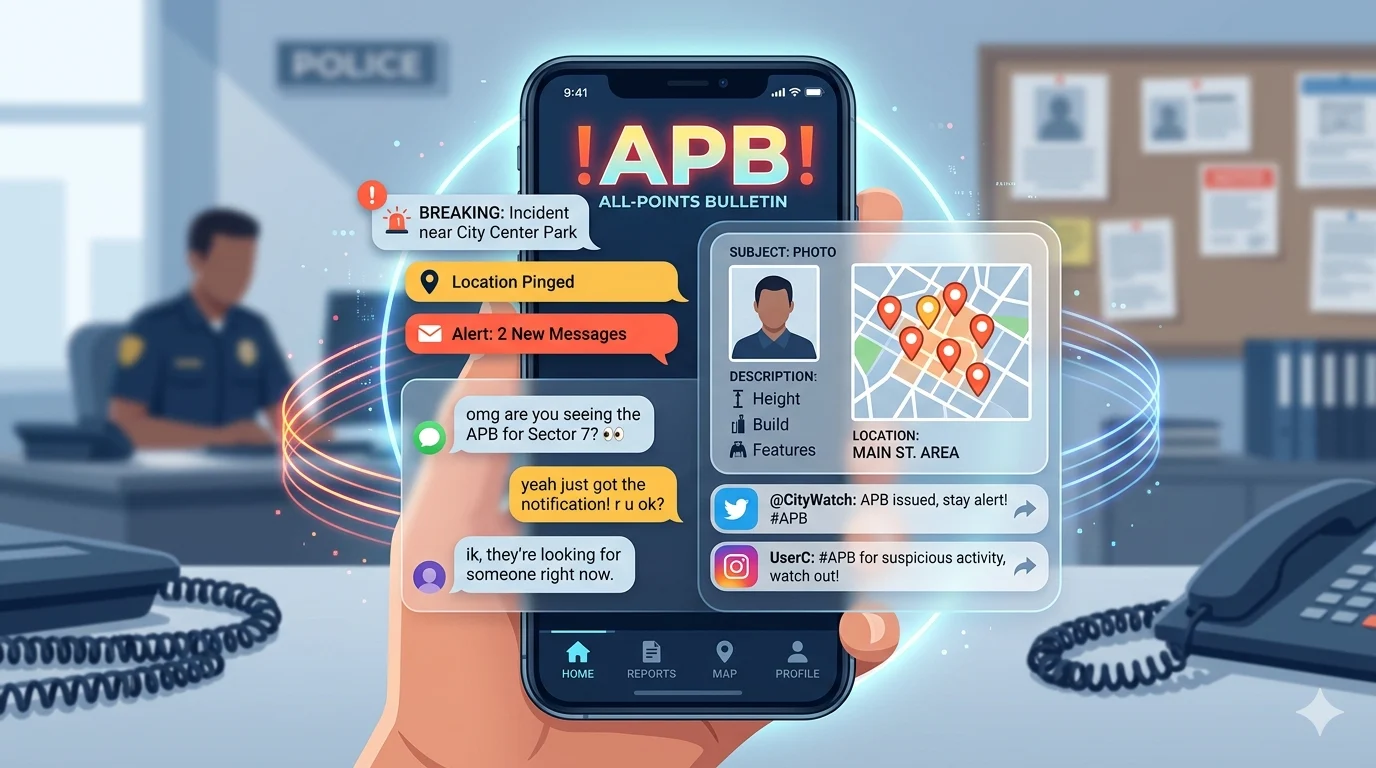
Meaning: APB most commonly stands for “All-Points Bulletin,” an alert issued to notify people about a person, vehicle, or situation. Online, it can also be used informally to request information or draw attention to something.
Full Form: All-Points Bulletin.
Context: Law enforcement, texting, social media, online communities
Tone: Usually urgent, informative, or attention-grabbing
If you’ve seen the abbreviation APB in a text message, social media post, online forum, or television show, you may be wondering what it means. While some internet abbreviations are used mainly in casual conversations, APB has a unique background that originated outside social media and eventually became part of online culture.
The term APB is most commonly associated with law enforcement, where it stands for “All-Points Bulletin.” Traditionally, an APB is an alert distributed to officers and agencies regarding a person, vehicle, or situation that requires attention. Over time, the phrase became familiar to the general public through news reports, crime dramas, movies, and television shows.
Today, APB also appears online in a more informal sense. People sometimes use it on social media, in group chats, or in community forums when asking others to help locate information, identify something, or spread awareness about a topic. Because the abbreviation can be used in different ways, understanding the surrounding context is important.
This guide explains the meaning of APB, how it is used in texting and social media, its origins, examples of real-life usage, related terms, and common misunderstandings that people have about the abbreviation.
What Does APB Mean?
The most common meaning of APB is All-Points Bulletin. This term originated in law enforcement and refers to a notification sent to multiple officers or agencies about a person, suspect, vehicle, or event that requires attention.
In simple terms, an APB is a broad alert designed to spread information quickly.
For example:
- Police issued an APB for the missing vehicle.
- An APB was sent regarding the suspect.
- Authorities released an APB after the incident.
Outside official settings, people sometimes use APB more casually to describe a request for help or information.
For example:
- APB: Has anyone seen my lost cat?
- APB for the name of this song.
- APB: Looking for recommendations.
In these situations, APB is being used informally to attract attention and gather responses.
What Does APB Mean in Texting, Slang, and Social Media?
In texting and social media, APB often takes on a less serious meaning than its law-enforcement origin.
Users may post an APB when they want assistance from friends, followers, or online communities. Instead of referring to a criminal investigation, the abbreviation simply signals that someone is seeking information or requesting help.
Examples include:
- APB: Does anyone know where I can buy this?
- APB for good movie recommendations.
- APB: Trying to identify this plant.
On platforms like TikTok, Instagram, Facebook, Reddit, and X, APB is sometimes used in posts designed to gain attention quickly. It acts as a shorthand way of saying, “I’m looking for help” or “I need information.”
Among younger internet users, APB is less common than abbreviations such as FYI, TBH, or IMO, but it still appears in niche communities and discussion groups.
Other Meanings of APB
All-Points Bulletin
This is the primary and most widely recognized meaning. It comes from law enforcement and remains the definition most people associate with APB.
Community Alert
In online communities, APB can function as an informal alert seeking information or assistance.
Business and Industry Uses
Some organizations use APB as an internal acronym. These meanings vary depending on the industry and company.
Entertainment References
Movies, television shows, books, and video games sometimes use APB in crime-related storylines, helping keep the abbreviation familiar to the public.
How APB Is Used in Real Conversations
Personal Messaging
Friends occasionally use APB humorously when looking for information.
Example:
Friend 1: Anyone know where Jake went?
Friend 2: APB on Jake. Nobody has heard from him today.
Social Media Discussions
APB is commonly used to crowdsource answers or recommendations.
Examples:
- APB: Looking for the best coffee shop in town.
- APB for affordable laptop recommendations.
- APB: Need help identifying this old photo.
News and Entertainment Contexts
In news reports and crime shows, APB is often used in its original sense.
Examples:
- Police issued an APB after the robbery.
- The detective sent out an APB for the suspect.
- The series revolves around solving cases connected to APBs.
Examples of APB in Sentences
Here are several natural examples showing different uses of APB:
- Police released an APB for the missing vehicle.
- APB: Does anyone know the name of this song?
- An APB was issued after the suspect fled the area.
- APB for good restaurant recommendations.
- The news mentioned an APB connected to the investigation.
- APB: Looking for a reliable plumber.
- My friend posted an APB to help find a lost pet.
- Officers responded immediately after receiving the APB.
Tone and Intent
Emotional Meaning
APB often carries a sense of urgency because of its law-enforcement origins. Even when used casually, it tends to signal that someone wants attention directed toward a specific issue.
Positive, Neutral, or Negative?
The abbreviation itself is neutral. Its tone depends on the situation.
For example:
- APB for movie recommendations is neutral.
- APB regarding a missing person is serious.
- APB for a lost pet may feel emotional or urgent.
Serious vs Casual Usage
Official APBs are serious and often involve safety concerns. Informal APBs are usually casual requests for information or assistance.
Origin and Background
Historical Origins
APB originated in law enforcement communication systems. The phrase “All-Points Bulletin” referred to information distributed broadly to officers across multiple jurisdictions.
Before modern digital systems, these bulletins helped agencies quickly share information about suspects, missing persons, or vehicles.
Internet Evolution
As people became familiar with the term through news coverage and entertainment, APB gradually entered everyday language.
Internet users adopted it as a convenient way to announce that they were searching for information or requesting help. This informal usage became common in forums, social media groups, and online communities.
Today, both meanings continue to exist side by side.
Is APB Rude or Inappropriate?
No, APB is not generally considered rude or offensive.
In both official and informal settings, the abbreviation is typically used to communicate information or request assistance.
However, because APB traditionally carries a serious meaning, using it jokingly in sensitive situations may not always be appropriate.
As with any abbreviation, context matters.
When NOT to Use APB
Formal Communication
Avoid using APB in professional communication if your audience may not understand the abbreviation.
Writing out “All-Points Bulletin” or using a more specific description may improve clarity.
Contexts That May Cause Confusion
Because APB has both official and informal meanings, some readers may misunderstand your intention.
For example:
- APB: Need a movie recommendation.
- APB issued regarding a suspect.
These examples have very different meanings despite using the same abbreviation.
Serious Situations
Avoid using APB humorously when discussing emergencies, crimes, or sensitive topics.
Similar and Related Slang Terms
PSA
Means “Public Service Announcement.”
FYI
Means “For Your Information.”
SOS
A signal used to request urgent help.
BOLO
Means “Be On the Lookout.”
Alert
A general notification designed to attract attention.
These terms share similarities with APB because they all communicate information or encourage awareness.
APB vs Related Terms
APB vs BOLO
Both involve notifying people about something important. However, BOLO specifically means “Be On the Lookout” and often focuses on identifying a person or object.
APB vs PSA
A PSA provides public information or awareness, while an APB usually seeks attention regarding a specific person, object, or issue.
APB vs SOS
SOS is a distress signal requesting immediate help. APB is broader and can be used for information-sharing rather than emergencies.
Comparison Table
| Term | Meaning | Usage | Key Difference |
|---|---|---|---|
| APB | All-Points Bulletin | Alerts and information requests | Focuses on locating or identifying something |
| BOLO | Be On the Lookout | Law enforcement and alerts | Specifically requests observation |
| PSA | Public Service Announcement | Public awareness | Shares information rather than seeking it |
| FYI | For Your Information | Casual communication | Informational only |
| SOS | Emergency distress signal | Emergencies | Indicates immediate danger or need |
Common Misunderstandings
Assuming APB Is Only a Police Term
Although APB originated in law enforcement, many people now use it informally online.
Believing Every APB Is Urgent
Some APBs are serious, while others simply request recommendations or information.
Ignoring Context
The same abbreviation can mean different things depending on where it appears.
For example:
- APB for a missing pet.
- APB for laptop suggestions.
The intent changes significantly based on the topic.
FAQ
What does APB stand for?
APB most commonly stands for All-Points Bulletin.
What does APB mean in texting?
In texting, APB often means a request for information, assistance, or attention.
Is APB a slang term?
It can be used informally online, although it originated as an official law-enforcement term.
Is APB commonly used on social media?
Yes. Users sometimes post APBs when seeking answers, recommendations, or assistance.
What does APB mean in law enforcement?
It refers to an alert distributed to officers regarding a person, vehicle, or situation.
Can APB have multiple meanings?
Yes. The exact meaning depends on the context.
Is APB formal or informal?
It can be both. Official APBs are formal, while social-media usage is informal.
How can I determine the correct meaning?
Look at the surrounding conversation and topic.
Is APB rude or offensive?
No. It is generally considered neutral.
Should I use APB in professional communication?
Only if your audience understands the abbreviation or if the context clearly supports it.
conclusion
APB most commonly means All-Points Bulletin, a term that originated in law enforcement and refers to an alert distributed to multiple people or agencies. Over time, the abbreviation expanded beyond its official roots and became part of online culture, where it is often used to request information, recommendations, or assistance.
Whenever you encounter APB, pay attention to the context. In news stories, crime discussions, and official communications, it usually refers to its traditional law-enforcement meaning. In social media posts and online communities, it may simply be a creative way of asking for help or information. Understanding the context will help you interpret APB correctly and use it effectively in your own communication.
1 thought on “APB Meaning in Text, Slang, Social Media, and Online Communication”