
Updated: October 21, 2026
Have you ever seen someone comment “That’s cap” or tell a friend “No cap” on TikTok, Instagram, or in a text message? These expressions are popular forms of internet slang, especially in casual American English. If you are unfamiliar with them, their meaning can be confusing because cap usually refers to a hat or something that covers your head.
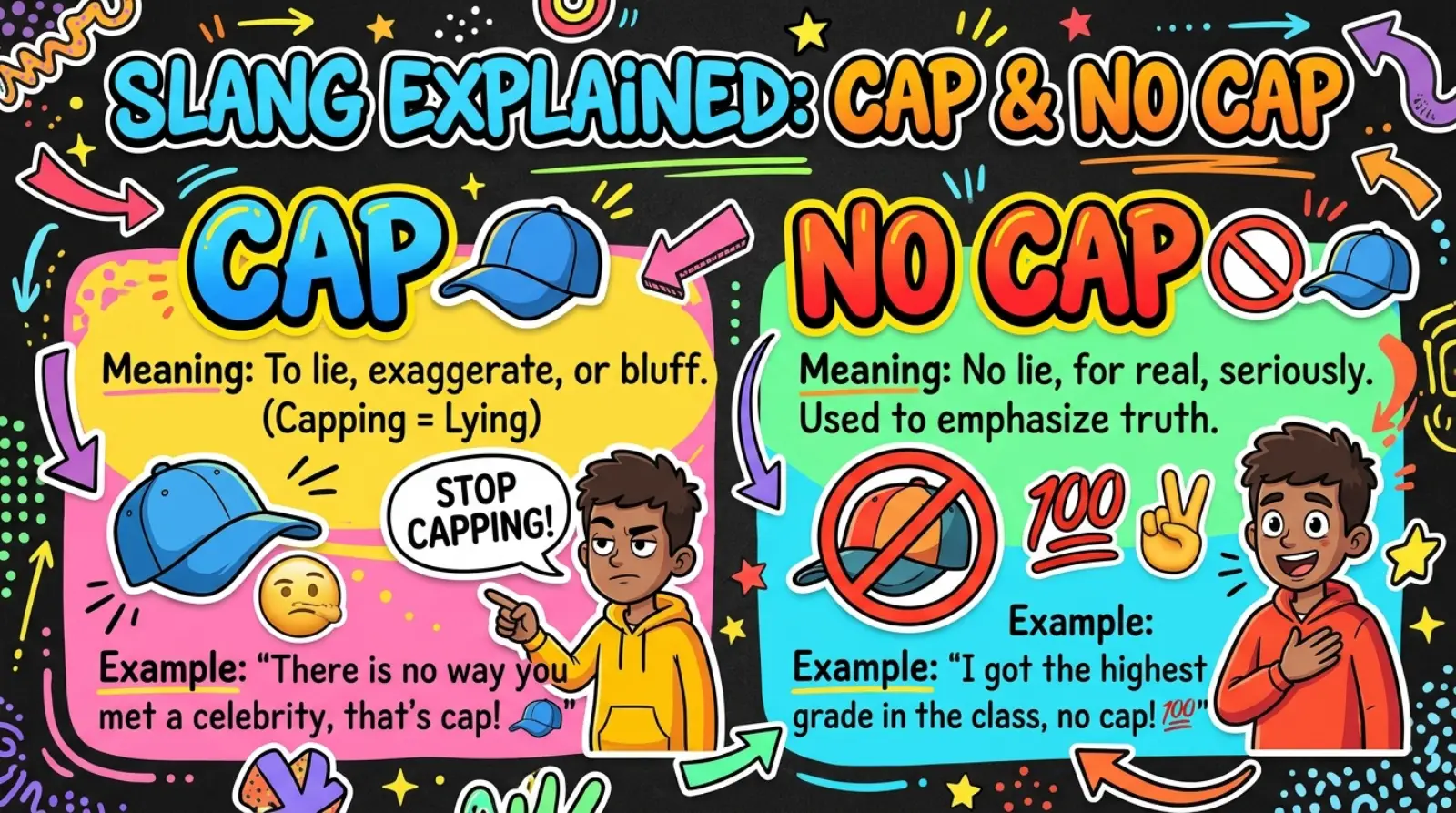
In slang, however, cap means a lie, a false claim, or an exaggeration. When someone says “That’s cap,” they are suggesting that another person is not telling the truth. When they say “no cap,” they mean they are being honest or serious.
This guide explains the meaning of cap slang, its origins, common expressions, real-life examples, and how to use it naturally in everyday conversations.
What Does “Nightcap” Mean? Real-Life Experiences and Common Misunderstandings
The word nightcap can be confusing because it contains the word cap, which has several meanings in English. In everyday conversation, however, a nightcap usually refers to a drink consumed late in the evening, often shortly before going to bed.
In an online discussion about the term, people shared different experiences with nightcaps. Most participants associated the word with an alcoholic drink, such as whiskey, wine, or another spirit, enjoyed after dinner or at the end of a social gathering. Some described it as a way to continue talking with friends before heading home, while others explained that the expression can sometimes carry a romantic or suggestive meaning when someone invites another person home for a nightcap.
A few participants noted that the word can be used more broadly and may refer to another late-night treat or activity, depending on the context. However, an alcoholic drink remains the most common meaning of “nightcap” in this expression.
Does a Nightcap Mean Alcohol or Coffee?
A nightcap usually refers to an alcoholic drink, although the exact meaning depends on the speaker and situation. Coffee is more commonly associated with an after-dinner drink than with a traditional nightcap because caffeine can interfere with sleep.
For example:
- “Would you like a nightcap?” Usually means an invitation to have an alcoholic drink before the evening ends.
- “Let’s have a nightcap before we leave.” Suggests having one final drink before departing.
- “Come back to my place for a nightcap.” May simply mean having a drink, but in a romantic context, it can also imply an invitation to spend more private time together.
Why Do People Have a Nightcap?
Some people enjoy a nightcap as part of a social routine, a way to end an evening, or an opportunity to continue a conversation. However, alcohol is not a reliable sleep aid. Although it may make someone feel sleepy initially, it can disrupt sleep quality later in the night.
The important distinction is that nightcap is a separate expression, not a slang meaning of cap itself. While cap can mean a lie in expressions such as “that’s cap,” nightcap usually refers to a late-evening drink.
What Does CAP Mean in Slang?
Cap means a lie or something untrue in slang. People use it to call out a statement they believe is false, exaggerated, or misleading.
Quick Answer:
- Meaning: A lie, false statement, or exaggeration
- Full form: CAP is not an abbreviation with a standard full form
- Context: Text messages, TikTok, Instagram, gaming, and everyday conversations
- Tone: Informal, playful, skeptical, or confrontational, depending on context
For example:
Person A: “I can run five miles in ten minutes.”
Person B: “That’s cap!”
Here, Person B is suggesting that the claim is unbelievable or probably untrue.
The expression is particularly common in informal American English, especially among younger speakers. However, people of different ages may use or recognize it through social media and popular culture.
What Does CAP Stand For?
Unlike abbreviations such as BRB, which stands for “Be Right Back,” cap is not generally an acronym. It is a slang word used to describe lying, exaggerating, or making a questionable claim.
The exact historical development of the expression is associated with African American Vernacular English (AAVE) and Black cultural usage before it became widely popular through music and social media.
In modern online communication, cap is often used in short expressions such as:
- Cap: A lie or false claim.
- That’s cap: That is not true.
- No cap: Honestly or without lying.
- Stop capping: Stop lying or exaggerating.
- Capping: Lying or making exaggerated claims.
These expressions all relate to honesty, credibility, and whether someone believes a statement.
7 Common CAP Slang Expressions and Their Meanings
1. Cap
The word cap by itself can mean a lie or an untrue claim.
Example:
“He said he met a famous actor yesterday, but I think that’s cap.”
Meaning: The speaker doubts that the person is telling the truth.
Depending on the conversation, cap can also be used as a short response to challenge someone’s statement.
2. No Cap
No cap means “no lie,” “honestly,” or “I’m telling the truth.” It is often used to emphasize that a statement is genuine.
Example:
“No cap, that was the best burger I’ve ever had.”
Meaning: The speaker genuinely believes the burger was excellent.
People may use no cap to express excitement, emphasize an opinion, or make a statement sound more sincere.
3. That’s Cap
That’s cap means “That’s a lie” or “I don’t believe you.”
Example:
“You finished the entire project in five minutes? That’s cap!”
Meaning: The speaker thinks the claim is exaggerated or unbelievable.
This expression can be playful among friends, but it may sound accusatory if the conversation is serious.
4. Stop Capping
Stop capping means “Stop lying” or “Stop exaggerating.”
Example:
“Stop capping. You didn’t score 100 points in one game.”
Meaning: The speaker does not believe the other person’s claim.
This phrase is common in casual conversations, online comments, and gaming chats.
5. Capping
Capping is the -ing form of cap and refers to the act of lying or exaggerating.
Example:
“She’s capping if she says she never watches movies.”
Meaning: The speaker believes she is not being truthful.
Capping is often used when someone thinks another person is making a claim that does not match the facts.
6. Big Cap
Big cap is an emphatic way to call something a major lie or a particularly unbelievable claim. It is an informal extension of the basic slang meaning.
Example:
“He said he bought a mansion with his first paycheck. Big cap!”
Meaning: The speaker strongly doubts the claim.
This expression is informal and may be used jokingly rather than as a serious accusation.
7. No-Cap Moment
A no-cap moment describes a situation in which someone is being genuine, expressing an honest opinion, or emphasizing something they sincerely believe.
Example:
“No-cap moment: that was the most helpful advice I’ve received all year.”
Meaning: The speaker is emphasizing that the statement is sincere.
This is a descriptive expression rather than a fixed phrase that everyone uses in the same way.
CAP Slang Meaning in Text Messages
In text messages, cap usually signals disbelief or a challenge to someone’s honesty. It can appear as a complete response or as part of a longer sentence.
Here are some common texting examples:
| Text message | Meaning |
|---|---|
| “That’s cap 😂” | I think you’re lying, probably jokingly. |
| “No cap, I’m exhausted.” | I’m genuinely exhausted. |
| “Bro, stop capping.” | Stop lying or exaggerating. |
| “Is that cap?” | Is that a lie? |
| “No cap, she’s talented.” | I’m being sincere about her talent. |
| “Cap detected 🚨” | I think someone has made a false claim. |
Example Conversation
Alex: “I got 100% on the test without studying.”
Jordan: “That’s cap 😂”
Alex: “No cap! I actually did.”
Jordan: “Okay, I believe you!”
In this conversation, Jordan initially doubts Alex’s claim. Alex responds with “no cap” to emphasize that the statement is true.
What Does CAP Mean on TikTok and Social Media?
On TikTok, Instagram, Snapchat, YouTube, and other social platforms, cap is often used to question the truth of a video, comment, story, or personal claim.
For example, someone might post a video claiming that they learned a new skill in one day. A viewer might comment, “That’s cap,” if the achievement seems exaggerated.
Common social media uses include:
- Calling out exaggeration: “Bro said he slept for 20 hours. Cap.”
- Emphasizing honesty: “No cap, this song is amazing.”
- Reacting to a surprising claim: “There’s no way that’s real. That’s cap.”
- Joking with friends: “Stop capping, you were scared too.”
However, the slang itself does not prove whether a claim is true or false. It only communicates the speaker’s opinion or suspicion.
What Does CAP Mean in Gaming?
In gaming conversations, cap is often used when players challenge someone’s claim about their performance, achievements, rank, or experience.
Examples:
- “You said you won ten matches in a row? Cap.”
- “No cap, that was the best play I’ve ever seen.”
- “Stop capping about your rank.”
In these examples, cap expresses disbelief, while no cap emphasizes sincerity.
Do not confuse this slang usage with cap in gaming instructions or game mechanics. Depending on the game, cap can also refer to a limit, a maximum value, capturing an objective, or other game-specific terms.
Where Did CAP Slang Come From?
The slang use of cap is associated with African American Vernacular English (AAVE) and Black American cultural expression. The related expressions capping and no cap existed before they became mainstream internet slang.
The phrases gained wider visibility through hip-hop, music, online communities, and social media. The expression “no cap” became especially recognizable in mainstream popular culture during the late 2010s.
Although people sometimes assume that cap is a recent invention of TikTok, its history goes back further than the platform’s popularity.
The precise origin of every expression is difficult to establish, so it is better to understand cap as slang that developed through cultural and linguistic use rather than as an abbreviation invented by one person.
Is CAP Slang Positive or Negative?
The tone of cap depends on how it is used.
| Expression | Typical tone | Example |
|---|---|---|
| “That’s cap” | Skeptical or teasing | “You ate six pizzas? That’s cap.” |
| “No cap” | Emphatic or sincere | “No cap, this is incredible.” |
| “Stop capping” | Challenging or confrontational | “Stop capping about what happened.” |
| “Big cap” | Strong disbelief or humor | “Big cap, nobody believes that.” |
Cap is not automatically rude. Among friends, it may be used as playful teasing. In an argument, however, calling someone a liar can sound disrespectful.
If you are speaking in a formal setting, use clearer expressions such as “I don’t think that’s accurate” or “Are you sure that’s true?”
CAP vs. NO CAP: What’s the Difference?
Cap and no cap express contrasting ideas.
| Feature | Cap | No cap |
|---|---|---|
| Meaning | A lie or exaggeration | Honestly or without lying |
| Purpose | Challenges a claim | Emphasizes sincerity |
| Example | “That’s cap.” | “No cap, it’s true.” |
| Typical reaction | Disbelief | Assurance or emphasis |
Remember: Cap questions someone’s honesty, while no cap emphasizes that the speaker is being honest.
CAP Slang vs. the Ordinary Word Cap
The word cap has several meanings in English. Its meaning depends on the context.
| Usage | Meaning | Example |
|---|---|---|
| Slang | A lie or exaggeration | “That’s cap.” |
| Clothing | A type of hat | “He wore a baseball cap.” |
| Limit | A maximum amount or level | “There’s a spending cap.” |
| Bottle or container | A cover or lid | “Put the cap back on the bottle.” |
| Verb in gaming | To capture an objective in some games | “Let’s cap the point.” |
This distinction matters because not every appearance of cap refers to slang. When someone writes “no cap” in a casual message, the slang meaning is usually intended. In other situations, the word may have its ordinary dictionary meaning.
How to Use CAP Slang Naturally
If you want to use cap naturally, start with simple expressions and pay attention to the tone of the conversation.
Use cap when:
- You think someone is lying or exaggerating.
- You want to joke about an unbelievable claim.
- You are responding informally to a friend’s message.
Use no cap when:
- You want to emphasize that you are telling the truth.
- You are expressing a strong, sincere opinion.
- You want to stress that you genuinely mean what you say.
Examples of Natural Usage
- “That’s cap. You didn’t finish that whole pizza by yourself.”
- “No cap, this is my favorite movie.”
- “Bro, stop capping about your high score.”
- “No cap, I really needed that advice.”
- “Is that cap, or are you serious?”
Avoid using these expressions in formal emails, academic writing, or professional reports unless you are discussing slang itself. They belong primarily to informal communication.
Frequently Asked Questions
1. What does cap mean in slang?
Cap means a lie, false claim, or exaggeration. When someone says “That’s cap,” they mean they do not believe what another person has said.
2. What does no cap mean?
No cap means “no lie,” “honestly,” or “I’m telling the truth.” People use it to emphasize that a statement is sincere.
3. What does cap mean in text messages?
In texting, cap is used to call a statement false or exaggerated. For example, “That’s cap” means “I don’t believe you.”
4. What does cap mean on TikTok?
On TikTok, cap usually means a lie or an unbelievable claim. Users may comment “cap” when they think a video or statement exaggerates the truth.
5. Is cap a bad word?
No. Cap is not generally considered profanity. However, saying “You’re capping” can sound rude or accusatory because it suggests that someone is lying.
6. Does cap stand for something?
No. In its common slang usage, cap is a word rather than an acronym. It does not have a standard full form.
7. What does stop capping mean?
Stop capping means “Stop lying” or “Stop exaggerating.” It is usually used in casual conversations.
8. What does big cap mean?
Big cap is an informal expression used to describe a claim that someone considers a major lie or an obvious exaggeration.
9. Where did cap slang originate?
Cap is associated with African American Vernacular English and Black American cultural expression. Its related forms became more widely recognized through hip-hop and social media.
10. Can cap mean a hat?
Yes. In ordinary English, a cap is a type of hat or covering. In slang, however, cap usually means a lie or exaggeration. The surrounding context determines which meaning applies.
Conclusion
Cap slang means a lie, false claim, or exaggeration. It is widely recognized in informal American English, text messages, social media comments, and online gaming.
The most important expressions to remember are “cap,” “that’s cap,” “no cap,” and “stop capping.” Cap challenges someone’s claim, no cap emphasizes honesty, and stop capping tells someone to stop lying or exaggerating.
When you see these expressions online, pay attention to the context and tone. Someone saying “That’s cap” may be seriously questioning a claim or simply joking with a friend.
Once you understand this difference, you can recognize and use cap slang more confidently in everyday digital conversations.