
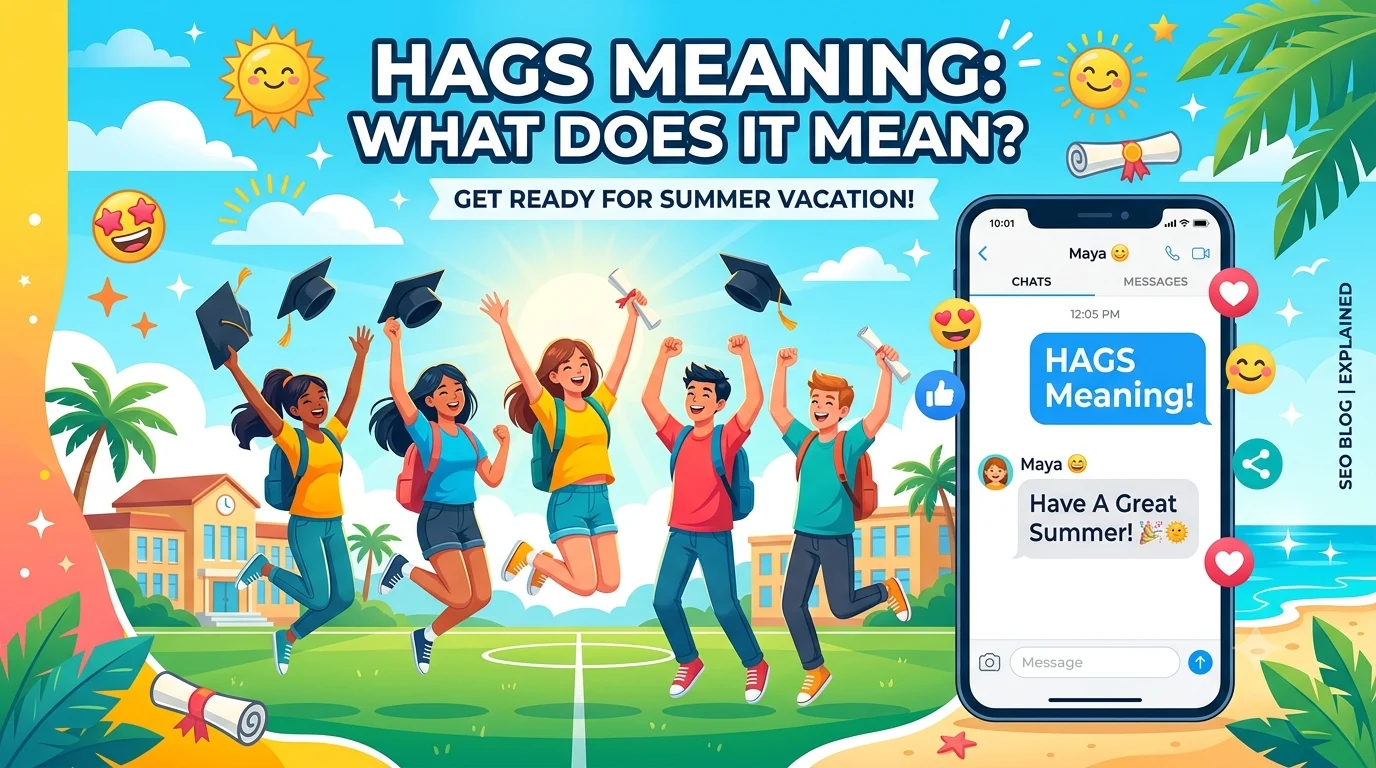
Meaning: HAGS most commonly stands for “Have A Great Summer.”
Full Form: Have A Great Summer
Context: Texting, school yearbooks, graduation messages, social media, and casual conversations.
Tone: Friendly, positive, and informal.
If you’ve come across HAGS in a text message, school yearbook, graduation card, or social media post, you may be wondering what it means. Like many internet abbreviations, HAGS is a shortened phrase that helps people communicate quickly while expressing a warm and friendly message.
The most common HAGS meaning is “Have A Great Summer.” Students, classmates, and friends often use it at the end of the school year to wish each other an enjoyable summer vacation. Instead of writing the full sentence, they simply type HAGS, making it a convenient and recognizable abbreviation.
Although HAGS is especially popular in schools, it also appears in text messages, Instagram captions, Snapchat chats, Facebook posts, and graduation messages. Because the letters can also resemble the English word “hags,” some people become confused about its meaning. Fortunately, the context usually makes it easy to understand.
In this guide, you’ll learn the HAGS meaning in texting, slang, and social media, how it’s used in real conversations, its history, examples, related abbreviations, and when it’s appropriate to use.
What Does HAGS Mean?
The abbreviation HAGS most commonly means “Have A Great Summer.”
People use it to wish someone an enjoyable, relaxing, and fun summer break. Instead of typing the entire phrase, they simply write HAGS.
For example:
- “School’s finally over. HAGS!”
- “See you next year. HAGS!”
- “Thanks for everything. HAGS!”
In each example, HAGS is simply a friendly goodbye.
The abbreviation became popular because students wanted an easy way to sign yearbooks and farewell notes. Over time, it spread into texting and online conversations.
Unlike many internet slang terms that have hidden meanings, HAGS is straightforward and positive. It expresses kindness and good wishes rather than humor or sarcasm.
What Does HAGS Mean in Texting, Slang, and Social Media?
HAGS Meaning in Text Messages
In texting, HAGS is commonly used when friends are saying goodbye before summer vacation.
Instead of writing:
“I hope you have a great summer.”
People simply write:
“HAGS!”
This saves time while still expressing the same warm message.
Examples:
Friend 1: “Can’t believe school is over.”
Friend 2: “I know! HAGS!”
Another example:
Friend 1: “See you in August.”
Friend 2: “HAGS!”
The abbreviation is casual, friendly, and easy to understand among students.
HAGS Meaning on Social Media
On social media, HAGS often appears in graduation posts, school memories, and farewell captions.
Examples include:
- “Good luck everyone! HAGS ❤️”
- “Thanks for the amazing year. HAGS!”
- “Can’t wait until next semester. HAGS!”
Platforms where you may see HAGS include:
- Snapchat
- TikTok
- X (formerly Twitter)
It is usually written with photos of classmates, graduation ceremonies, or end-of-school celebrations.
HAGS Meaning Among Students and Gen Z
HAGS has been used by students for decades, especially in middle schools and high schools.
One of its most famous uses is in yearbook signing.
Students often write short farewell messages such as:
“Stay awesome! HAGS!”
or
“It was fun being in class together. HAGS!”
Although modern students also use emojis and longer farewell messages, HAGS remains a recognizable abbreviation in many schools.
Among Gen Z, the abbreviation isn’t as common as newer internet slang, but it is still understood, especially during graduation season and summer vacation.
Other Meanings of HAGS
HAGS as “Have A Great Summer”
This is by far the most common meaning in texting and social media.
Whenever someone is saying goodbye before summer vacation, HAGS almost always means Have A Great Summer.
Examples:
- “Have fun at the beach! HAGS!”
- “Enjoy your vacation. HAGS!”
Hags as the Dictionary Word
Outside internet slang, the word hag has a completely different meaning.
Traditionally, a “hag” refers to an unpleasant or frightening old woman in folklore or literature.
However, this has nothing to do with the abbreviation HAGS.
The difference is simple:
- HAGS (uppercase) = Have A Great Summer.
- hags (lowercase word) = Plural form of hag.
The surrounding conversation will usually make the meaning obvious.
Other Rare Meanings
In some organizations or technical fields, HAGS may have unique meanings or represent the initials of a company or project.
These uses are uncommon.
In everyday texting and online conversations, HAGS almost always refers to Have A Great Summer.
How HAGS Is Used in Real Conversations
The abbreviation HAGS is most commonly used when people are saying goodbye before summer vacation. It is especially popular among students, classmates, teachers, and friends who may not see each other until the new school year.
Although it originated in school settings, HAGS can also appear in text messages and social media whenever someone wants to wish another person a wonderful summer.
End of the School Year
The most common situation is the last day of school.
Examples:
- “See you next year. HAGS!”
- “It was great being your classmate. HAGS!”
- “Good luck this summer. HAGS!”
Yearbook Messages
For many years, students have written HAGS in yearbooks because there is limited space for messages.
Examples:
- “Stay awesome! HAGS!”
- “Never change. HAGS!”
- “Hope you have an amazing summer. HAGS!”
Graduation Messages
Graduates often include HAGS in farewell notes.
Examples:
- “Congratulations on graduating! HAGS!”
- “Enjoy your break before college. HAGS!”
Text Messages
Friends also use HAGS in personal conversations.
Example:
Friend 1: “I’m leaving for vacation tomorrow.”
Friend 2: “That’s awesome! HAGS!”
Social Media Posts
People may include HAGS in captions after finishing exams or completing the school year.
Examples:
- “Finally done with finals! HAGS everyone!”
- “Thanks for the memories. HAGS ❤️”
Examples of HAGS in Sentences
Here are some natural examples of how HAGS is used:
- “School’s over! HAGS everyone!”
- “See you in September. HAGS!”
- “Have fun on vacation. HAGS!”
- “Thanks for being a great friend. HAGS!”
- “Hope you enjoy your summer break. HAGS!”
- “I’ll miss everyone. HAGS!”
- “Can’t wait for next year. HAGS!”
- “Have an amazing vacation with your family. HAGS!”
Each example expresses a friendly wish rather than ending a friendship or conversation permanently.
Tone and Intent of HAGS
One reason HAGS has remained popular is its positive tone. It is meant to encourage and wish someone well.
Friendly
Most people use HAGS to show kindness.
Example:
“HAGS! See you next semester.”
Positive
The abbreviation expresses good wishes.
Example:
“Have fun at the beach. HAGS!”
Casual
HAGS is informal and best suited for friends, classmates, and family members.
Example:
“HAGS 😊”
Sincere
Although short, HAGS usually carries a genuine meaning.
It tells someone:
- Enjoy your vacation.
- Stay safe.
- Have fun.
- See you after summer.
Origin and Background of HAGS
The abbreviation HAGS became popular long before smartphones and social media.
During the 1980s and 1990s, students commonly signed one another’s yearbooks before leaving school for summer vacation.
Because yearbooks had limited writing space, students began shortening common farewell phrases.
Instead of writing:
“Have a great summer!”
they simply wrote:
“HAGS.”
As texting became popular in the late 1990s and early 2000s, many school abbreviations moved into mobile messaging.
Eventually, HAGS appeared on:
- SMS text messages
- MSN Messenger
- AOL Instant Messenger
- Snapchat
Although newer internet slang changes quickly, HAGS has survived because it is easy to remember and tied to a yearly tradition that millions of students still experience.
Is HAGS Rude or Inappropriate?
No.
HAGS is generally polite, friendly, and completely appropriate in casual conversations.
It simply wishes someone a great summer.
Examples:
- “HAGS!”
- “Have fun! HAGS!”
Neither message is offensive.
When Confusion Can Happen
Some people confuse HAGS with the English word hag, which has a negative dictionary meaning.
However, when written as HAGS in a farewell message, it almost always means Have A Great Summer.
The surrounding conversation makes the intended meaning clear.
When NOT to Use HAGS
Although HAGS is friendly, it does not fit every situation.
Professional Emails
Instead of writing:
“HAGS.”
Use:
“Have a wonderful summer.”
This sounds more professional.
Business Communication
Clients or coworkers may not recognize internet abbreviations.
Writing complete sentences avoids confusion.
Formal School Letters
Teachers writing official announcements should generally spell out the full phrase instead of using HAGS.
Outside Summer Context
Avoid HAGS during winter holidays or other seasons because it specifically refers to summer.
Instead, use phrases like:
- Have a great day.
- Have a wonderful holiday.
- Take care.
Similar and Related Slang Terms
HAGS is one of many friendly internet abbreviations used to send good wishes or say goodbye. Several other terms have similar meanings, but each one is used in different situations.
HAGN (Have A Good Night)
HAGN stands for “Have A Good Night.”
People use it when ending a conversation in the evening.
Examples:
- “I’m going to sleep. HAGN!”
- “Talk tomorrow. HAGN 😊”
Difference from HAGS:
- HAGS is related to summer.
- HAGN is related to nighttime.
TTYL (Talk To You Later)
TTYL means “Talk To You Later.”
It is used when someone is leaving a conversation but plans to talk again in the future.
Examples:
- “I have homework. TTYL.”
- “Gotta go now. TTYL!”
Difference from HAGS:
- TTYL does not include a seasonal greeting.
- HAGS specifically wishes someone a great summer.
TC (Take Care)
TC means “Take Care.”
It is a general farewell phrase used throughout the year.
Examples:
- “See you soon. TC!”
- “Stay safe. TC.”
Difference from HAGS:
- TC works anytime.
- HAGS is mainly used before or during summer vacation.
BRB (Be Right Back)
BRB means “Be Right Back.”
It is used when someone temporarily leaves a conversation but intends to return quickly.
Examples:
- “Someone’s calling me. BRB.”
- “Need some water. BRB.”
Difference from HAGS:
- BRB means a short absence.
- HAGS is a seasonal goodbye message.
HAGS vs Related Terms
Understanding the difference between these abbreviations helps you use them correctly.
HAGS vs HAGN
Both are friendly wishes, but they refer to different times.
HAGS:
- Have A Great Summer
- Used before summer vacation
HAGN:
- Have A Good Night
- Used when ending a conversation at night
Example:
Summer vacation:
“School is over. HAGS!”
Before sleeping:
“I’m tired. HAGN!”
HAGS vs TTYL
Both can appear when ending conversations.
HAGS:
- A summer farewell
- Usually used at the end of the school year
TTYL:
- Means you will talk later
- Does not depend on a season
Example:
“See you after summer. HAGS!”
“I have to leave now. TTYL!”
HAGS vs TC
Both express good wishes.
HAGS:
- Specific to summer
TC:
- General caring goodbye
Example:
Summer:
“Enjoy your vacation. HAGS!”
Anytime:
“Stay safe. TC!”
HAGS vs BRB
These abbreviations have opposite purposes.
HAGS:
- Ends a conversation for a longer period
- Usually before summer break
BRB:
- Shows a temporary absence
- Means the person will return soon
Example:
“I need to answer the phone. BRB.”
“School is finished. HAGS!”
Comparison Table
| Term | Meaning | Usage | Key Difference |
|---|---|---|---|
| HAGS | Have A Great Summer | School endings, vacations, farewell messages | Specifically related to summer |
| HAGN | Have A Good Night | Evening conversations | Used before sleeping |
| TTYL | Talk To You Later | Casual chats | Means future conversation |
| TC | Take Care | General goodbye messages | Works in any season |
| BRB | Be Right Back | Live chats and gaming | Means a short temporary absence |
Common Misunderstandings About HAGS
Mistake 1: Thinking HAGS Is an Insult
Because the word “hag” has a negative meaning in English, some people assume HAGS is offensive.
However, in texting and social media, HAGS almost always means “Have A Great Summer.”
Example:
“Enjoy your vacation! HAGS!”
This is a positive message.
Mistake 2: Using HAGS at the Wrong Time
HAGS is connected to summer.
Using it during winter or another season may sound unusual.
Better alternatives:
- Happy holidays
- Have a great day
- Take care
Mistake 3: Assuming Everyone Knows the Meaning
Older and newer internet users may not immediately recognize HAGS.
If someone is unfamiliar with abbreviations, writing the full phrase is clearer.
Mistake 4: Confusing HAGS With Other Goodbye Terms
HAGS, BRB, TTYL, and TC all relate to communication, but they serve different purposes.
Understanding the difference prevents confusion.
Frequently Asked Questions (FAQs)
What does HAGS mean in texting?
In texting, HAGS usually means “Have A Great Summer.” It is a friendly way to wish someone an enjoyable summer vacation.
What is the full form of HAGS?
The most common full form of HAGS is:
Have A Great Summer
Is HAGS still used today?
Yes, although it is not as common as newer internet abbreviations. It is still recognized, especially among students and during graduation season.
What does HAGS mean in a yearbook?
In a yearbook, HAGS means “Have A Great Summer.” Students often write it as a short farewell message before summer break.
Is HAGS slang?
HAGS is considered an informal internet abbreviation rather than traditional slang.
Can HAGS have other meanings?
Yes. In some situations, HAGS may have other meanings, but in texting and social media it usually means “Have A Great Summer.”
Is HAGS appropriate for professional messages?
Generally, no. It is better for casual conversations. Professional communication should use the complete phrase.
Why do students write HAGS?
Students write HAGS because it is a quick and friendly way to wish classmates a fun summer vacation.
conclusion
The HAGS meaning in texting, slang, and social media is usually “Have A Great Summer.” It is a positive abbreviation commonly used by students, friends, and online users when saying goodbye before summer vacation.
You will often see HAGS in yearbooks, graduation messages, social media captions, and casual chats. It carries a friendly message that means someone hopes you enjoy your summer.
Although the word “hag” has another meaning in normal English, the abbreviation HAGS has a completely different purpose when used online. Context is the key to understanding it.
If you see someone write “HAGS!” at the end of a message, they are simply wishing you a great summer. ☀️