
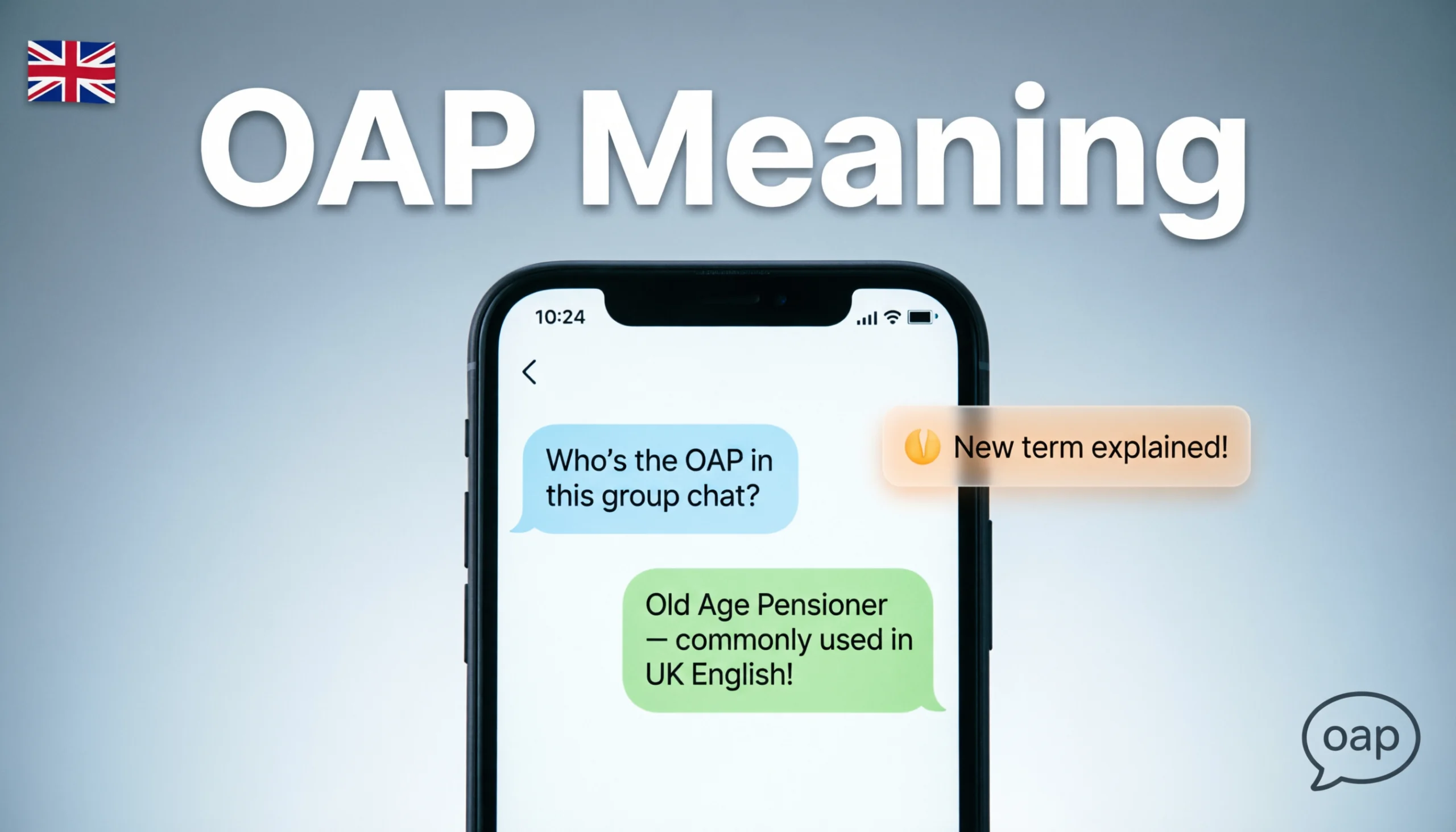
Quick Answer: What Does OAP Mean?
OAP most commonly means “Old Age Pensioner.” The term is mainly associated with British English and refers to an older person who receives a pension.
If you see OAP in a text, social media post, or everyday conversation about retirement, older people, discounts, or public services, this is likely the intended meaning.
Meaning: Old Age Pensioner
Full form: Old Age Pensioner
Context: British English, texting, social media, retirement, pensions, and everyday communication
Tone: Usually neutral, but it can sound insensitive when used to mock someone’s age
OAP can also have other meanings in specialized fields, so context matters. It is not automatically a texting slang term just because you see it online.
Introduction
If you have come across OAP in a text message, comment, post, or conversation, you may have wondered what those three letters mean. Short abbreviations can be surprisingly confusing because the same combination of letters can mean different things in different situations.
The most common OAP meaning is “Old Age Pensioner.” This expression is especially familiar in British English and is often used when talking about older people, pensions, retirement, public transportation, discounts, or community services.
You might see something like “OAP discount available” at a business or “My dad is officially an OAP now” in a casual message. Both examples relate to the same basic meaning, although their tone is different.
The confusion comes from the fact that OAP can also appear in technical, professional, or specialized contexts. In those situations, it may stand for something completely different.
Another common question is whether OAP is slang. Generally, it is better described as an abbreviation rather than modern internet slang. It can be used casually online, but its history goes beyond texting and social media.
Let’s look at the different ways OAP is used and how context can help you understand it correctly.
What Does OAP Mean?
OAP stands for “Old Age Pensioner.”
In British English, an old age pensioner is traditionally an older person who receives a pension.
For example:
“The museum offers a discount for OAPs.”
Here, OAPs is the plural form and refers to older pensioners who qualify for the discount.
You may encounter several written forms, including:
- OAP
- OAPs
- Attn-style abbreviations are not relevant here; OAP is a separate abbreviation
- O.A.P.
- oap, particularly in informal digital writing
The core idea is simple: OAP is a shortened way of referring to an old age pensioner.
However, it is important not to assume that every older person is automatically an OAP. The traditional expression specifically connects the person with pension or retirement status.
Today, people may choose different expressions depending on the situation. Terms such as older person, older adult, senior, or pensioner may sound more natural or respectful in certain contexts.
What Does OAP Mean in Texting, Slang, or Social Media?
When you see OAP in texting, the most likely meaning depends on the conversation.
If the topic is retirement, grandparents, pensions, senior discounts, or getting older, OAP probably means “Old Age Pensioner.”
For example:
“Grandad says he gets an OAP discount now.”
The context makes the meaning easy to understand.
On social media, OAP may also be used in a playful way.
For example:
“Apparently going to bed at 9 PM makes me an OAP 😂.”
The person is joking about feeling old. The abbreviation still refers to “Old Age Pensioner,” but the intent is humorous.
You might also see posts such as:
“ATTENTION OAPs: free travel starts Monday.”
In this type of post, OAP is being used in a practical or informational way rather than as slang.
Is OAP Gen Z Slang?
OAP is not generally considered mainstream Gen Z slang.
It does not belong to the same category as newer internet expressions such as “rizz,” “sus,” or “no cap.” OAP has a much older history and is strongly connected with British English.
A younger person may still use or understand OAP, especially if they encounter it in a family conversation, British media, a business notice, or an online post. But that does not make it modern Gen Z slang.
So if someone types OAP in a chat, do not automatically assume it has a hidden or trendy meaning. Look at the topic of the conversation first.
Other Meanings of OAP
Although “Old Age Pensioner” is a major meaning, OAP can also represent other terms in specialized areas.
OAP as “Old Age Pensioner”
This is the meaning most people are likely to encounter in British everyday communication.
It can appear in discussions about:
- Retirement
- Pensions
- Senior discounts
- Public transportation
- Entertainment
- Government services
- Community programs
- Older generations
For example:
“OAP fares are available after 9 AM.”
The phrase refers to fares available to qualifying older pensioners.
OAP in Other Contexts
Abbreviations often have different definitions in professional and technical fields. OAP can therefore have specialized meanings in areas such as technology, business, organizations, education, or other industries.
This is why context is essential.
If someone is discussing software and suddenly writes OAP, it would not necessarily make sense to interpret it as “Old Age Pensioner.” The surrounding terminology may point toward another definition.
There is no reason to force one meaning onto every situation. When an abbreviation has multiple possible definitions, the sentence around it usually provides the clue.
How OAP Is Used in Real Conversations
The way people use OAP can change depending on the platform and audience.
OAP in Text Messages
In text messages, OAP is most likely to appear when people are discussing older relatives, retirement, pensions, or age-related discounts.
For example:
“My nan gets an OAP discount at the cinema.”
Another example is:
“Dad keeps joking that he’s an OAP now.”
The first sentence is practical. The second is more playful.
OAP on Social Media
Social media gives people more freedom to use abbreviations humorously.
Someone might post:
“I feel like an OAP after spending all weekend gardening.”
Here, the speaker may not literally be using the term as an official description. They are joking about feeling older or tired.
OAP can also appear in informational posts:
“OAP travel discounts have changed this year.”
The meaning remains connected to older pensioners.
OAP in Everyday and Formal Communication
The abbreviation can appear outside digital communication too.
Businesses may use it when describing discounts:
“OAP discount: 20% off.”
Transportation providers may use it when explaining fares. Community organizations may use it in information aimed at older residents.
In formal communication, however, the writer should consider whether the audience understands the abbreviation. Spelling out the phrase or using a more current term may sometimes be clearer.
OAP Meaning Examples
Here are some natural examples of OAP in different situations:
- “The cinema offers an OAP discount on weekday mornings.”
OAP means “Old Age Pensioner” and identifies people eligible for the discount. - “My grandfather says becoming an OAP has its benefits.”
The term refers to his pensioner status and is being used casually. - “Do OAPs get cheaper bus fares?”
The speaker is asking about transportation discounts for older pensioners. - “My mum joked that she’s officially an OAP now.”
The abbreviation is being used humorously in a personal conversation. - “The hotel offers special rates for OAPs.”
Here, OAPs refers to older pensioners who qualify for the special rate. - “The council has published new information for OAPs.”
This is a more formal use relating to older pensioners. - “I must be turning into an OAP because I’d rather stay home tonight.”
This is a humorous social media-style use. - “The form asks whether the applicant qualifies as an OAP.”
The abbreviation is being used in an administrative context.
These examples show that the same abbreviation can appear in both serious and playful communication.
Tone and Intent Behind OAP
The tone of OAP depends on how it is used.
By itself, the abbreviation is generally neutral. It does not automatically communicate anger, excitement, sarcasm, or affection.
Consider:
“OAP discounts are available.”
This is simply informational.
Now compare it with:
“I’m officially an OAP 😂.”
That sentence is playful and humorous.
Positive Uses
Someone might use OAP jokingly about themselves or a family member without intending anything negative.
For example:
“Dad loves his new OAP discount.”
The tone is light and friendly.
Neutral Uses
In a business or public-service context, OAP can simply identify an eligibility category.
“OAP fares are available with valid identification.”
There is no obvious emotional meaning.
Negative or Insensitive Uses
The term can become uncomfortable when someone uses it to mock another person’s age.
For example:
“Look at you, you old OAP!”
Depending on the relationship and tone, this could be friendly teasing or an insult.
The important point is that OAP itself is not automatically insulting. The intention and surrounding words determine how it is received.
Sarcasm vs. Serious Use
Online, people sometimes use OAP sarcastically.
For example:
“I went to bed at 8:30, so I guess I’m an OAP now.”
The speaker is obviously joking rather than making a literal statement about pension status.
Origin and Background of OAP
OAP comes from the phrase “Old Age Pensioner.”
The expression is strongly associated with British English and developed around the language of pensions and retirement. The abbreviated form became useful in situations where the longer phrase needed to be repeated frequently.
You can find the abbreviation in contexts involving:
- Pensioners
- Transportation
- Discounts
- Public services
- Entertainment
- Community organizations
For example, businesses may use OAP when listing different admission or pricing categories.
As communication moved from paper forms and printed notices to websites, emails, text messages, and social media, established abbreviations naturally moved with it.
This is why OAP can appear online today even though it was not originally created as internet slang.
Language also changes over time. Some people still use OAP regularly, while others prefer newer or more neutral terms such as older adult, older person, or senior.
Is OAP Rude or Inappropriate?
OAP is not inherently rude or inappropriate.
It is a recognized abbreviation, particularly in British English. In a practical context such as a discount category, there is usually nothing offensive about it.
For example:
“OAP discount available.”
is simply a statement about pricing.
However, using the term to make fun of someone because of their age can make it sound disrespectful.
For example:
“You’re such an OAP!”
could be harmless joking between close friends, but it could also offend someone depending on the relationship.
If you are discussing an individual in a sensitive or professional setting, terms such as older person or older adult may be more appropriate.
When Should You NOT Use OAP?
There are situations where OAP may not be the best choice.
When Your Audience Is International
OAP is particularly associated with British English. Readers from the United States or other countries may not immediately understand it.
If your audience is international, spelling out the phrase or using a clearer alternative can help.
In Sensitive Conversations
When discussing someone’s age or personal circumstances, avoid using OAP as a label if it could make the person uncomfortable.
A neutral phrase such as older adult may be better.
In Formal Writing
If your readers may not know the abbreviation, introducing the full phrase first can improve clarity.
For example:
“Old Age Pensioners (OAPs) may qualify for the discount.”
After that, the abbreviation can be used if necessary.
In Casual Personal Messages
OAP may sound overly formal in a simple conversation.
Instead of:
“ATTN: OAP, are you coming to dinner?”
a normal personal message would be much clearer and more natural.
The best communication is not always the shortest. It is the communication that the reader understands immediately.
Similar and Related Terms to OAP
Several terms are connected with OAP, but they do not have exactly the same meaning.
Senior
“Senior” is a broad term for an older adult. It does not necessarily mean the person receives a pension.
Pensioner
A pensioner is generally someone who receives a pension. The word does not necessarily carry exactly the same age-related emphasis as “old age pensioner.”
Older Person
“Older person” is a straightforward and neutral expression. It describes age without suggesting pension status.
Older Adult
“Older adult” is another neutral phrase commonly used in professional, social, and informational contexts.
Elderly
“Elderly” can refer to older people, but some people consider it less preferred or somewhat dated in certain contexts.
Choosing between these terms depends on the audience, purpose, and tone.
OAP vs. Related Terms
OAP vs. senior: OAP traditionally refers to an older pensioner, while “senior” is broader and does not necessarily imply pension status.
OAP vs. pensioner: A pensioner is someone receiving a pension, while OAP specifically combines the idea of old age with pensioner status.
OAP vs. older person: “Older person” focuses simply on age and does not imply that the person receives a pension.
OAP vs. older adult: “Older adult” is a neutral modern expression that is often suitable for professional or respectful communication.
OAP vs. elderly: Both can refer to older people, but OAP has a specific pension-related meaning, while “elderly” is a general description of age.
OAP Comparison Table
| Term | Meaning | Usage | Key Difference |
|---|---|---|---|
| OAP | Old Age Pensioner | British English, pensions, discounts | Connects age with pensioner status |
| Senior | Older adult | Everyday and formal communication | Broader term with no necessary pension connection |
| Pensioner | Person receiving a pension | Retirement and financial contexts | Focuses mainly on pension status |
| Older person | Person who is older | General communication | Neutral and does not mention pensions |
| Older adult | An older person | Professional and social contexts | Modern, neutral wording |
| Elderly | Older person | General descriptions | Broad age-related term without a pension focus |
Common Misunderstandings About OAP
One of the biggest misconceptions is that OAP is modern texting slang. It is not primarily an internet expression. It is an established abbreviation that can be used in digital communication.
Another misunderstanding is that OAP simply means “old person.” Its traditional meaning is more specific because it refers to an old age pensioner.
People also sometimes assume that OAP always has a negative tone. It does not. A business using “OAP discount” is usually using the term in a practical way.
Another source of confusion is regional language. Someone in Britain may immediately recognize OAP, while someone in America may be unfamiliar with the abbreviation.
Finally, OAP can have specialized meanings outside the pension context. If the abbreviation appears in a technical report, workplace document, or industry-specific conversation, the surrounding terminology should be checked before choosing a definition.
The easiest rule is simple: look at the context first.
FAQs
What does OAP stand for?
OAP most commonly stands for “Old Age Pensioner.” It is especially associated with British English.
What does OAP mean in texting?
In texting, OAP usually means “Old Age Pensioner” when the conversation involves retirement, pensions, older people, or age-related discounts. The abbreviation can have other meanings in specialized contexts.
Is OAP slang?
OAP is generally considered an abbreviation rather than modern slang. It can be used casually, but it has a longer history in British written communication.
What does OAP mean in British English?
In British English, OAP commonly means “Old Age Pensioner.” It can appear in conversations about pensions, retirement, public transportation, discounts, and older people.
Is OAP offensive?
OAP is not inherently offensive. However, using it to mock or insult someone because of their age can make it sound disrespectful.
What does OAP mean on social media?
On social media, OAP can mean “Old Age Pensioner,” especially in posts about aging, retirement, discounts, or older generations. It can also be used humorously.
What is the difference between OAP and senior?
OAP has a specific connection with an older pensioner, while “senior” is a broader term for an older adult and does not necessarily indicate pension status.
Why does OAP have different meanings?
Abbreviations can develop different meanings across countries, industries, and communities. The topic and surrounding words usually reveal which meaning is intended.
Is OAP commonly used in the United States?
The abbreviation OAP meaning “Old Age Pensioner” is much more closely associated with British English. American speakers are generally less likely to use it in everyday conversation with this meaning.
Should I use OAP when talking about an older person?
It depends on the context. OAP can be suitable when discussing a pension-related category or discount, but older person, older adult, or senior may be clearer or more respectful in personal and sensitive situations.
Conclusion
The most common OAP meaning is “Old Age Pensioner.” It is particularly associated with British English and is used when talking about older people who receive pensions or qualify for age-related services and discounts.
Although you may see OAP in texts, comments, and social media posts, it is not primarily modern internet slang. It is an established abbreviation that has been used in written communication for many years.
The context remains important. In a conversation about retirement, an OAP discount, or an older relative, the meaning is usually clear. In a technical or professional setting, however, OAP may stand for something entirely different.
The simplest way to understand the term is to remember this: OAP usually means “Old Age Pensioner,” but always check the context before assuming its meaning.