
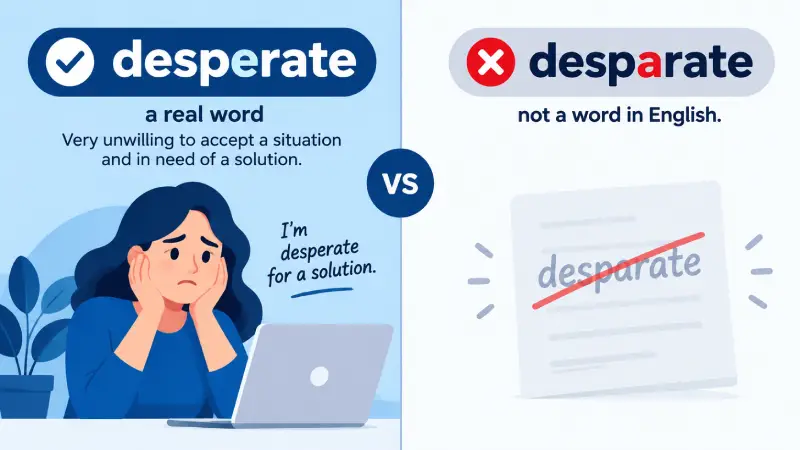
Desperate and desparate are commonly confused because they look and sound similar. However, only one is the standard English spelling.
Desperate is the correct spelling. Desparate is a misspelling and should not be used in standard English writing.
Desperate vs. Desparate: Quick Answer
| Spelling | Correct? | Meaning |
|---|---|---|
| Desperate | ✅ Yes | Feeling or showing an urgent need, strong desire, or lack of hope |
| Desparate | ❌ No | Common misspelling of desperate |
The Correct Spelling
Desperate is the correct spelling.
Desparate is incorrect.
She was desperate to find a new job.
Not:
She was desparate to find a new job.
What Does Desperate Mean?
Desperate is an adjective that describes a person who has an extremely strong need or desire for something, often because the situation feels urgent or difficult.
It can also describe an action or attempt made because someone feels they have very few options.
Examples
- I was desperate for some good news.
- He became desperate to find his missing wallet.
- They made a desperate attempt to save the business.
- She was desperate for a break after working all week.
The word can describe emotional urgency, serious need, or an extreme attempt to achieve something.
Why Is “Desparate” Incorrect?
Desparate is a spelling mistake. The standard spelling is desperate, with an e after the p:
des-per-ate
A common reason for the mistake is that the pronunciation can make the spelling less obvious. Writers may incorrectly insert an a and produce desparate.
Remember:
desperate = correct
desparate = incorrect
A useful visual reminder is:
DESP + ERATE = DESPERATE
7 Clear Differences Between Desperate and Desparate
1. Desperate Is the Correct Word
The biggest difference is simple: desperate is a standard English word, while desparate is not the standard spelling.
Correct:
I am desperate for help.
Incorrect:
I am desparate for help.
2. Desperate Appears in Dictionaries
Desperate is an established English adjective with several related meanings.
Desparate, when used as an intended spelling of this word, is simply a misspelling.
3. Desperate Describes Strong Need
Desperate can describe an urgent or extreme need.
He was desperate for water after the long hike.
Here, desperate emphasizes the seriousness of the need.
4. Desperate Can Describe Strong Desire
The word can also describe an intense desire to achieve or obtain something.
She was desperate to win the competition.
This means she wanted to win very strongly.
5. Desperate Can Describe Extreme Actions
Desperate can describe something done when someone believes they have very few options.
They made a desperate attempt to escape the storm.
The phrase suggests an urgent or extreme effort.
6. Desperate Can Describe a Difficult Situation
The word can describe circumstances that are extremely serious or concerning.
The company was in desperate need of funding.
Here, desperate emphasizes the seriousness of the situation.
7. Desparate Should Be Corrected
If you see desparate in an article, email, essay, résumé, or other formal writing, it should normally be corrected to desperate.
Desperate Meaning and Examples
Here are several common ways to use desperate correctly.
Desperate for Something
Desperate for means having a very strong need or desire for something.
I was desperate for sleep.
The team was desperate for a victory.
She was desperate for an answer.
Desperate to Do Something
Desperate to means having a very strong desire to do something.
He was desperate to get home.
She was desperate to prove herself.
They were desperate to find a solution.
Desperate Need
The phrase desperate need describes an extremely urgent need.
The community was in desperate need of food and supplies.
Desperate Attempt
A desperate attempt is an extreme or urgent effort to accomplish something.
He made a desperate attempt to fix the problem.
Desperate in Everyday English
Desperate is common in both conversation and writing.
For example:
“I’m desperate for coffee.”
This can simply mean that someone really wants coffee. It does not necessarily mean the situation is literally dangerous.
The meaning can therefore range from strong everyday desire to serious urgent need, depending on context.
Desperate in Formal Writing
Desperate is acceptable in formal English when its meaning fits the context.
Examples include:
The organization is in desperate need of additional funding.
The patient required desperate measures to address the emergency.
The company made a desperate effort to remain operational.
In formal writing, however, choose the word carefully because it can convey a strong sense of urgency or seriousness.
Desperate vs. Desparately
Another common spelling mistake is desparately.
The correct adverb is:
desperately
Not:
desparately
Example
Correct:
She desperately wanted to find her keys.
Incorrect:
She desparately wanted to find her keys.
The spelling pattern is:
desperate → desperately
Desperate vs. Despair
Although desperate and despair are related in meaning and history, they are different words.
| Word | Part of Speech | Meaning |
|---|---|---|
| Desperate | Adjective | Extremely urgent, needy, or strongly desired |
| Despair | Noun/verb | A complete loss of hope |
Examples
He was desperate for help.
She began to despair after receiving the bad news.
Desperate vs. Urgent
These words can overlap but are not identical.
Desperate often describes a very strong need, desire, or extreme situation.
Urgent emphasizes that something needs immediate attention.
Compare:
She was desperate to find her lost dog.
The situation was urgent and required immediate action.
Desperate vs. Desparate in Sentences
| Incorrect | Correct |
|---|---|
| I am desparate for help. | I am desperate for help. |
| He was desparate to leave. | He was desperate to leave. |
| She felt desparate for answers. | She felt desperate for answers. |
| They made a desparate attempt. | They made a desperate attempt. |
| We were desparate for food. | We were desperate for food. |
Common Phrases With Desperate
Learning common phrases can make the correct spelling easier to remember.
Desperate for
I’m desperate for a vacation.
Desperate to
He is desperate to succeed.
Desperate need
The project is in desperate need of funding.
Desperate attempt
They made a desperate attempt to solve the problem.
Desperate situation
The family was facing a desperate situation.
Desperate measures
The company considered desperate measures to avoid closure.
How to Remember the Spelling of Desperate
A simple way to remember the spelling is to focus on the middle:
DESP + ERATE
Think:
despERate
The incorrect version desparate uses a where the correct spelling has e.
Memory Tip
“Desperate has an E after P.”
So:
desp + erate = desperate
Is Desparate Ever Correct?
For standard modern English, desparate should not be used as the spelling of desperate.
If you mean the adjective describing an extreme need, desire, or situation, use:
desperate
Which Is Correct: Desperate or Desparate?
Desperate is correct. Desparate is incorrect.
Use desperate when you mean extremely needy, urgent, strongly desired, or involving an extreme situation.
Correct:
She was desperate to find a solution.
Incorrect:
She was desparate to find a solution.
Frequently Asked Questions
1. Is desperate or desparate correct?
Desperate is correct. Desparate is a misspelling.
2. How do you spell desperate correctly?
The correct spelling is desperate: D-E-S-P-E-R-A-T-E.
3. What does desperate mean?
Desperate means having an extremely strong need or desire, or being in a very serious or difficult situation.
4. Why do people spell desperate as desparate?
The mistake usually occurs because desperate and desparate look and sound similar, making the vowel sequence easy to confuse.
5. Is desparate a word?
Desparate is not the standard spelling of the word desperate. Use desperate instead.
6. What is the adverb of desperate?
The adverb is desperately.
Example:
He desperately needed help.
7. What is the difference between desperate and despair?
Desperate is an adjective describing extreme need, desire, or urgency. Despair refers to a loss of hope and can function as a noun or verb.
8. What is an easy way to remember desperate?
Remember: desperate has an E after P.
desp + erate = desperate
Final Answer
The correct spelling is desperate.
Desparate is a common spelling mistake and should be corrected in standard English writing.
If you are writing an email, school assignment, résumé, article, or professional document, always use desperate.
Correct: desperate
Incorrect: desparate