
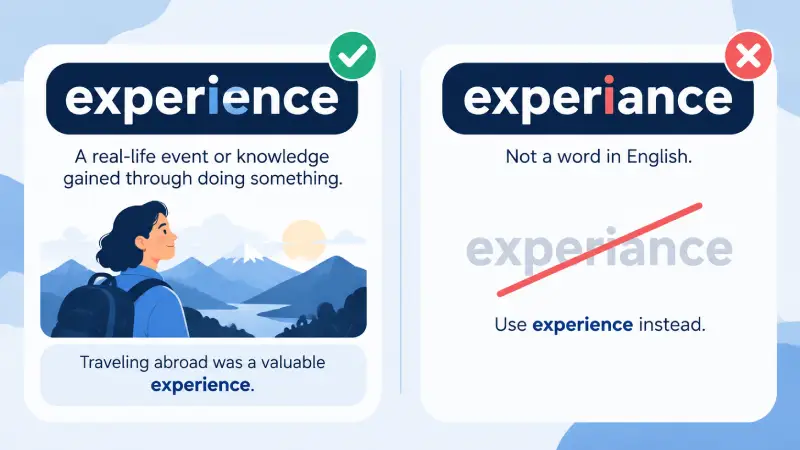
If you are unsure whether the correct spelling is experience or experiance, you are not alone. These words look very similar, but only one is correct in standard English.
The correct spelling is experience. Experiance is a common spelling mistake and should not be used in standard American English.
Quick Answer
| Spelling | Correct? | Meaning |
|---|---|---|
| Experience | ✅ Correct | Knowledge, skill, or familiarity gained through doing or encountering something |
| Experiance | ❌ Incorrect | Common misspelling of experience |
Correct: I have five years of work experience.
Incorrect: I have five years of work experiance.
Experience vs. Experiance: Which Spelling Is Correct?
Experience is the only standard spelling.
Experiance is incorrect. Although it may appear in informal online writing, messages, or user-generated content, it is considered a spelling error in standard English.
The correct spelling is:
E-X-P-E-R-I-E-N-C-E
A useful way to remember it is to focus on the middle of the word:
experience → -ence
Not:
experiance → -iance
What Does Experience Mean?
Experience is a noun that usually refers to knowledge, skills, or understanding gained by doing something or living through events.
For example:
- She has extensive experience in marketing.
- Traveling gave him valuable experience.
- I had a strange experience yesterday.
- This job requires previous work experience.
Experience can also be used as a verb. In that case, it means to go through, feel, or encounter something.
For example:
- We experienced heavy traffic.
- She experienced a major change in her career.
- They experienced several problems during the trip.
7 Clear Differences Between Experience and Experiance
1. Experience Is the Correct Spelling
The most important difference is spelling.
Experience is correct.
Experiance is incorrect.
Example:
He has years of experience in customer service.
Not:
He has years of experiance in customer service.
2. Experience Is a Standard English Word
Experience appears in dictionaries and is widely used in American and British English.
Experiance is not the standard spelling of the word.
This makes experience the appropriate choice for:
- School assignments
- Resumes
- Cover letters
- Business writing
- Emails
- Websites
- Academic writing
- Professional documents
3. Experience Can Be a Noun
As a noun, experience can describe knowledge gained through practice or an event that someone goes through.
Examples:
- She has three years of teaching experience.
- The trip was an unforgettable experience.
- His work experience helped him get the position.
4. Experience Can Also Be a Verb
Experience can also function as a verb.
Examples:
- Many people experience stress at work.
- We experienced delays during the flight.
- She experienced a new culture while traveling.
Experiance cannot be used as the verb because it is simply a misspelling.
5. Experience Is Common in Professional Writing
The word experience is especially common when discussing careers and qualifications.
Examples:
- Relevant work experience
- Previous experience
- Professional experience
- Customer service experience
- Management experience
- Industry experience
For a resume, always write experience, never experiance.
6. Experience Refers to More Than Work
Some people associate experience only with jobs, but the word has a much broader meaning.
You can have:
- Life experience
- Travel experience
- Educational experience
- Personal experience
- Work experience
- Customer experience
- Learning experience
Example:
Studying abroad was an important experience for her.
7. Experiance Is a Spelling Mistake
Experiance often occurs because English spelling can make the ending confusing.
Writers may incorrectly change -ence to -ance, producing:
❌ experiance
Instead, remember:
✅ experience
The correct ending is -ence.
Experience in Different Contexts
The meaning of experience can change slightly depending on the context.
| Context | Meaning | Example |
|---|---|---|
| Work | Skills or knowledge gained from a job | She has five years of work experience. |
| Education | Knowledge gained through learning or activities | College was a valuable experience. |
| Travel | Events or activities encountered while traveling | The trip was an amazing experience. |
| Personal life | Something that happened to someone | It was a difficult experience. |
| Business | A customer’s interaction with a company | The company improved the customer experience. |
| Technology | How someone interacts with a product or service | The app provides a smooth user experience. |
Common Phrases With Experience
Here are some common expressions that use experience:
Work experience
I have three years of work experience.
Previous experience
Previous experience is preferred for this position.
Professional experience
She has extensive professional experience.
Life experience
Life experience can teach valuable lessons.
Personal experience
I can speak from personal experience.
Customer experience
The company is focused on improving customer experience.
User experience
The website has a better user experience after the redesign.
Learning experience
The program provides a valuable learning experience.
Experience vs. Experiance in a Sentence
Here are examples showing the correct usage:
Correct
- I have several years of experience in sales.
- That was an interesting experience.
- She gained valuable experience during college.
- We had a great travel experience.
- Previous experience is not required.
- He experienced several challenges at work.
Incorrect
- I have several years of experiance in sales.
- That was an interesting experiance.
- She gained valuable experiance during college.
In each incorrect example, replace experiance with experience.
Why Do People Spell Experience as Experiance?
The mistake usually happens because experience is pronounced in a way that does not make its spelling completely obvious.
The endings -ence and -ance can also cause confusion in English.
For example:
- experience → -ence
- attendance → -ance
- importance → -ance
- confidence → -ence
Because both endings occur frequently in English, it is easy to write the wrong one.
The safest approach is to memorize the spelling:
experience = E-X-P-E-R-I-E-N-C-E
Easy Memory Trick for Experience
Use this simple trick:
Experience ends with “ence.”
Think:
Experience = exper + i + ence
Another useful reminder is:
EXPERIENCE has E at the end of the middle sound: -ENCE.
So when you are deciding between experience and experiance, choose:
✅ experience
Is Experience the Correct Spelling in American English?
Yes. Experience is the standard spelling in American English.
It is also the standard spelling in British English and other major varieties of English.
Experiance is not an alternative American spelling. It is a misspelling.
Experience on a Resume or Job Application
When writing a resume, CV, cover letter, or job application, always use experience.
Common headings include:
- Work Experience
- Professional Experience
- Relevant Experience
- Employment Experience
Example:
Professional Experience
Marketing Manager, ABC Company
Five years of experience in digital marketing and content strategy.
Writing experiance in a professional document can make the writing appear careless, so checking the spelling is important.
Common Mistakes With Experience
Mistake 1: Writing Experiance
❌ I have two years of experiance.
✅ I have two years of experience.
Mistake 2: Using the Wrong Ending
❌ Experiance
✅ Experience
Remember that the correct ending is -ence, not -ance.
Mistake 3: Using “Experiences” Incorrectly
Experiences is the plural form of experience, but it is not always interchangeable with the singular.
For example:
Traveling has given me many memorable experiences.
This is correct when referring to multiple events or situations.
But:
She has five years of work experience.
Here, the uncountable form experience is natural.
Experience vs. Experiences
The distinction can sometimes be confusing.
Experience can refer generally to knowledge or skill gained over time:
He has extensive teaching experience.
Experiences usually refers to separate events or things someone has gone through:
Her travel experiences changed her perspective.
Simple rule
Use experience for general knowledge, skill, or experience as a whole.
Use experiences when talking about multiple individual events.
Experience vs. Experiance: Quick Comparison
| Feature | Experience | Experiance |
|---|---|---|
| Standard spelling | ✅ Yes | ❌ No |
| Dictionary word | ✅ Yes | ❌ No |
| Used in American English | ✅ Yes | ❌ No |
| Used in professional writing | ✅ Yes | ❌ No |
| Can be a noun | ✅ Yes | ❌ No |
| Can be a verb | ✅ Yes | ❌ No |
| Correct ending | -ence | Incorrect -iance |
Frequently Asked Questions
1. Is experience or experiance correct?
Experience is correct. Experiance is a misspelling.
2. How do you spell experience correctly?
The correct spelling is:
E-X-P-E-R-I-E-N-C-E
3. Is experiance a word?
No. Experiance is not the standard spelling of the English word. It is a common misspelling of experience.
4. Why do people spell experience as experiance?
The error usually comes from confusion between the English endings -ence and -ance. The correct spelling uses -ence.
5. What is the plural of experience?
The plural is experiences.
For example:
Her travel experiences were unforgettable.
However, experience is often used as an uncountable noun when referring to knowledge or skill:
He has extensive work experience.
6. Is experience used in American English?
Yes. Experience is the standard spelling in American English.
7. Can experience be a verb?
Yes. As a verb, experience means to go through, encounter, or feel something.
Example:
They experienced heavy rain during the trip.
8. What is the easiest way to remember the spelling?
Remember that experience ends with -ence, not -ance.
Correct: experience
Incorrect: experiance
Final Answer
The correct spelling is experience.
Experiance is a common spelling mistake and should be avoided in standard English.
If you are writing a resume, email, school assignment, website, or professional document, always use experience.
Remember:
✅ Experience
❌ Experiance
The easiest memory tip is simple: experience ends in -ence.