
Last Updated: October 28, 2026
Have you ever received a text that simply says “DWBI” and wondered what those four letters mean? If you have seen this abbreviation in a private message, group chat, or social media conversation, you might have been unsure whether the sender was being friendly, dismissive, or simply trying to save time while typing.
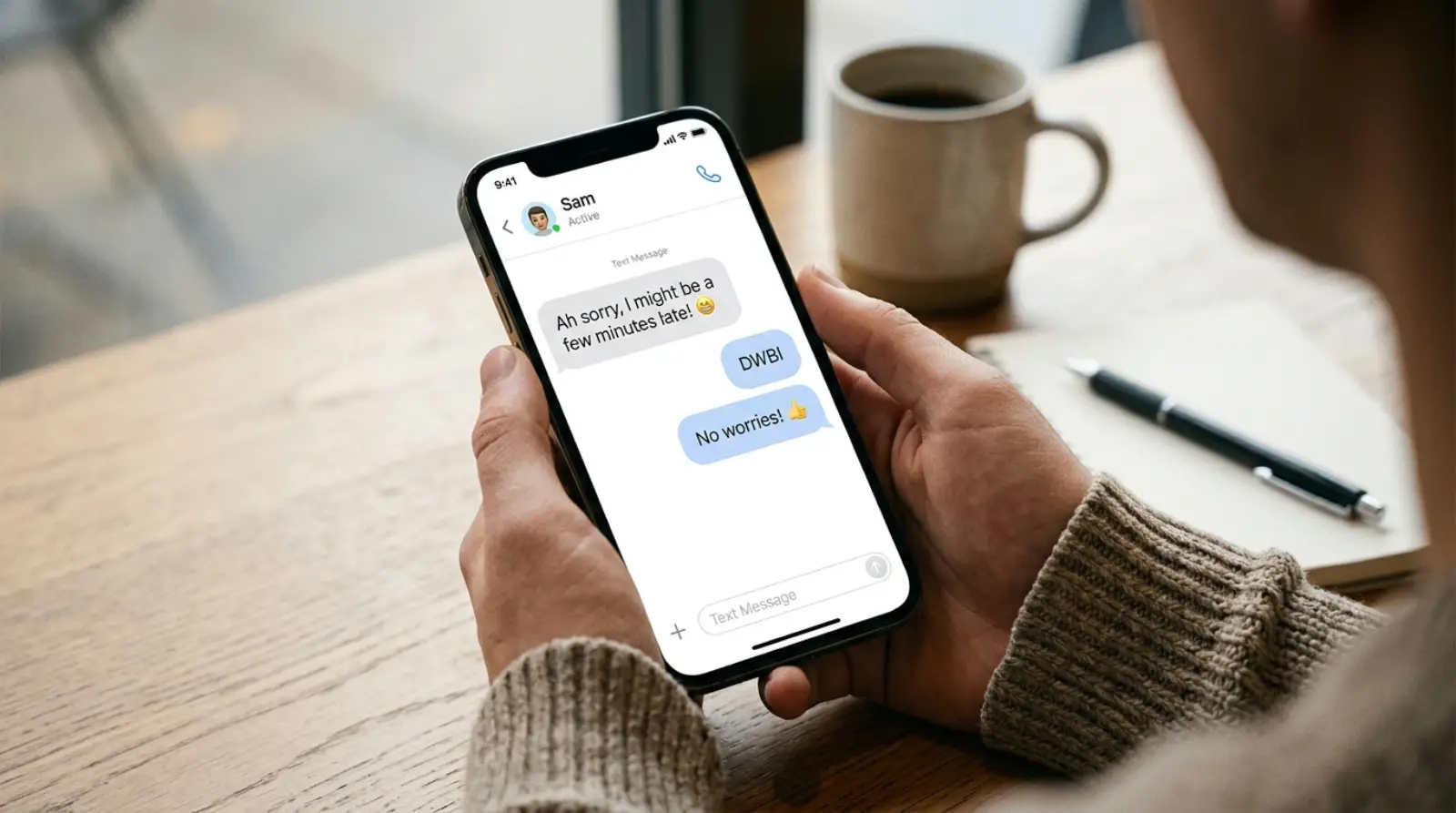
In casual texting, DWBI usually means “Don’t Worry ‘Bout It,” an informal version of “Don’t Worry About It.” People use it to reassure someone, accept a small apology, dismiss a minor problem, or explain that something does not require further attention. In simple terms, it can mean “It’s okay,” “No problem,” or “You don’t need to worry about it.”
For example, imagine that you apologize to a friend because you forgot to reply to a message. Your friend might respond, “DWBI, it’s all good.” In this situation, the abbreviation tells you that your friend is not concerned about the late reply and does not want you to feel bad about it.
However, DWBI does not always communicate the same tone. A friendly message with extra words or an emoji may sound reassuring, while a short “dwbi” during an argument might feel cold or dismissive. The surrounding conversation matters more than the abbreviation alone.
You may also encounter DWBI on messaging apps and social platforms such as Snapchat, Instagram, TikTok, and Discord. Its meaning can occasionally vary in specialized communities, so it is helpful to consider what the people involved are discussing before interpreting it.
In this guide, you will learn the DWBI meaning in text, its full form, how people use it, real conversation examples, possible tone differences, similar abbreviations, and the best ways to reply. By the end, you will understand when DWBI is a friendly response and when you may need more context to interpret it correctly.
Quick Answer: What Does DWBI Mean?
DWBI stands for “Don’t Worry ‘Bout It.” It is an informal texting abbreviation that usually tells someone not to worry about a mistake, apology, inconvenience, or minor concern.
| Detail | Explanation |
|---|---|
| Abbreviation | DWBI |
| Full form | Don’t Worry ‘Bout It |
| Standard phrase | Don’t Worry About It |
| Main use | Reassurance or casual dismissal |
| Common context | Text messages, private chats, and social media |
| Tone | Friendly, casual, neutral, or sometimes dismissive |
| Example | “Sorry I’m late.” “DWBI, you’re good!” |
The simplest way to understand DWBI is to think of it as a shortened way of saying “Don’t worry about it.”
What Does DWBI Stand for in Texting?
DWBI is formed from the initial letters of the informal phrase “Don’t Worry ‘Bout It.” The word “’bout” is a casual spoken form of “about.”
Here is how the abbreviation breaks down:
- D: Don’t
- W: Worry
- B: ‘Bout
- I: It
Together, the letters form DWBI.
People use this abbreviation because it makes a familiar expression shorter in casual digital conversations. Instead of typing the entire phrase, they can use four letters to communicate the same general idea.
Although DWBI is understandable in the right context, it is less widely recognized than many common texting abbreviations. Some people may need the surrounding message to figure out what it means.
The Main Meaning of DWBI in Text Messages
In everyday texting, DWBI generally serves several related purposes. Its exact meaning depends on the situation.
1. Reassuring Someone
The most straightforward use of DWBI is to let someone know that everything is okay.
For example:
Person A: I hope I didn’t upset you earlier.
Person B: DWBI, we’re good!
Here, Person B is reassuring the other person that there is no reason to worry.
2. Accepting a Small Apology
People may use DWBI when someone apologizes for a minor mistake or inconvenience.
Example:
“Sorry I forgot to send you the picture.”
“DWBI, I’ll send it again later.”
The response means that the mistake is not a big deal.
3. Brushing Off a Minor Problem
DWBI can also communicate that an issue is too small to deserve additional stress.
Example:
“Sorry, I spilled a little water on the table.”
“DWBI. I’ll clean it up.”
In this situation, the sender is telling the other person not to worry about the small accident.
4. Ending a Topic
Sometimes, DWBI means that the sender does not think the subject needs further discussion.
Example:
“What happened at the party?”
“It’s a long story. DWBI.”
Here, the sender may be suggesting that the other person does not need to get involved or that they do not want to explain the situation.
This use can sound dismissive, especially if the other person is asking a serious question.
5. Letting Someone Know a Task Is Handled
DWBI can also be used when a person has already taken care of something.
Example:
“Do you still need me to call the restaurant?”
“Nah, DWBI. I already called.”
The practical meaning is that no further action is necessary.
DWBI Meaning on Snapchat, Instagram, TikTok, and Discord
The basic texting meaning of DWBI generally remains the same across social platforms, but the surrounding conversation can help clarify the intended message.
DWBI Meaning on Snapchat
On Snapchat, DWBI may appear in private chats or replies to snaps.
For example:
You: Sorry I sent you that snap by accident.
Friend: dwbi 😂
Your friend is probably saying that the accidental snap is not a problem.
Because Snapchat conversations are often quick and informal, the abbreviation may appear without an explanation. If you are unsure, consider the message that came before it.
DWBI Meaning on Instagram
On Instagram, DWBI may appear in direct messages, comments, or replies to stories.
For example:
You: Sorry I missed your story reply yesterday.
Friend: DWBI, no worries!
The likely meaning is that your friend is not bothered by the delayed response.
In some Instagram contexts, DWBI may also be interpreted as “Don’t Wanna Be Involved,” particularly when the conversation concerns drama, arguments, or someone else’s personal business. This is a context-dependent alternative, not the default interpretation in ordinary texting.
For example:
“I don’t want to pick sides in this argument. DWBI.”
In that context, the sender may mean that they do not want to become involved.
DWBI Meaning on TikTok
On TikTok, DWBI may appear in comments, direct messages, or conversations about a small mistake or misunderstanding.
For example:
Commenter: Sorry, I thought this was a different video.
Creator: DWBI lol.
The creator is casually telling the commenter not to worry about the mistake.
However, not every abbreviation appearing in a TikTok comment has a universal meaning. A private joke, trend, or community-specific usage may change how a term is understood.
DWBI Meaning on Discord
On Discord, DWBI may appear in group chats, direct messages, or gaming conversations.
For example:
Player 1: Sorry, I made the wrong move.
Player 2: DWBI, we can try again.
Here, DWBI reassures the player that the mistake is not a major problem.
In any online community, the surrounding conversation is the best guide when an abbreviation has more than one possible interpretation.
7 Realistic DWBI Text Conversation Examples
These examples show how people might use DWBI in ordinary digital conversations.
Example 1: After a Late Reply
Alex: Sorry I took so long to respond.
Jamie: DWBI, I was busy too.
Meaning: Jamie is saying that the delayed response is not a problem.
Example 2: After Forgetting Something
Mia: I forgot to bring your book. Sorry!
Noah: DWBI, just bring it tomorrow.
Meaning: Noah is telling Mia not to worry about forgetting the book.
Example 3: After an Accidental Message
Taylor: Oops, that message wasn’t meant for you.
Jordan: DWBI 😂
Meaning: Jordan is brushing off the accidental message in a casual way.
Example 4: When Someone Feels Guilty
Sam: I feel bad that I couldn’t help you yesterday.
Riley: DWBI. I understand you had a lot going on.
Meaning: Riley is reassuring Sam that there is no need to feel guilty.
Example 5: When a Friend Offers to Help
Chris: Do you want me to pick up the food?
Morgan: No, DWBI. I already ordered it.
Meaning: Morgan is saying that the task has already been handled.
Example 6: When Someone Asks About a Personal Matter
Avery: Why were you two arguing?
Casey: It’s personal. DWBI.
Meaning: Casey may be indicating that Avery does not need to be involved or that Casey does not want to discuss the matter.
Example 7: During a Group Conversation
Friend 1: Sorry I changed the meeting time without asking everyone.
Friend 2: DWBI, the new time works for me.
Meaning: Friend 2 is saying that the change is acceptable and does not cause a problem.
Does DWBI Sound Friendly or Rude?
DWBI can sound friendly, neutral, or dismissive depending on context. The abbreviation itself does not prove that someone is upset or being rude.
Consider these differences:
| Message | Likely Tone | Why |
|---|---|---|
| “DWBI 😊 you’re fine!” | Friendly | Extra words and an emoji provide reassurance |
| “dwbi lol” | Casual | The wording suggests a relaxed response |
| “DWBI.” | Neutral or possibly cold | The short reply provides little emotional context |
| “DWBI, I already handled it.” | Practical | The sender explains that no action is needed |
| “I said DWBI. Stop asking.” | Irritated | The additional words clearly express frustration |
These are possible interpretations, not fixed rules. Some people naturally send short messages, while others use emojis frequently.
Do not assume someone is angry just because they wrote DWBI without an emoji. If the topic is important and the reply feels unclear, asking a calm follow-up question is usually better than guessing.
DWBI vs. DW vs. NBD vs. NP
DWBI is related to several other texting abbreviations, but they are not always interchangeable.
| Abbreviation | Full Form | Meaning |
|---|---|---|
| DWBI | Don’t Worry ‘Bout It | Tells someone not to worry about something |
| DW | Don’t Worry | Reassures someone not to be concerned |
| NBD | No Big Deal | Says something is not important or serious |
| NP | No Problem | Commonly responds to a thank-you or apology |
| NVM | Never Mind | Withdraws a question or says to disregard something |
| IDC | I Don’t Care | Expresses indifference, which may sound blunt |
For example, if someone apologizes for being late, you might reply with “DWBI,” “DW,” or “NP.” All three can communicate that the delay is acceptable, although their wording differs.
If someone says, “I forgot to bring the snacks,” replying “NBD” means that the mistake is not a big deal.
By contrast, NVM usually means that a question or request can be disregarded, while IDC expresses indifference rather than straightforward reassurance.
How Should You Reply to DWBI?
If someone sends you DWBI, your response can be simple. The best reply depends on what you were discussing and whether you still need to address the issue.
If You Were Apologizing
You can say:
- “Thanks, I appreciate it!”
- “Okay, thank you.”
- “Glad we’re good.”
- “Thanks for understanding.”
If You Were Worried About a Mistake
You might respond:
- “Okay, good to know.”
- “Thanks for being understanding.”
- “I won’t worry about it, then.”
- “Appreciate it!”
If the Message Seems Dismissive
If the conversation matters to you, you can politely ask for clarification.
For example:
You: I wanted to explain what happened.
Them: DWBI.
You: Do you mean it’s okay, or would you rather talk about it later?
This approach avoids assuming that the sender is angry while giving them a chance to explain what they mean.
If DWBI Means They Do Not Want to Get Involved
If the surrounding conversation suggests that DWBI means “Don’t Wanna Be Involved,” you can respect that boundary.
For example:
You: Can you tell me whose side you’re on?
Friend: DWBI.
You: Fair enough. I won’t put you in the middle.
The key is to respond to the meaning supported by the context rather than treating every use of DWBI as identical.
Is DWBI Common Slang?
DWBI is a recognizable abbreviation in some casual online conversations, but it is less universally familiar than common texting shortcuts such as LOL, BTW, or IDK.
Some people will immediately understand it as “Don’t Worry ‘Bout It,” while others may be unfamiliar with the abbreviation or interpret it from the surrounding conversation.
For that reason, DWBI is most suitable for informal chats with people who are likely to understand it. If you want to be completely clear, writing “Don’t worry about it” in full is a better option.
The phrase itself is ordinary conversational English. DWBI is simply a shortened form that may be convenient in digital communication.
Is DWBI Appropriate for Work or Formal Messages?
DWBI is generally best reserved for informal conversations with friends, family members, or familiar coworkers.
In a professional email, customer message, or formal discussion, using the complete phrase is usually clearer.
Instead of writing:
“DWBI, I’ll fix it.”
You could write:
“Don’t worry about it. I’ll take care of it.”
Or, in a more professional setting:
“No problem. I’ll take care of it.”
The full wording reduces the chance of confusion, especially when the recipient may not recognize the abbreviation.
Other Possible Meanings of DWBI
Although “Don’t Worry ‘Bout It” is the main interpretation in casual texting, DWBI can have other meanings in specific settings.
One example is Data Warehousing and Business Intelligence, a technical term associated with storing, organizing, and analyzing business data.
In an ordinary personal chat, this technical definition is unlikely to be relevant. In a workplace document about databases, reporting, or analytics, however, the technical meaning may be the intended one.
Another possible interpretation in some social-media contexts is “Don’t Wanna Be Involved.” This meaning is more plausible when the discussion involves conflict, gossip, or a desire to stay out of a situation.
Because DWBI is not a universally standardized abbreviation, the safest approach is to examine the surrounding words, subject, and platform before deciding which meaning applies.
Frequently Asked Questions About DWBI
What does DWBI mean in text messages?
DWBI usually means “Don’t Worry ‘Bout It.” It is an informal way to reassure someone that a mistake, apology, delay, or minor problem is not a big deal.
What is the full form of DWBI?
The full form is “Don’t Worry ‘Bout It.” It is an informal version of the standard phrase “Don’t Worry About It.”
What does DWBI mean from a girl or guy?
If a girl or guy sends DWBI during an ordinary conversation, they usually mean “Don’t Worry ‘Bout It.” They may be accepting your apology, reassuring you, or telling you that something is not a problem. The abbreviation alone does not indicate romantic interest.
Is DWBI the same as don’t worry about it?
Yes. DWBI is a shortened form of “Don’t Worry ‘Bout It,” which communicates essentially the same meaning as “Don’t Worry About It.”
Does DWBI mean don’t wanna be involved?
It can have that interpretation in some social-media contexts, especially when people are discussing drama or conflict. However, “Don’t Worry ‘Bout It” is the primary interpretation in ordinary texting.
Is DWBI rude?
Not automatically. DWBI can be a friendly way to reassure someone. However, a brief reply may sound dismissive if the conversation is tense or the sender appears unwilling to discuss an important issue.
How do you respond when someone texts DWBI?
You can reply with “Thanks,” “I appreciate it,” or “Glad we’re good.” If the message seems unclear during an important conversation, politely ask what the person means.
Is DWBI a Gen Z slang term?
DWBI is informal digital shorthand, but there is not enough evidence to classify it exclusively as Gen Z slang. People may encounter or use it across different age groups.
Can I use DWBI in a professional email?
It is better to avoid DWBI in formal emails because some recipients may not recognize it. Use “Don’t worry about it,” “No problem,” or another clear professional expression instead.
What is the difference between DWBI and DW?
DWBI usually means “Don’t Worry ‘Bout It,” while DW means “Don’t Worry.” Both can reassure someone, but DWBI explicitly refers to the thing the person should not worry about.
What does DWBI mean in business or technology?
In some technical settings, DWBI stands for Data Warehousing and Business Intelligence. This meaning is separate from the casual texting abbreviation and is most relevant in data and analytics discussions.
Conclusion
The most common DWBI meaning in text is “Don’t Worry ‘Bout It,” an informal version of “Don’t Worry About It.” People use it to accept apologies, reassure friends, brush off minor mistakes, and let others know that a situation does not require more concern.
For example, if you apologize for replying late and someone responds, “DWBI, you’re good,” they are probably telling you that the delay is not a problem. However, a short reply can sometimes sound dismissive, so consider the conversation and the sender’s usual communication style before interpreting the tone.
Remember that DWBI can also have context-specific meanings, including “Don’t Wanna Be Involved” in some social conversations and “Data Warehousing and Business Intelligence” in technical settings. In ordinary texting, though, “Don’t Worry ‘Bout It” is the safest interpretation unless the surrounding context suggests otherwise.
Final thought: When you see DWBI in a casual message, think of “No worries, it’s okay.” If you are unsure whether the sender is reassuring you or ending the conversation, ask politely instead of guessing.