
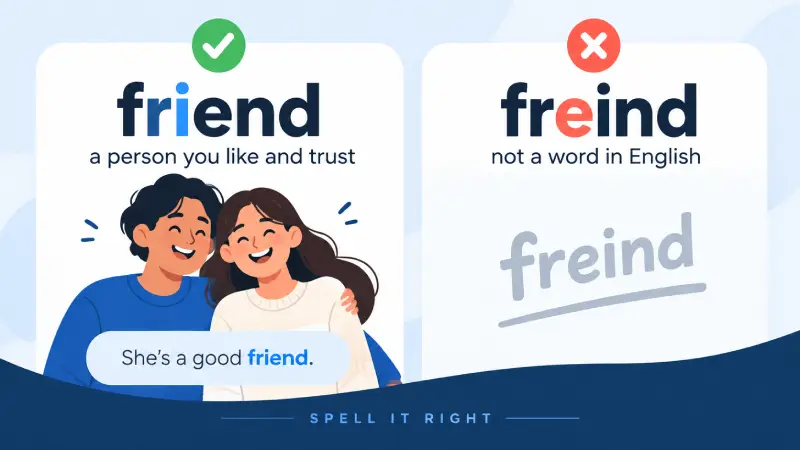
If you are wondering whether friend or freind is the correct spelling, the answer is clear: friend is the standard spelling in modern English, while freind is normally a misspelling.
The confusion comes from the two middle vowels. It is easy to accidentally reverse i and e, especially when typing quickly or relying on memory. The correct spelling is:
F-R-I-E-N-D = friend
Not:
F-R-E-I-N-D = freind
In this guide, you will learn the difference between friend and freind, what friend means, why freind is usually incorrect, how to remember the spelling, and how to use friend correctly in American English.
Updated: September 23, 2026
Quick Answer
Friend is the correct standard spelling.
Freind is normally an incorrect spelling of friend in modern English.
| Spelling | Status | Meaning |
|---|---|---|
| friend | Correct | A person you know and like, trust, or have a relationship with |
| freind | Incorrect in modern standard English | Usually a misspelling of friend |
Correct: She is my best friend.
Incorrect: She is my best freind.
Cambridge defines friend as a person you know well and like, usually someone who is not a member of your family.
Friend vs. Freind at a Glance
The main difference is simply the order of two letters.
| Feature | Friend | Freind |
|---|---|---|
| Standard modern spelling | Yes | No |
| Letter order | IE | EI |
| Meaning | A person you know and like or trust | No standard modern meaning as a spelling of friend |
| Formal writing | Correct | Avoid |
| School writing | Correct | Avoid |
| Business writing | Correct | Avoid |
| Texting and social media | Correct | Usually a typo |
| Pronunciation | /frend/ | Not a standard spelling |
| American English | friend | Incorrect |
The correct form is always:
FRIEND
The common mistake is:
FREIND
What Does Friend Mean?
Friend is primarily a noun. It describes someone you know and like, often someone with whom you have a relationship based on affection, trust, companionship, or mutual support.
For example:
- My friend called me yesterday.
- Sarah is my best friend.
- I met a new friend at college.
- He has been my friend for many years.
- My friends invited me to dinner.
Cambridge gives the basic American English meaning as a person you know well and like a lot, usually someone outside your family.
The word can describe many types of relationships, including:
- best friend
- childhood friend
- school friend
- college friend
- work friend
- close friend
- family friend
- online friend
What Does Freind Mean?
In contemporary standard English, freind is normally treated as a misspelling of friend.
For example:
Incorrect: My freind lives in Texas.
Correct: My friend lives in Texas.
The intended meaning is usually obvious, but the spelling is still incorrect in ordinary modern English.
There is a historical detail worth knowing: freind appears in older English texts as an obsolete or historical form, and it is also documented as a modern misspelling. That historical use does not make freind an acceptable modern spelling of the everyday word friend.
7 Powerful Differences Between Friend and Freind
1. Friend Is the Standard Spelling
The first and most important difference is that friend is the standard spelling used in modern English.
Use:
friend ✅
Avoid:
freind ❌
This applies to American English as well as other major varieties of modern English.
2. The Middle Letters Are Different
The two forms differ because the i and e have been switched.
Correct:
FR-I-E-N-D
Incorrect:
FR-E-I-N-D
The easiest thing to memorize is:
Friend has IE.
3. Friend Has a Clear Modern Meaning
Friend is a normal English word with several uses.
It can refer to:
- someone you know and like
- someone you trust
- a companion
- a supporter or ally
- a person connected with you on a social platform
Dictionary.com also records friend as both a noun and, in modern informal usage, a verb related to adding someone as a social-media contact.
4. Freind Is Usually a Spelling Error
If someone writes freind in a text, email, article, assignment, or social media post, the intended word is almost certainly friend.
For example:
❌ I met my new freind yesterday.
✅ I met my new friend yesterday.
The reader can understand the incorrect version, but it should still be corrected in polished writing.
5. Friend Works in Formal and Casual Writing
Unlike some words that have different formal and informal versions, friend works naturally in many contexts.
Casual:
My friend is coming over tonight.
Workplace:
A friend recommended this company to me.
Academic:
The author describes the character as a trusted friend.
Social media:
I just added a new friend.
The spelling remains friend in every case.
6. The Pronunciation Does Not Clearly Show the Spelling
One reason people make this mistake is pronunciation.
Friend is pronounced approximately /frend/ in American English.
The pronunciation does not clearly tell you that the written word contains i before e.
That makes it easy to remember the sound but accidentally reverse the letters when spelling.
7. Friend Has Several Related Forms
Once you remember friend, you can recognize several related words:
| Word | Meaning |
|---|---|
| friend | A person you know and like or trust |
| friends | More than one friend |
| friendship | The relationship between friends |
| friendly | Kind, pleasant, or welcoming |
| friendless | Without friends |
| befriend | To become or act as a friend to someone |
These forms all use the friend spelling pattern.
How Do You Spell Friend Correctly?
The correct spelling is:
F-R-I-E-N-D
A useful way to break it down is:
FRI + END = FRIEND
This gives you a simple visual memory aid:
FRI + END → FRIEND
You can also remember the phrase:
“Friends until the end.”
The important spelling pattern is:
FRIEND = IE
not:
FREIND = EI
Why Do People Spell Friend as Freind?
There are several reasons this mistake happens.
The I and E Are Easy to Reverse
The biggest reason is simply that the two vowels sit next to each other.
The correct order is:
I → E
A writer may accidentally type:
E → I
Pronunciation Can Be Misleading
Friend is pronounced /frend/, so the sound does not clearly remind you that an i appears in the written word.
English Has Inconsistent Spelling Patterns
English contains many words with different ie and ei patterns. Because of this, people sometimes remember the general spelling rule but apply it incorrectly.
The safest approach is to memorize the spelling of friend itself.
Friend vs. Freind Examples
Here are practical examples showing the correct form.
Example 1
Correct: He is my best friend.
Incorrect: He is my best freind.
Example 2
Correct: I called my friend after work.
Incorrect: I called my freind after work.
Example 3
Correct: She made several new friends at school.
Incorrect: She made several new freinds at school.
Example 4
Correct: My friendship with her has lasted for years.
Incorrect: My freindship with her has lasted for years.
Example 5
Correct: A friend recommended this restaurant.
Incorrect: A freind recommended this restaurant.
Example 6
Correct: We have been friends since childhood.
Incorrect: We have been freinds since childhood.
Common Friend Spelling Mistakes
The most common mistake is:
freind ❌
instead of:
friend ✅
But writers sometimes make other typing errors too.
| Incorrect | Correct |
|---|---|
| freind | friend |
| firend | friend |
| frined | friend |
| frend | friend |
| freindship | friendship |
| freinds | friends |
The key is to remember the sequence:
F-R-I-E-N-D
Friend, Friends, Friend’s, and Friends’ Explained
Another useful distinction involves the different forms of friend.
Friend
Use friend for one person.
My friend lives nearby.
Friends
Use friends for two or more people.
My friends are coming over.
Friend’s
Use friend’s when something belongs to one friend.
My friend’s car is outside.
Friends’
Use friends’ when something belongs to multiple friends.
My friends’ house is nearby.
| Form | Use | Example |
|---|---|---|
| friend | One person | My friend called. |
| friends | Two or more | My friends called. |
| friend’s | Belonging to one friend | My friend’s phone rang. |
| friends’ | Belonging to multiple friends | My friends’ phones rang. |
Friend as a Verb
Although friend is most commonly used as a noun, it can also function as a verb in modern English.
For example:
She friended me on social media.
This means she added or connected with me on a social platform.
Dictionary.com records this modern social-media use of friend as a verb.
Other forms include:
- friended
- friending
Examples:
He friended me yesterday.
They are friending people from their old school.
The spelling still begins with fri, not fre.
Friend in American English
For a US audience, the standard spelling is friend.
There is no American spelling variation that changes friend into freind.
So these are correct:
- American English: friend
- British English: friend
- Canadian English: friend
- Australian English: friend
The spelling does not change based on the English variety.
Friend in Texting and Social Media
People use friend frequently in casual digital communication.
Examples include:
- “My friend sent me this.”
- “I need to ask my friend.”
- “She is one of my closest friends.”
- “I just made a new friend.”
- “He friended me yesterday.”
Because texting is informal, people sometimes type freind accidentally. The context may make the meaning obvious, but the spelling is still normally considered a typo.
Friend in School and Workplace Writing
Correct spelling becomes especially important in polished writing.
School
My best friend helped me with the assignment.
College
The narrator describes his childhood friend.
Workplace
A friend of mine recommended your services.
Resume or professional profile
Collaborated with a former friend and business partner.
In all these situations, use friend, not freind.
Easy Ways to Remember Friend
Memory Trick 1: FRI + END
Think:
FRI + END = FRIEND
This is one of the easiest visual tricks because the letters FRI are followed by END.
Memory Trick 2: Friend Has IE
Look at the middle:
FRIEND
The vowels are:
I-E
not:
E-I
Memory Trick 3: “Friends Until the End”
Think:
FRIENDS UNTIL THE END
The phrase can help you remember that the word starts with FRI.
Memory Trick 4: Remember “Friday”
Another useful spelling cue is that both friend and Friday begin with fri:
FRIend
FRIday
Dictionary.com also suggests using Friday as a memory aid for remembering the i in friend.
Is Freind Ever Correct?
In ordinary modern English, friend is the spelling you should use.
Historical sources do contain freind as an older form, and dictionaries such as Wiktionary document historical examples.
However, this historical information does not change the practical answer for modern writing:
Use friend.
If you are writing an email, article, assignment, resume, social post, or message today, friend is the appropriate standard spelling.
Friend vs. Freind: Comparison Table
| Question | Friend | Freind |
|---|---|---|
| Correct modern spelling? | Yes | No |
| Standard English word? | Yes | Usually no |
| Refers to a companion? | Yes | No |
| Used in American English? | Yes | No |
| Used in formal writing? | Yes | No |
| Used in texting? | Yes | Only as a typo |
| Correct vowel order | IE | EI |
| Pronunciation | /frend/ | Not a standard modern spelling |
| Related word | friendship | freindship is incorrect |
Common Sentences With Friend
Here are some natural examples:
- My friend lives in New York.
- She has been my best friend since childhood.
- I met a new friend at college.
- My friends are coming over tonight.
- He introduced me to his closest friend.
- A friend gave me some helpful advice.
- Their friendship lasted for many years.
- She friended me on social media.
Common Questions About Friend vs. Freind
1. Is friend or freind correct?
Friend is the correct standard spelling in modern English. Freind is normally a misspelling.
2. How do you spell friend correctly?
The correct spelling is F-R-I-E-N-D.
3. Why do people spell friend as freind?
The i and e are easy to reverse, and the pronunciation /frend/ does not clearly reveal their order.
4. Is freind a real word?
In contemporary standard English, freind is normally treated as a misspelling of friend. Historical sources do contain the spelling, but it is not the standard spelling to use today.
5. Is friend spelled the same in American and British English?
Yes. Friend is the standard spelling in both American and British English.
6. What is an easy trick for spelling friend?
Remember:
FRI + END = FRIEND
You can also remember that friend begins with fri, just like Friday.
7. What is the plural of friend?
The plural is friends.
Example:
I have several good friends.
8. Can friend be used as a verb?
Yes. In modern digital communication, friend can be used as a verb meaning to add someone as a social-media connection.
Final Takeaway
When choosing between friend and freind, use friend.
The correct spelling is:
F-R-I-E-N-D
The common incorrect form is:
F-R-E-I-N-D
The easiest way to remember it is:
FRI + END = FRIEND
So whether you are writing a school assignment, work email, social media post, text message, or website article, choose friend. It is the standard modern spelling in American English and other major varieties of English.