
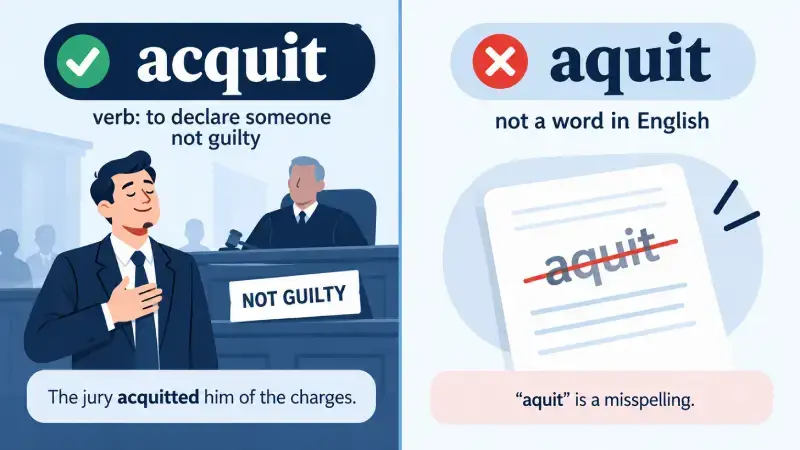
If you are wondering about “acquit vs. aquit,” the correct standard English spelling is acquit. Aquit is not the standard spelling of the English verb, so it should not be used when you mean “to find someone not guilty” or “to perform or behave in a particular way.”
Acquit vs. Aquit: The Quick Answer
Acquit is the correct word.
- Acquit , a standard English verb meaning to find someone not guilty of a crime or charge; it can also mean to conduct or perform oneself in a particular way.
- Aquit , a misspelling of acquit in standard modern English.
Correct: The jury decided to acquit the defendant.
Incorrect: The jury decided to aquit the defendant.
The confusion is understandable because the “c” in acquit is not pronounced as a separate sound. When people hear the word rather than see it written, “aquit” can seem like a logical spelling.
What Does “Acquit” Mean?
Acquit is a verb. Its most common meaning in American English is related to law: to officially decide that someone is not guilty of a criminal charge.
For example:
The jury acquitted the defendant after reviewing the evidence.
Here, acquitted means that the defendant was found not guilty.
The word can also be used outside a courtroom. In the expression “acquit oneself,” it means to behave, perform, or handle a situation in a particular way.
For example:
She acquitted herself well during the interview.
In this sentence, acquitted herself well means that she performed or conducted herself well.
Acquit as a legal term
In legal contexts, acquit has a specific function. A court or jury can acquit a defendant when the defendant is found not guilty.
The basic structure is:
acquit + person + of + charge
Examples:
- The jury acquitted him of the charges.
- The court acquitted the defendant of fraud.
- She was acquitted of all criminal charges.
- The judge ordered a new trial after the earlier conviction was overturned.
Notice that acquit normally takes a person as its object in this construction.
Acquit oneself
A different construction is:
acquit oneself + adverb/adverbial phrase
This means to perform or conduct oneself in a particular manner.
Examples:
- He acquitted himself well under pressure.
- The student acquitted herself admirably during the presentation.
- The new manager acquitted himself professionally during the negotiations.
This meaning is less common in everyday conversation than the legal meaning, but it remains standard English.
Why Is “Aquit” Wrong?
Aquit is generally a spelling error rather than an alternative form of acquit.
The standard spelling contains cc:
acquit
Breaking the spelling down visually:
a + c + quit = acquit
The word begins with acq-, followed by uit.
The spelling can be difficult because English pronunciation does not always make every written letter obvious. In acquit, the word is pronounced approximately uh-KWIT, so a listener may not perceive the written c clearly.
That creates a common spelling pathway:
acquit → heard as “uh-quit” → written as “aquit”
But pronunciation does not change the standard spelling.
Why does “acquit” have two c’s?
The spelling acquit is established English usage. The c belongs to the written form even though it does not represent a separate pronounced /k/ sound in the way a learner might expect.
The same general lesson applies to many English words: spelling cannot always be reconstructed reliably from pronunciation.
If you know the word means “find not guilty,” use acquit, not aquit.
When Is “Acquit” Correct?
Use acquit when you are talking about finding someone not guilty, especially in legal writing, journalism, or ordinary discussion of a criminal case.
1. Legal and courtroom writing
The jury voted to acquit the defendant.
The judge did not have the authority to acquit the accused without a trial.
Prosecutors presented additional evidence before the jury decided whether to convict or acquit him.
2. News and journalism
After two days of deliberation, the jury acquitted the former executive.
The defendant was acquitted of the most serious charges but convicted on a lesser offense.
The court acquitted her after determining that the prosecution had not proved its case.
3. Everyday conversation
I was surprised when the jury decided to acquit him.
They thought the evidence was strong enough to convict, but the jury acquitted the defendant.
If the court acquits her, she will not be convicted of that charge.
4. Formal or professional writing
The appellate court ultimately ordered proceedings that resulted in the defendant being acquitted.
The available evidence was insufficient to support a conviction, and the jury acquitted the defendant.
5. “Acquit oneself” in performance or conduct
Despite the difficult questions, Maya acquitted herself well during the interview.
The intern acquitted himself admirably during his first major presentation.
The candidate acquitted herself professionally throughout the debate.
Here, acquit has nothing to do with a criminal verdict. The phrase acquit oneself concerns someone’s conduct or performance.
Acquit vs. Aquit: Side-by-Side Comparison
| Feature | Acquit | Aquit |
|---|---|---|
| Standard English word? | Yes | No, as a standard spelling of this verb |
| Part of speech | Verb | — |
| Main meaning | Find someone not guilty | — |
| Other use | “Acquit oneself” = perform or conduct oneself | — |
| Common context | Law, journalism, formal writing, general English | Spelling error |
| Correct example | The jury acquitted him. | — |
| Recommended spelling | acquit | Avoid |
The important distinction is simple: these are not two words with different meanings. In standard English, acquit is the word you want.
Common Mistakes With Acquit and Aquit
Mistake 1: Dropping the first “c”
Wrong: The jury voted to aquit the defendant.
Right: The jury voted to acquit the defendant.
This is the most direct spelling error. The pronunciation makes the missing c easy to overlook.
Mistake 2: Writing “aquit” because it sounds right
Wrong: She was aquit of the charges.
Right: She was acquitted of the charges.
The sound of acquit can lead writers to spell it according to pronunciation. Remember that the written word contains cc.
Mistake 3: Confusing “acquit” with “acquired”
These words look somewhat similar at the beginning, but they have completely different meanings.
Acquit means to find someone not guilty or, in another construction, to conduct oneself.
Acquire means to obtain or gain something.
Correct:
The jury decided to acquit the defendant.
The company plans to acquire a smaller competitor.
A company can acquire an asset, but a jury can acquit a defendant.
Mistake 4: Confusing “acquit” with “convict”
These two legal verbs describe opposite outcomes.
To acquit someone is to find that person not guilty.
To convict someone is to find that person guilty of a crime.
Compare:
The jury acquitted the defendant.
The jury convicted the defendant.
This contrast is especially useful when proofreading legal or news writing.
Mistake 5: Using “aquit” in “acquit oneself”
The phrase is sometimes misspelled because writers remember only the sound.
Wrong: He aquitted himself well during the interview.
Right: He acquitted himself well during the interview.
The past tense is acquitted, with the spelling acquitt- before the ending.
How to Tell “Acquit” and “Aquit” Apart Fast
Use this simple memory trick:
AC + QUIT = ACQUIT
Think of the word as beginning with AC:
AC + QUIT → ACQUIT
If you are writing about a jury, judge, defendant, criminal charge, or a person’s performance, the standard spelling is acquit.
Another useful test is to ask:
Am I trying to write the verb meaning “find not guilty”?
If yes, write acquit.
For the past tense:
acquit → acquitted
Not:
aquit → aquitted
And for the noun:
acquittal
Not aquittal.
Acquit in Different Sentence Structures
Understanding how acquit behaves in a sentence can make the spelling easier to remember.
Acquit + object
The jury acquitted the defendant.
The defendant is the person receiving the legal action.
Acquit + object + of + charge
The jury acquitted the defendant of fraud.
This structure identifies the charge involved.
Passive voice
The defendant was acquitted of fraud.
This is extremely common in legal and news writing.
Acquit oneself + adverb
The candidate acquitted herself well.
Here, oneself refers back to the person performing the action.
These constructions demonstrate that acquit is a genuine verb with several established uses, not merely a word that appears in one fixed legal sentence.
Acquit vs. Acquittal vs. Acquitted
Another useful distinction is between the related forms of the same word.
Acquit
Acquit is the base-form verb.
The jury may acquit him.
Acquitted
Acquitted is the past tense and past participle.
The jury acquitted him.
He was acquitted of the charges.
Acquittal
Acquittal is a noun referring to the act or result of being acquitted.
The defendant’s acquittal came after a lengthy trial.
All three retain the acqu- spelling.
Real-World Contexts
Text message
Jordan: Did they convict him?
Alex: No. The jury acquitted him.
Jordan: Wow. I thought the evidence was stronger than that.
The spelling remains acquitted, even in an informal text.
Professional email
The court has acquitted the defendant of the charges. We will update the case summary to reflect the decision and remove the earlier provisional wording.
A formal email does not require a different spelling. Acquit is standard in both formal and informal contexts.
Article-style writing
After several hours of deliberation, the jury returned a verdict and acquitted the defendant on the criminal charges. Legal analysts noted that the decision turned on the prosecution’s failure to establish the required elements of the case beyond the applicable standard.
This is the kind of context where acquit frequently appears in journalism and legal reporting.
Related Confusions
Acquit vs. Convict
These are opposing legal terms. Acquit means to find someone not guilty, while convict means to find someone guilty.
The jury acquitted the defendant.
The jury convicted the defendant.
A person may be acquitted of one charge and convicted of another, so the words are not simply labels for a person’s overall legal status.
Acquit vs. Acquire
The words look somewhat alike but have unrelated meanings.
Acquit concerns a legal verdict or a person’s conduct.
Acquire means to get, obtain, or come into possession of something.
The court acquitted the defendant.
The company acquired the property.
A missing c can therefore create not just a spelling problem but confusion with another legitimate word.
Acquit vs. Acquittal
Acquit is a verb; acquittal is a noun.
The court acquitted the defendant.
The defendant’s acquittal was reported the following morning.
The spelling changes slightly because the grammatical form changes, but both begin with acqu-.
Acquit vs. Acquitted
Acquit is the base form, while acquitted is its past tense and past participle.
The jury may acquit the defendant.
The jury acquitted the defendant.
When writing in the past tense, do not create aquit + ed. The correct form is acquitted.
Are “Acquit” and “Aquit” Both Correct?
No. Aquit is not a standard alternative spelling of acquit in modern English.
If you are writing standard American English, use acquit for the verb. If you encounter aquit in someone’s writing, it is ordinarily best understood as a misspelling rather than a different grammatical form.
Is “Aquit” Ever Used in English?
You may encounter aquit as a typo, particularly because the pronunciation of acquit does not make the written c obvious.
However, seeing a spelling in informal online writing does not make it a standard English variant. For edited writing, schoolwork, professional communication, journalism, and published content, acquit is the appropriate form.
FAQs
Is “aquit” a word?
Not as the standard spelling of the English verb meaning “to find not guilty.” The correct spelling is acquit.
How do you spell “acquit” in past tense?
The past tense is acquitted.
The jury acquitted the defendant.
It is spelled with acquitt-, not aquitt-.
What does “acquit” mean?
Most commonly, acquit means to find someone not guilty of a criminal charge. It can also appear in acquit oneself, meaning to conduct or perform oneself in a particular way.
Is “acquitted” the same as “found guilty”?
No. Acquitted means found not guilty. It contrasts with convicted, which means found guilty.
Why is “acquit” spelled with a c?
The established English spelling is acquit, and the written c is part of the word even though its pronunciation does not make it obvious. Because the word sounds roughly like “uh-KWIT,” aquit is an understandable but nonstandard spelling.
Quick Reference: Acquit vs. Aquit
Acquit = correct standard spelling.
Aquit = misspelling.
Acquit is a verb meaning:
- to find someone not guilty of a charge
- to conduct or perform oneself, as in acquit oneself well
Correct
The jury decided to acquit the defendant.
She acquitted herself well during the interview.
He was acquitted of the charges.
Incorrect
The jury decided to aquit the defendant.
She aquitted herself well.
He was aquitted of the charges.
Bottom line: If you mean “find not guilty,” spell it acquit, with “acq,” not “aq.”
2 thoughts on “Acquit vs. Aquit: Which Is Correct? Meaning, Spelling & Usage”