
| Term | Meaning |
|---|---|
| OOC | Out Of Character (most common meaning) |
| Full Form | Out Of Character |
| Used In | Texting, gaming, roleplay, social media, fandom communities |
| Context | Describing behavior that does not match someone’s usual personality or a fictional character |
| Tone | Usually neutral, sometimes humorous or critical |
If you have seen OOC in a chat, gaming community, Reddit post, Discord server, or social media comment, you may wonder what it means. This short abbreviation is common online, but its meaning depends heavily on the situation where it appears.
The most common OOC definition is “Out Of Character.” People use this term when someone behaves differently from their normal personality or when a fictional character acts in a way that does not match their established personality.
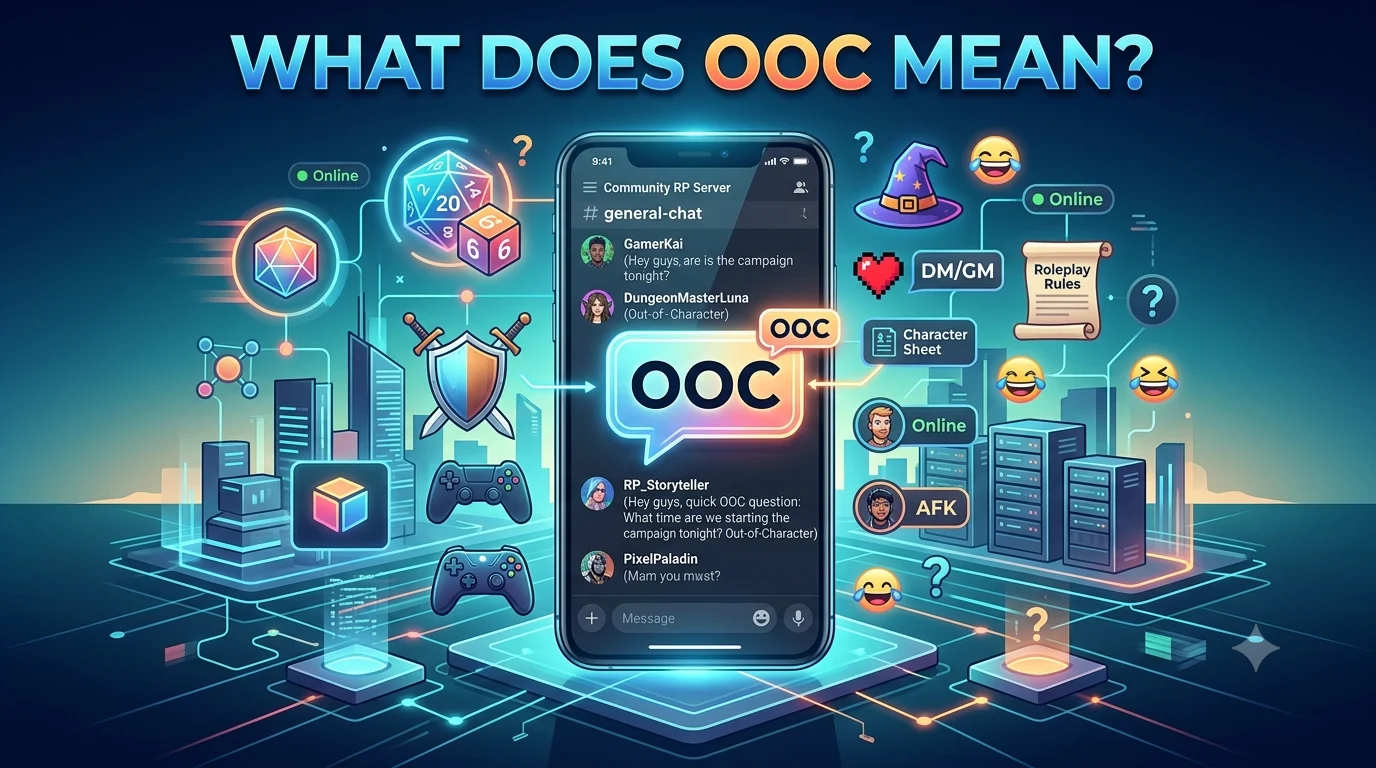
OOC is especially popular in online roleplay communities, gaming groups, and fan discussions. For example, a person playing a fictional character may say “OOC” before speaking as themselves instead of the character.
However, OOC can also mean other things, such as “Out Of Context,” depending on the conversation. Since internet abbreviations often have multiple meanings, understanding the surrounding discussion is important.
This guide explains what OOC means, how it is used in texting and social media, its different meanings, examples, related terms, and common misunderstandings.
What Does OOC Mean?
The most common meaning of OOC is “Out Of Character.”
The phrase describes something that does not match a person’s usual behavior, personality, or style.
It is commonly used in two situations:
- Talking about real people
- Talking about fictional characters
For example:
“That joke was so OOC for him.”
This means:
“That joke was unusual because he normally does not behave that way.”
In fictional worlds, OOC means a character is acting differently from how they are normally written.
Example:
A serious superhero suddenly acting silly might be described as OOC by fans.
Simple Explanation
Think of OOC as saying:
“Normally, this person or character would not do this.”
It highlights a change from expected behavior.
For example:
- A quiet person suddenly becoming extremely loud
- A serious character making unusual jokes
- A roleplayer speaking as themselves instead of their character
All of these situations can be described as OOC.
What Does OOC Mean in Texting, Slang, and Social Media?
The meaning of OOC changes depending on the online community.
OOC in Text Messages
In casual texting, people use OOC when someone does something surprising or unusual.
Examples:
- “You bought that? That’s totally OOC.”
- “Your reaction was OOC today.”
Here, the person means the action is different from what they normally expect.
OOC on Social Media
On platforms like Reddit, Twitter/X, TikTok, and Discord, OOC is often used in discussions about:
- Celebrities
- Fictional characters
- Movies
- TV shows
- Books
- Online personalities
Example:
A fan writes:
“This scene feels OOC for the main character.”
Meaning:
“This scene does not match how the character usually behaves.”
OOC in Gaming and Roleplay
OOC is extremely common in roleplay communities.
In roleplay, people act as fictional characters. The opposite of OOC is IC, which means In Character.
Example:
IC: A wizard character speaking to another wizard in a fantasy world.
OOC: The real player saying, “I need to leave now.”
Players use OOC to separate real-life communication from roleplay.
Example:
“OOC: I have to go, I’ll continue later.”
This tells others that the message is from the actual person, not the character.
Other Meanings of OOC
Although Out Of Character is the most common meaning, OOC can represent other phrases.
Out Of Context
In some online conversations, OOC means Out Of Context.
This is used when something is shown without the information needed to understand it.
Example:
“This quote is hilarious OOC.”
Meaning:
“This quote is funny when taken out of its original situation.”
Out Of Control
In some informal conversations, OOC may mean Out Of Control.
Example:
“The party was completely OOC.”
Meaning:
“The party became wild or uncontrolled.”
This meaning is less common online.
Organization or Technical Meanings
In professional environments, OOC may represent specific terms related to:
- Organizations
- Technology
- Business systems
- Industry-specific abbreviations
These meanings depend completely on the field.
How OOC Is Used in Real Conversations
OOC appears in many types of online communication.
Everyday Chat Usage
People may use OOC when someone behaves differently than expected.
Example:
Friend 1:
“Why did Jake sing in front of everyone?”
Friend 2:
“That was so OOC for him.”
The meaning is that Jake normally would not do that.
Online Communities
OOC is common in:
- Discord servers
- Gaming groups
- Fan communities
- Roleplay forums
- Reddit discussions
Users often add OOC before messages to clarify they are speaking personally.
Example:
“OOC: I won’t be online tomorrow.”
This prevents confusion between the player and the character.
Examples of OOC in Sentences
Here are some natural examples:
- “That behavior is completely OOC for her.”
- “The character’s decision felt OOC.”
- “OOC: I need to take a break from the game.”
- “His reaction was so OOC that everyone was surprised.”
- “Fans complained that the movie version was OOC.”
- “Sorry, speaking OOC for a moment.”
- “That comment is totally out of character.”
- “The villain becoming kind suddenly felt OOC.”
Tone and Intent of OOC
The meaning of OOC depends on how someone uses it.
Emotional Meaning
OOC can express:
- Surprise
- Confusion
- Humor
- Criticism
- Observation
Someone may use it positively or negatively.
Example:
Positive:
“Seeing him dance was OOC but adorable.”
Negative:
“That scene was OOC and ruined the character.”
Positive, Negative, or Neutral?
OOC itself is neutral.
The feeling comes from the situation.
Positive use:
- Someone trying something new
- A funny personality change
- A surprising moment
Negative use:
- Poor character writing
- Unexpected behavior
- Actions that feel unrealistic
Serious vs Sarcastic Usage
People often use OOC jokingly online.
Example:
“My cat sleeping all day is so OOC.”
This is humorous because sleeping is actually normal for cats.
The meaning depends on the context and tone.
Origin and Background of OOC
The term Out Of Character existed before modern social media.
It was first commonly used in:
- Acting
- Theater
- Writing
- Roleplaying
Actors and writers used the phrase to describe behavior that did not match a character.
As online roleplaying communities grew, OOC became a standard internet abbreviation.
Gaming forums, chat rooms, and fandom groups helped spread the term.
Today, OOC is widely recognized across many online spaces.
Is OOC Rude or Inappropriate?
No, OOC is generally not rude.
It is simply a way to describe behavior or communication.
However, the way it is used can affect how it sounds.
For example:
Friendly:
“That’s so OOC for you!”
This may sound playful.
Critical:
“This character is completely OOC.”
This may be criticism.
The abbreviation itself is harmless, but the message around it matters.
When NOT to Use OOC
OOC is mostly an informal internet term.
Avoid using it in:
- Business emails
- Professional reports
- Academic writing
- Formal communication
Instead, use clearer phrases like:
- “Out of character”
- “Unusual behavior”
- “Different from normal”
Avoiding Confusion
Some people may know OOC as “Out Of Context” rather than “Out Of Character.”
If your audience is unfamiliar with internet slang, explain the meaning.
Similar and Related Slang Terms
IC (In Character)
IC is the opposite of OOC.
It means someone is speaking or acting as their character.
IRL (In Real Life)
IRL refers to the real world outside the internet.
Example:
“I know him online but haven’t met him IRL.”
Out of Context
This means something is shown without its original background.
Breaking Character
This means someone stops acting like their fictional character.
OOC vs Related Terms
OOC vs IC
- OOC = Speaking as yourself
- IC = Speaking as your character
IT vs Out Of Context
- OOC = Usually “Out Of Character”
- Out Of Context = Missing background information
OOC vs IRL
- OOC separates character and player
- IRL refers to real-world situations
IT vs Breaking Character
- OOC describes being outside the character
- Breaking character means suddenly stopping the role
Comparison Table
| Term | Meaning | Usage | Key Difference |
|---|---|---|---|
| OOC | Out Of Character | Gaming, roleplay, fandoms, chats | Not acting or speaking as a character |
| IC | In Character | Roleplay communities | Acting as the fictional character |
| IRL | In Real Life | Online conversations | Refers to real-world life |
| Out Of Context | Missing background information | Social media discussions | Something removed from its original situation |
| Breaking Character | Stopping a role | Acting and roleplay | Leaving the character behavior |
Common Misunderstandings
Because OOC has multiple meanings, confusion is common.
Confusing OOC With Out Of Context
Some users think OOC always means “Out Of Context.”
The correct meaning depends on the conversation.
Thinking OOC Is Always Negative
OOC is not automatically criticism.
It can simply describe something unusual.
Using OOC Without Explanation
People unfamiliar with online slang may not understand it.
Confusing Player and Character
In roleplay, OOC helps separate the real person from the fictional character.
Frequently Asked Questions
What does OOC mean in texting?
OOC usually means “Out Of Character” and describes unusual behavior or speaking as yourself instead of a character.
What does OOC mean in roleplay?
In roleplay, OOC means a person is communicating as themselves rather than pretending to be their character.
Is OOC a slang term?
Yes, OOC is commonly used as internet slang.
What is the difference between IC and OOC?
IC means In Character, while OOC means Out Of Character.
Can OOC mean Out Of Context?
Yes, in some situations OOC can mean Out Of Context, but Out Of Character is the most common online meaning.
Where is OOC commonly used?
OOC is popular in gaming, Discord, Reddit, social media, and fandom communities.
Is OOC rude?
No, OOC is not rude. Its meaning depends on how it is used.
Why do people use OOC?
People use OOC to clarify whether they are speaking personally or acting as a character.
conclusion
OOC most commonly means “Out Of Character.” It is used online to describe behavior, comments, or actions that do not match someone’s usual personality or a fictional character’s expected behavior.
The term is especially popular in gaming, roleplay, fandom communities, and social media conversations. While OOC can have other meanings like “Out Of Context,” the surrounding conversation usually reveals the correct definition.
Understanding the context behind abbreviations like OOC makes online communication easier and helps avoid confusion.