
Updated: October 25, 2026
If you have noticed a dash (—, –, or -) in a text message, you may wonder what the sender is trying to communicate. A dash can indicate a pause, connect ideas, show an interruption, add emphasis, or separate information. Its meaning depends on the type of dash, the sentence, and the conversation.
Unlike common texting abbreviations such as LOL, BRB, and IDK, a dash is a punctuation mark rather than a slang term. However, people often use it creatively in texting and social media to express their thoughts and make messages sound more natural.
Quick Answer: What Does a Dash Mean in Text Messages?
A dash in text messages usually indicates a pause, interruption, change of thought, or emphasis. It can also connect related ideas or introduce additional information. In casual texting, a dash may make a message feel conversational, dramatic, thoughtful, or unfinished.
For example:
- “I wanted to go—but I was too tired.” The dash emphasizes a change or contrast.
- “Wait—I have something to tell you!” The dash creates a pause before an important point.
- “I thought you knew—” The dash may indicate that the message is unfinished or interrupted.
A dash does not have one universal meaning in texting. Read the complete message and consider the surrounding conversation before interpreting it.
What Is the Dash Symbol?
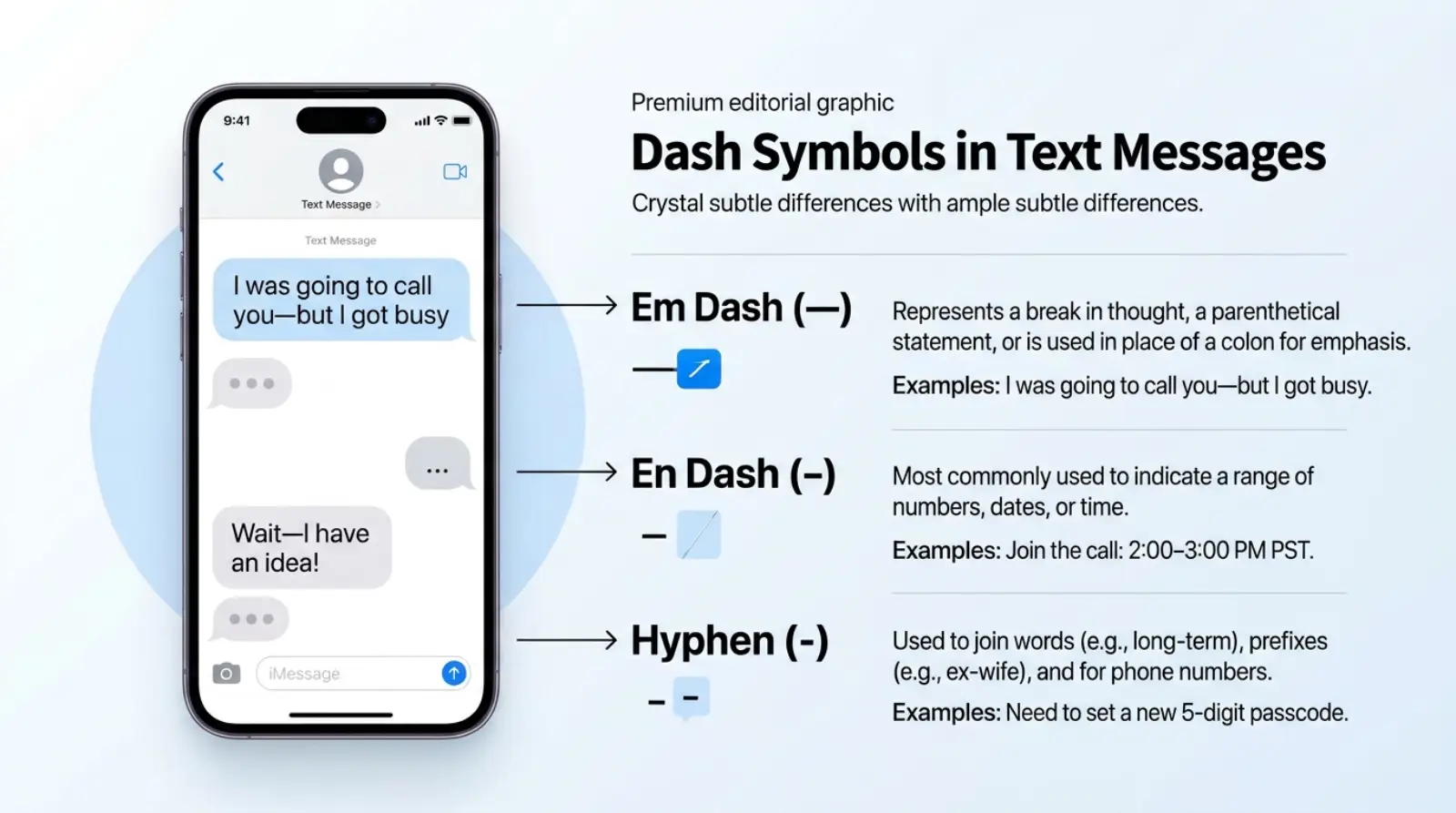
A dash is a punctuation mark used to connect, separate, or emphasize parts of a sentence. In digital communication, people use different dash-like marks, sometimes interchangeably.
Here are the three most common marks:
| Symbol | Name | Common Use |
|---|---|---|
| – | Hyphen | Connects words, as in “well-known” |
| – | En dash | Shows a range, as in “10–20 minutes” |
| — | Em dash | Creates a pause, interruption, or emphasis |
| … | Ellipsis | Suggests trailing thoughts, hesitation, or an unfinished message |
Although a hyphen and a dash may look similar on a phone screen, they serve different purposes in standard writing.
7 Common Meanings of a Dash in Text Messages
1. A Pause in the Conversation
One common use of a dash is to create a natural pause. The sender may want the reader to pause briefly before continuing to the next idea.
Examples:
- “I was thinking—we should meet tomorrow.”
- “You know what—I actually agree with you.”
- “I have an idea—let me explain.”
Meaning: The sender separates thoughts to make the message easier to follow or give the next phrase more attention.
2. An Interruption or Sudden Change of Thought
An em dash can show that a thought has been interrupted or replaced by another thought. It can make written conversation resemble spoken language.
Examples:
- “I was going to tell you—but never mind.”
- “Wait—I forgot something!”
- “I thought you were coming—oh, you already arrived.”
Meaning: The sender changes direction, interrupts the original thought, or introduces new information.
3. Emphasis on Important Information
A dash can highlight the words that follow it. This is especially common when someone wants the second part of a sentence to stand out.
Examples:
- “There is only one thing I need—your honesty.”
- “I finally found it—the perfect gift!”
- “Remember this—your time matters.”
Meaning: The sender emphasizes a particular point or adds a detail they consider important.
4. A Change in Direction or Contrast
A dash can introduce an unexpected result or contrast between two ideas.
Examples:
- “I wanted to stay—but I had to leave.”
- “It looked difficult—but it was actually easy.”
- “I planned to study—all I did was sleep.”
Meaning: The sender signals a shift in the sentence. The contrast may be serious, humorous, or casual.
5. An Unfinished Thought
When a message ends with a dash, it may indicate that the sender stopped mid-thought, was interrupted, or intended to continue.
Examples:
- “I was about to tell you—”
- “If you knew what happened—”
- “I thought we agreed on this—”
Meaning: The thought may be incomplete, and the sender might expect a response or intend to send more.
However, a message ending in a dash does not automatically mean the sender is angry, upset, or expecting you to guess something. Context matters.
6. A Dramatic or Playful Effect
Some people use dashes to create suspense, humor, or a dramatic reveal. This is common in informal chats, captions, and social media posts.
Examples:
- “Guess who I saw today—you!”
- “I have some news—and you’re going to love it.”
- “My biggest achievement today—getting out of bed.”
Meaning: The dash builds anticipation or makes the ending more noticeable.
7. Separating Extra Information
A dash can introduce an explanation, clarification, or additional detail.
Examples:
- “My brother—who lives in Texas—is visiting this weekend.”
- “I need three things—water, food, and rest.”
- “The plan is simple—meet at six and leave together.”
Meaning: The dash separates additional information from the main sentence, helping the reader understand the message.
What Does a Dash at the End of a Text Mean?
A dash at the end of a message can have several interpretations, depending on how the sender uses punctuation.
| Text Message | Possible Meaning |
|---|---|
| “I wanted to say something—” | An unfinished thought |
| “That’s what I meant—” | An emphasis or continuation |
| “Well, I guess—” | Hesitation or uncertainty |
| “I told you already—” | Emphasis, frustration, or a continuing thought |
| “And then he said—” | The sender may be about to quote someone |
Important: Punctuation alone cannot reliably reveal someone’s emotions or intentions. Consider their usual texting style and the conversation before deciding what the dash means.
Does a Dash in Texting Mean Someone Is Angry?
Not necessarily. A dash is not a standard symbol for anger, annoyance, or disappointment.
For example:
- Neutral: “I will call you later—probably around seven.”
- Excited: “Guess what—I got the job!”
- Frustrated: “I explained this already—and you still don’t understand.”
- Thoughtful: “Maybe we should talk—I have been thinking about it.”
The frustrated example sounds annoyed because of the words themselves, not simply because a dash appears.
If someone usually writes short messages without punctuation but suddenly sends a message with unusual punctuation, you might notice the change. Still, it is better to ask for clarification than to assume a particular emotion.
Dash vs. Hyphen vs. Ellipsis in Text Messages
A dash, hyphen, and ellipsis can look similar in casual messaging, but they have different functions.
| Punctuation | Symbol | Typical Meaning in Texting | Example |
|---|---|---|---|
| Hyphen | – | Connects words or parts of words | “part-time job” |
| En dash | – | Shows a range or connection | “Monday–Friday” |
| Em dash | — | Pause, interruption, emphasis | “I called—but no answer.” |
| Ellipsis | … | Trailing thought, hesitation, or omission | “I don’t know…” |
An ellipsis may sometimes make a message feel hesitant or suggestive, while an em dash often marks a sharper break in the thought. Neither punctuation mark has a fixed emotional meaning.
How to Reply When Someone Uses a Dash
You generally do not need to respond to the punctuation itself. Reply to the message’s meaning.
Here are some examples:
If the message seems unfinished:
- Sender: “I wanted to tell you—”
- Reply: “What were you going to say?”
If the dash introduces important news:
- Sender: “Guess what—I passed my exam!”
- Reply: “That’s amazing! Congratulations!”
If the message sounds unclear:
- Sender: “I thought we had an agreement—”
- Reply: “Can you explain what you mean?”
If you suspect frustration:
- Sender: “I already explained this—and you keep asking.”
- Reply: “Sorry, I may have misunderstood. Can we go over it once more?”
Responding to the actual words is usually more useful than trying to decode the punctuation alone.
Examples of Dash Symbols in Realistic Text Conversations
Example 1: Making a Plan
Alex: “We can meet tomorrow—if you’re free.”
Sam: “Sure! What time?”
Here, the dash introduces a condition.
Example 2: Expressing Surprise
Alex: “You won’t believe what happened—I won!”
Sam: “Seriously? That’s great!”
The dash emphasizes the surprising news.
Example 3: Changing the Subject
Alex: “I wanted to ask you something—but it’s not urgent.”
Sam: “Okay, go ahead.”
The dash separates the original thought from the clarification.
Example 4: Leaving a Thought Incomplete
Alex: “I thought you said you were going to—”
Sam: “Going to what?”
The dash suggests an interruption or unfinished statement.
Example 5: Adding Humor
Alex: “My weekend plans are exciting—sleeping for twelve hours.”
Sam: “Honestly, that sounds perfect.”
The dash sets up a humorous ending.
Why Do People Use Dashes Instead of Commas or Periods?
People often use dashes because they create a stronger break in a sentence than a comma and can feel less final than a period.
- Comma: Connects parts of a sentence with a lighter pause.
- Period: Marks the end of a sentence.
- Dash: Highlights a shift, interruption, explanation, or emphasized detail.
Compare these examples:
- “I was tired, so I went home.”
- “I was tired. I went home.”
- “I was tired—so I went home.”
All three communicate a similar basic idea, but the dash gives the final version a more conversational rhythm and stronger connection between the thoughts.
Frequently Asked Questions
What does a dash mean in a text from a girl?
A dash in a text from a girl does not have a special universal meaning. She may be using it to create a pause, emphasize a thought, show an interruption, or separate ideas. Interpret her message based on the words and context rather than her gender.
What does a dash mean in a text from a guy?
A dash in a text from a guy usually serves the same punctuation purposes as it does for anyone else. It may indicate a pause, an unfinished thought, or emphasis. It does not automatically mean he is annoyed, flirting, or hiding something.
What does two dashes mean in a text message?
Two consecutive dashes, such as --, may be a keyboard-friendly substitute for an em dash. Some people also use them to mark an interruption or create a dramatic pause. The intended meaning depends on the message.
What does a long dash mean in texting?
A long dash, usually an em dash (—), commonly marks a strong pause, a sudden change in thought, an interruption, or an emphasized explanation. In casual texting, it can make writing feel more expressive.
Is a dash in a text message rude?
No. A dash is not inherently rude. The wording, conversation, and sender’s communication style matter more than the punctuation mark itself.
Does a dash mean someone wants a reply?
Sometimes, particularly when a message ends with an unfinished thought. However, a dash does not automatically request a response. If the message is unclear, ask the sender what they meant.
What is the difference between a dash and three dots in texting?
A dash often signals a break, interruption, or shift in thought. Three dots, called an ellipsis, often suggest hesitation, a trailing thought, or omitted information. Both can convey different tones depending on context.
Can a dash change the meaning of a text?
Yes. A dash can affect emphasis, pacing, and how readers connect different parts of a sentence. However, it usually changes the tone or structure rather than creating an entirely new meaning.
Conclusion
The dash symbol meaning in text messages depends on how it is used. Most often, it signals a pause, interruption, change of thought, emphasis, or additional explanation. A dash at the end of a message may indicate an unfinished thought, but it does not automatically reveal anger, sadness, or any hidden intention.
To understand a dash correctly, read the full message, consider the surrounding conversation, and remember that people have different texting habits. The words themselves provide the most reliable clues to what the sender means.
2 thoughts on “Dash Symbol Meaning in Text Messages: 7 Clear Uses, Examples & What It Means (2026)”