
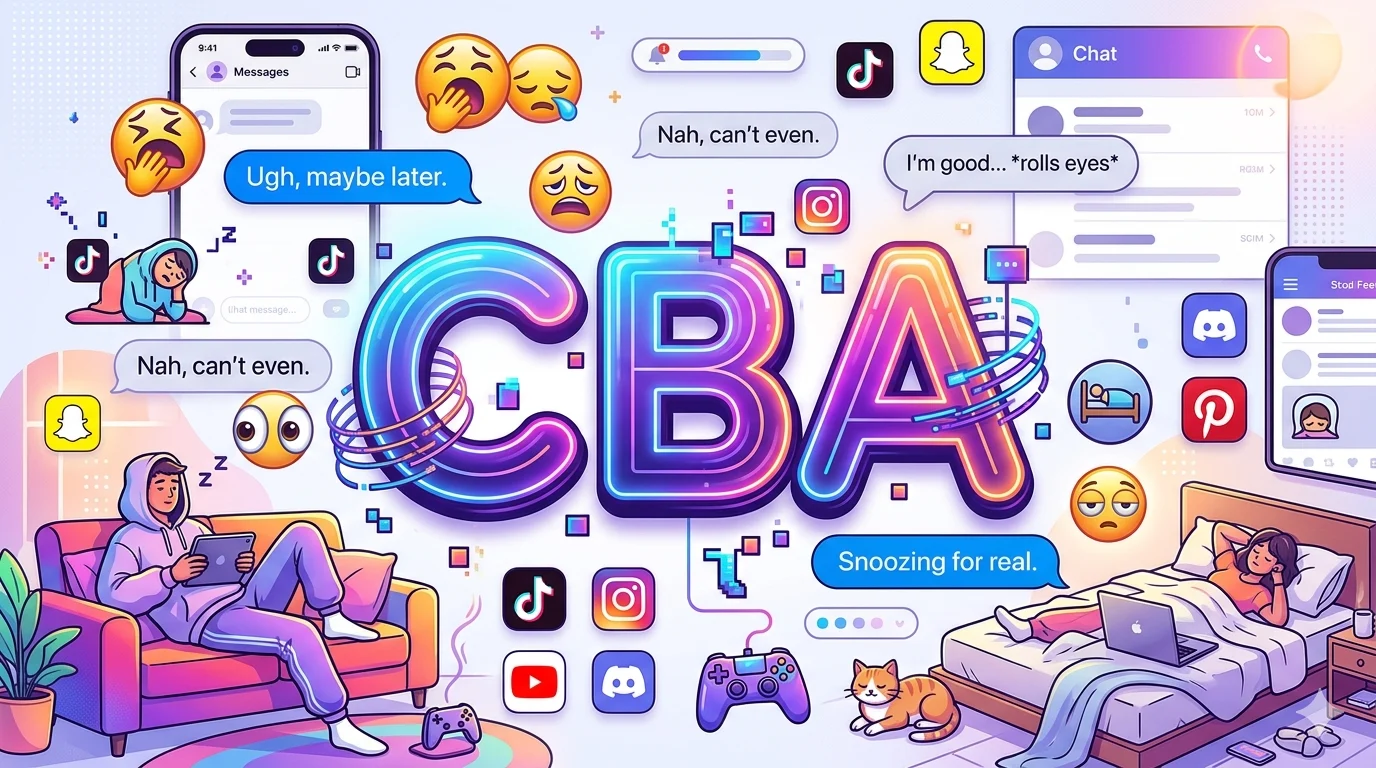
Meaning: CBA means “Can’t Be Asked,” a slang phrase used to show no interest or lack of motivation to do something.
Full Form: Can’t Be Asked (sometimes interpreted as “Can’t Be Bothered”).
Context: Text messages, social media posts, Snapchat, TikTok, and casual online chats.
Tone: Informal, lazy, dismissive, or relaxed depending on context.
If you’ve seen the term “CBA” in a text message, Snapchat chat, TikTok comment, or online conversation, you might be confused about what it means. At first glance, it looks like a random combination of letters, but in internet slang, CBA is a very common abbreviation used in casual communication. It is mainly used to express a lack of interest or motivation to do something.
In most cases, CBA stands for “Can’t Be Asked” or “Can’t Be Bothered.” People use it when they don’t feel like doing a task, replying to messages, or getting involved in something. Instead of typing a long explanation like “I don’t feel like doing it,” they simply write CBA to save time and keep the conversation short.
This slang is especially popular in texting culture, gaming chats, and social media platforms like TikTok, Snapchat, and Instagram. It is commonly used by younger audiences who prefer fast and simple communication. However, because it is informal, it may sound rude or dismissive depending on the situation.
Understanding the meaning of CBA helps you better interpret online conversations and avoid confusion when chatting in modern digital spaces.
What Does CBA Mean?
CBA most commonly stands for “Can’t Be Asked.”
In simple terms, it means someone does not want to do something because they feel lazy, unmotivated, or simply not interested.
It is often used as a quick reaction instead of a full explanation.
For example:
- “Do you want to go out?”
- “CBA.”
This shows the person does not feel like going.
In many cases, people also interpret CBA as “Can’t Be Bothered,” which carries the same meaning. Both versions are used interchangeably in casual conversation.
What Does CBA Mean in Texting, Slang, or Social Media?
Chat Meaning
In texting, CBA is used as a short response when someone doesn’t want to do something.
Examples:
- “Clean your room.”
- “CBA right now.”
- “Do you want to join the call?”
- “CBA, maybe later.”
It expresses laziness or lack of motivation in a quick way.
Social Media Usage
On platforms like TikTok, Snapchat, and Instagram, CBA appears in captions, comments, and replies.
Examples:
- “CBA going out today 😩”
- “CBA even replying anymore.”
- “CBA with this weather.”
It is commonly used to express mood or daily feelings.
Gen Z Context
Among Gen Z users, CBA is part of everyday slang used in fast, expressive communication. It fits well with short messages, emojis, and casual online tone. It is especially popular in British and informal English-speaking online communities.
Other Meanings of CBA
While slang usage is the most common, CBA can also mean different things in other contexts.
Cost-Benefit Analysis
In business or academic settings, CBA stands for Cost-Benefit Analysis, a method used to compare costs and advantages before making decisions.
Example:
- “We did a CBA before launching the project.”
Context Matters
The meaning of CBA depends completely on where it is used. In casual chats, it almost always means “Can’t Be Asked,” while in professional settings it usually refers to analysis or evaluation.
How CBA Is Used in Real Conversations
Everyday Situations
CBA is often used in daily life conversations about:
- Homework
- Chores
- Going out
- Responding to plans
Online Platforms
You will frequently see it on:
- TikTok captions
- Snapchat chats
- Instagram comments
- Gaming chats
- WhatsApp messages
Examples of CBA in Sentences
Here are natural examples of how people use CBA:
- “CBA getting out of bed today.”
- “Do you want to study?” “CBA honestly.”
- “CBA replying to all these messages.”
- “CBA going to the gym right now.”
- “CBA dealing with this drama.”
- “He asked me to help, but I said CBA.”
- “CBA cooking, let’s order food.”
- “CBA with everything today.”
These examples show how the term is used to express mood or lack of motivation.
Tone and Intent
Emotional Meaning
CBA usually reflects feelings like:
- Laziness
- Exhaustion
- Disinterest
- Lack of motivation
Positive, Negative, or Neutral?
CBA is generally neutral, but it can sound negative depending on tone.
For example:
- Neutral: “CBA, I’ll do it later.”
- Negative: “CBA with everything.”
Sarcasm vs Serious Use
Sometimes CBA is used jokingly among friends, especially when exaggerating laziness. In other cases, it is used seriously to show real disinterest.
Origin or Background
British Slang Origins
CBA is believed to have originated from British slang, where “can’t be asked” and “can’t be bothered” are common informal phrases.
Spread Through Internet Culture
With the rise of texting, forums, and social media, the abbreviation became widely used in online communication. It is now recognized in many English-speaking online communities.
Is CBA Rude or Inappropriate?
General Safety
CBA is not an offensive word. It is generally safe to use in casual conversations.
Context Matters
However, it can sound rude or dismissive if used without explanation, especially in serious or emotional conversations.
For example:
- “Can you help me?” → “CBA.” (may sound rude)
Adding context can make it softer and more polite.
When NOT to Use CBA
Formal Situations
Avoid using CBA in:
- Work emails
- School assignments
- Professional messages
- Formal communication
Sensitive Conversations
CBA should also be avoided when talking about important or emotional topics, as it may come across as careless.
Similar and Related Slang Terms
Related Abbreviations
- IDC (I Don’t Care)
- IDK (I Don’t Know)
- NVM (Never Mind)
- TBH (To Be Honest)
Similar Expressions
- Can’t be bothered
- Not in the mood
- Too lazy
- Not feeling it
CBA vs Related Terms
CBA is specifically about lack of motivation, while similar slang terms express different feelings.
- CBA → Not willing to make effort
- IDC → Lack of care or concern
- IDK → Lack of knowledge
- NVM → Canceling or dismissing a thought
Understanding these differences helps avoid confusion in conversations.
Comparison Table
| Term | Meaning | Usage | Key Difference |
|---|---|---|---|
| CBA | Can’t Be Asked | Shows lack of effort | Focus on laziness or disinterest |
| IDC | I Don’t Care | Expresses indifference | More emotional detachment |
| IDK | I Don’t Know | Shows uncertainty | About knowledge, not effort |
| NVM | Never Mind | Cancels statement | Used to dismiss something |
| Meh | Indifference | Casual reaction | Less direct than CBA |
Common Misunderstandings
Confusion With Business Meaning
Many people confuse CBA slang with “Cost-Benefit Analysis” used in business or economics.
Tone Misinterpretation
CBA can sometimes be misunderstood as rude when it is actually just casual shorthand.
FAQ Section
What does CBA mean in texting?
It means “Can’t Be Asked” or “Can’t Be Bothered.”
Is CBA rude?
Not usually, but it can sound dismissive depending on tone.
What does CBA mean on Snapchat or TikTok?
It is used to show laziness or lack of interest in doing something.
Is CBA British slang?
Yes, it is commonly used in British informal communication.
What is the difference between CBA and IDC?
CBA shows lack of effort, while IDC shows lack of care.
Can CBA be used professionally?
No, it is informal slang and not suitable for professional communication.
Is CBA still popular?
Yes, it is still widely used in texting and social media.
What does CBA stand for in business?
It stands for “Cost-Benefit Analysis.”
conclusion
CBA is a popular internet slang term that usually means “Can’t Be Asked” or “Can’t Be Bothered.” It is widely used in texting, social media, and casual conversations to show laziness, disinterest, or lack of motivation. While it is harmless in informal chats, it should be avoided in professional or serious situations. Understanding CBA helps you better interpret modern digital language and communicate more naturally online.