
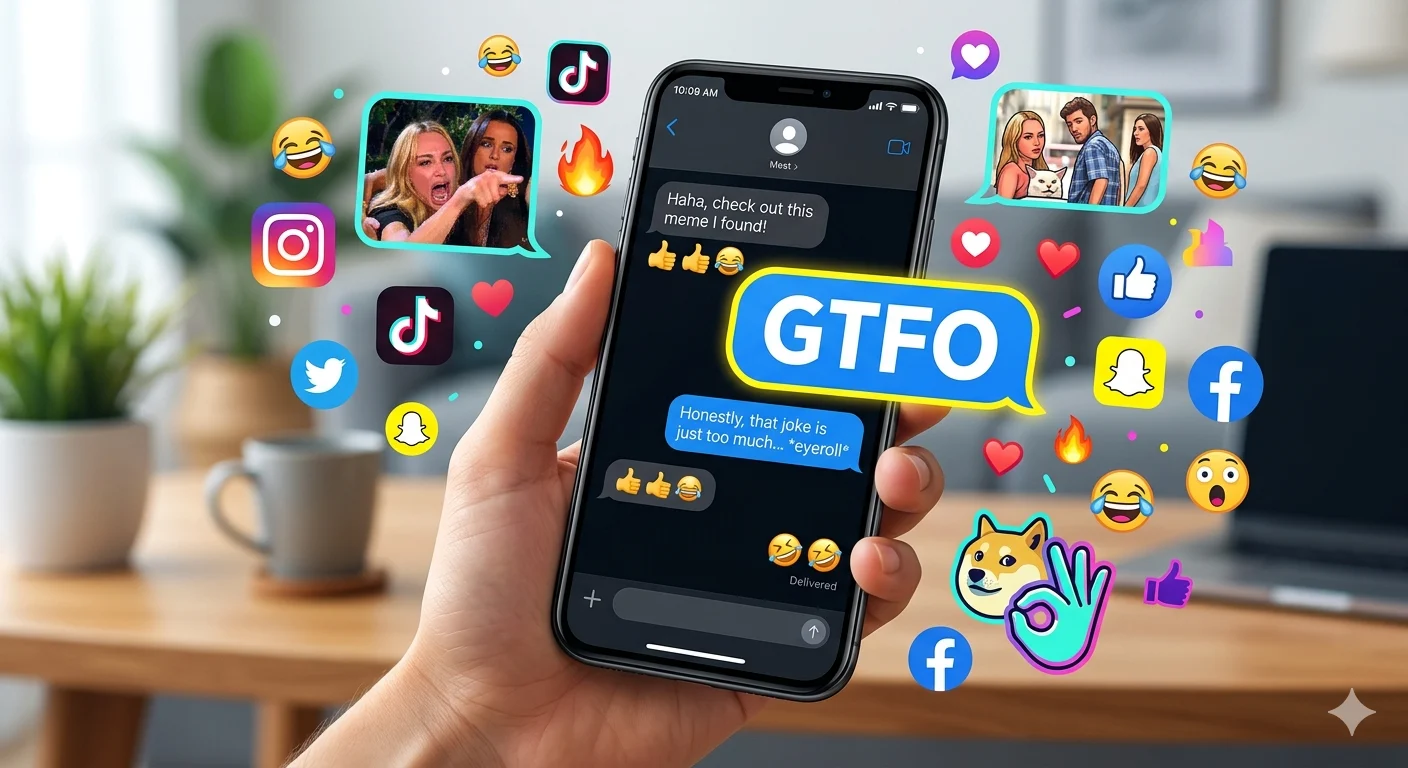
Meaning: GTFO is a popular internet slang abbreviation used to express disbelief, surprise, frustration, or a demand for someone to leave.
Full Form: Get The F*** Out.
Context: Texting, social media, memes, gaming, online chats.
Tone: Informal, emotional, humorous, surprised, or sometimes aggressive.
If you’ve spent time on social media, gaming platforms, forums, or group chats, you’ve probably seen the abbreviation GTFO. It is one of the most widely used internet slang terms and can carry several meanings depending on the situation. For people unfamiliar with online slang, GTFO may seem confusing because it can be used as both a serious statement and a playful reaction.
In its most basic form, GTFO stands for “Get The F*** Out.” While the phrase originally meant telling someone to leave, its modern internet usage has evolved significantly. Today, many people use GTFO to express shock, disbelief, amazement, or surprise rather than literally asking someone to go away.
Because the abbreviation contains profanity in its full form, it is generally considered informal slang. However, it remains extremely popular in memes, social media comments, gaming communities, and online conversations. Depending on the context, GTFO can sound funny, excited, sarcastic, or even angry.
Understanding the GTFO meaning can help you better interpret online conversations and avoid misunderstandings. In this guide, you’ll learn what GTFO means, how people use it, where it came from, examples of real-life usage, and when it may be inappropriate to use.
What Does GTFO Mean?
Core Definition
GTFO stands for “Get The F*** Out.”
Traditionally, the phrase was used as a forceful way of telling someone to leave a place. However, internet culture has expanded its meaning.
Today, GTFO often expresses:
- Surprise
- Disbelief
- Amazement
- Shock
- Frustration
- Excitement
Simple Explanation
In simple terms, GTFO usually means:
“You’re kidding me!”
“No way!”
“That’s unbelievable!”
For example:
“My friend won a million dollars.”
Response:
“GTFO! Seriously?”
In this case, the speaker is expressing surprise rather than telling someone to leave.
What Does GTFO Mean in Texting, Slang, and Social Media?
Chat Meaning
In texting, GTFO often appears when someone hears surprising news.
Examples include:
- Unexpected achievements
- Shocking stories
- Amazing events
- Funny situations
Friends commonly use GTFO to react emotionally during conversations.
Social Media Usage
On social media platforms, GTFO appears in:
- Instagram comments
- TikTok reactions
- Facebook discussions
- X replies
- Reddit threads
Users often write GTFO when reacting to unbelievable videos, celebrity news, viral content, or surprising announcements.
Example:
“You met your favorite celebrity?”
“GTFO! That’s amazing.”
Gen Z and Internet Culture
GTFO remains popular among younger internet users because it conveys strong emotions quickly.
Many memes use GTFO as a reaction phrase because it communicates disbelief in only four letters.
The abbreviation also appears frequently in gaming culture and online communities where fast communication is important.
Other Meanings of GTFO
Although “Get The F*** Out” is by far the most common meaning, GTFO can occasionally have different interpretations depending on the context.
Some users may use it as:
- A humorous reaction
- An expression of disbelief
- A way to reject an idea
- A joking response between friends
In nearly all online conversations, however, GTFO relates to the main slang meaning.
How GTFO Is Used in Real Conversations
Everyday Situations
People use GTFO in many situations, including:
- Hearing surprising news
- Reacting to achievements
- Expressing disbelief
- Responding to unbelievable stories
- Showing frustration
For example:
Friend: “I got free concert tickets.”
You: “GTFO! How did that happen?”
Popular Platforms
GTFO is common on:
- TikTok
- Discord
- X
- Gaming chats
- Online forums
Its popularity comes from its ability to express strong reactions quickly.
Examples of GTFO in Sentences
Here are some natural examples:
- “GTFO, you actually won the competition?”
- “That plot twist was insane. GTFO.”
- “GTFO, that’s the funniest thing I’ve heard all day.”
- “You met the actor in person? GTFO!”
- “GTFO with those excuses.”
- “The game just gave me a legendary item. GTFO!”
- “GTFO, I can’t believe that happened.”
- “GTFO, that’s incredible news.”
These examples show how tone changes based on context.
Tone and Intent
Emotional Meaning
GTFO is often used to communicate strong emotions.
These may include:
- Shock
- Excitement
- Disbelief
- Frustration
- Amazement
The abbreviation helps users react instantly without writing long explanations.
Positive, Negative, or Neutral?
GTFO can be positive or negative depending on the situation.
Positive Examples:
- Surprise at good news
- Amazement at achievements
- Excitement over success
Negative Examples:
- Anger
- Rejection
- Frustration
The surrounding conversation determines the emotional tone.
Sarcasm vs Serious Usage
GTFO is frequently used sarcastically.
Serious Example:
“GTFO! You really got the job?”
Sarcastic Example:
“GTFO with that terrible excuse.”
Understanding tone is essential when interpreting the abbreviation.
Origin and Background
Where It Came From
GTFO emerged during the early years of internet communication and online chatrooms.
Users created abbreviations to communicate quickly while typing. GTFO became popular because it condensed a longer phrase into four easy-to-type letters.
The abbreviation spread through:
- Online forums
- Chat rooms
- Multiplayer games
- Message boards
Growth in Popularity
As social media expanded, GTFO became part of mainstream internet slang.
Memes, viral videos, and gaming communities helped introduce the abbreviation to millions of users.
Today, it remains one of the most recognized reaction phrases online.
Is GTFO Rude or Inappropriate?
General Acceptability
GTFO contains profanity in its full form, so it can be considered offensive in certain situations.
Among friends and online communities, it is often viewed as casual slang.
However, not everyone appreciates strong language.
Situations to Be Careful About
Avoid using GTFO with:
- Employers
- Teachers
- Clients
- Professional contacts
- Formal audiences
What feels humorous to one person may seem rude to another.
Always consider your audience before using the term.
When NOT to Use GTFO
Formal Communication
GTFO should not be used in:
- Business emails
- Academic papers
- Professional reports
- Job applications
- Official communications
Its slang nature makes it unsuitable for formal environments.
Incorrect Contexts
Avoid GTFO when:
- Speaking with people who dislike profanity
- Communicating professionally
- Writing formal content
- Interacting with younger children
Safer alternatives are often a better choice.
Similar and Related Slang Terms
Common Alternatives
Several internet slang expressions communicate similar reactions:
- OMG (Oh My God)
- WTF (What The F***)
- No Way
- Seriously?
- BRUH
- SMH
Each expresses surprise or disbelief in different ways.
Related Internet Reactions
Modern internet culture includes many reaction phrases:
- Mind blown
- Unreal
- That’s crazy
- You’re kidding
- Impossible
These alternatives can be used when stronger language is inappropriate.
GTFO vs Related Terms
Key Differences
GTFO is stronger and often more emotional than many alternatives.
OMG expresses surprise.
WTF expresses confusion or shock.
BRUH often communicates disbelief or disappointment.
GTFO combines surprise, disbelief, and strong emotional emphasis.
Comparison Table
| Term | Meaning | Usage | Key Difference |
|---|---|---|---|
| GTFO | Get The F*** Out | Surprise, disbelief, rejection | Strongest emotional impact |
| OMG | Oh My God | Surprise and excitement | More family-friendly |
| WTF | What The F*** | Shock or confusion | Focuses on confusion |
| BRUH | Expression of disbelief | Casual reactions | Less intense |
| SMH | Shaking My Head | Disappointment | Expresses disapproval |
Common Misunderstandings About GTFO
Frequent Confusions
Many people assume GTFO always means “leave immediately.”
While that is the original meaning, modern internet users often employ it as a reaction to surprising information.
Misuse Examples
Incorrect assumption:
“GTFO always means an insult.”
Correct understanding:
“GTFO can be playful, surprised, humorous, or aggressive depending on context.”
The tone of the conversation determines its meaning.
FAQ About GTFO
What does GTFO stand for?
GTFO stands for “Get The F*** Out.”
Is GTFO offensive?
It can be, because its full form contains profanity.
Is GTFO used as a joke?
Yes. Many people use it humorously to express surprise.
Can GTFO mean disbelief?
Yes. That is one of its most common modern meanings.
Is GTFO common on social media?
Yes. It appears frequently on major social platforms.
Can GTFO be used in gaming chats?
Yes. Gamers use it regularly to react to surprising events.
Is GTFO appropriate for work?
No. It is generally considered too informal and potentially offensive.
What is the difference between GTFO and OMG?
GTFO is stronger and contains profanity, while OMG is more family-friendly.
Why do people use GTFO online?
It expresses strong emotions quickly and efficiently.
Are there safer alternatives?
Yes. Alternatives include OMG, No Way, Seriously, and That’s Crazy.
conclusion
GTFO is a popular internet slang abbreviation that stands for “Get The F*** Out.” While it originally meant telling someone to leave, modern online culture often uses it to express shock, disbelief, excitement, amazement, or frustration. It is common in texting, gaming, memes, and social media conversations where people react to surprising information.
Because the phrase contains profanity, GTFO should be reserved for casual settings and avoided in professional communication. Understanding the GTFO meaning helps you interpret online conversations correctly and use the term appropriately based on your audience and situation.