
Updated: October 24, 2026
Have you come across the word “copacetic” in a conversation, book, or social media post and wondered what it means? Copacetic means fine, satisfactory, or going well. It is an informal American English word people use to describe a situation where everything is okay or working out as expected. For example, if someone says, “Everything is copacetic,” they mean that everything is fine. Although the word can sound a little old-fashioned, it remains a useful way to express that things are in good shape.
Quick Answer: What Does Copacetic Mean?
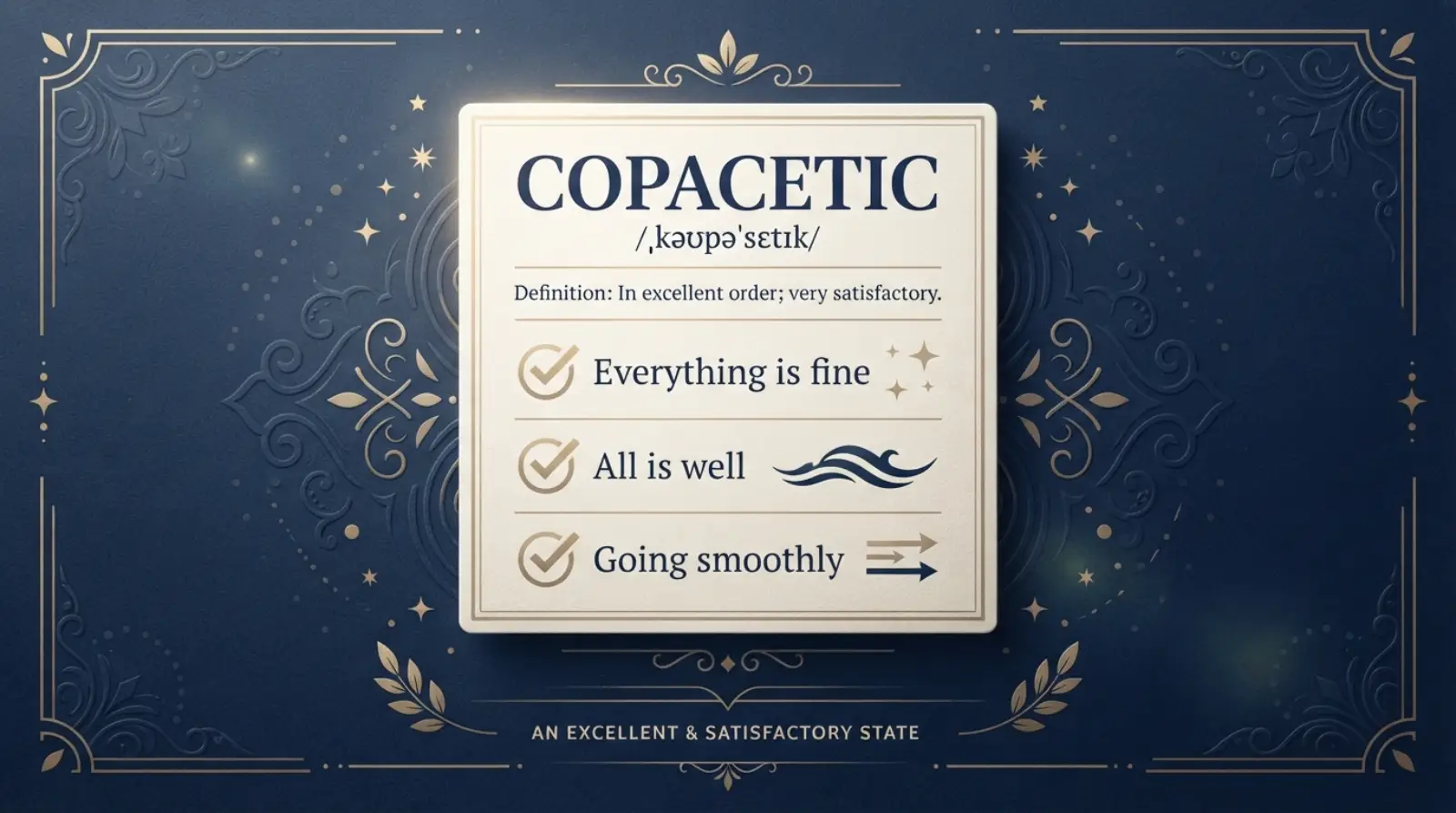
Copacetic means fine, satisfactory, or going very well. It is an informal American English adjective used to describe a situation, relationship, plan, or condition that is acceptable or in good order.
For example, if someone asks, “Is everything copacetic?” they are asking whether everything is okay or going smoothly.
The word is sometimes considered old-fashioned, but it remains recognizable in American English. It can sound playful, distinctive, or slightly humorous compared with everyday words such as “fine” and “good.” Cambridge Dictionary labels it an informal, old-fashioned US expression meaning very good or going very well.
What Does Copacetic Mean in Simple Words?
In simple terms, copacetic means “all good.” When something is copacetic, there are no significant problems, everything is satisfactory, or the situation is working out well.
For example:
- “Everything is copacetic.” means everything is fine.
- “Our plans are copacetic.” means the plans are satisfactory.
- “The situation is copacetic now.” means the situation is under control or going well.
The exact strength of the word depends on the context. Sometimes it means that something is merely okay; in other situations, it suggests that everything is excellent or running smoothly.
Copacetic is an adjective, so it describes a person’s circumstances, a relationship, an arrangement, or another noun. It is not an abbreviation or an acronym.
Copacetic Meaning and Definition
Copacetic (adjective): satisfactory, fine, agreeable, or in excellent order.
The word is most strongly associated with informal American English. It can describe something that meets expectations, a situation without obvious problems, or an arrangement that works well for everyone involved.
Consider these examples:
- “The schedule is copacetic.” The schedule works well.
- “Things are copacetic between us.” The relationship is fine.
- “The deal sounds copacetic.” The deal seems acceptable.
- “Everything was copacetic after the misunderstanding.” The situation returned to normal.
The word does not necessarily mean that something is perfect. A copacetic arrangement may simply be good enough, satisfactory, and free of major concerns.
7 Copacetic Examples in Everyday English
Here are seven original examples showing how Americans might use copacetic in different situations.
1. Everything Is Fine
“Don’t worry about the arrangements. Everything is copacetic.”
Meaning: All the arrangements are satisfactory, and there is no major problem.
This is a natural example of the phrase “everything is copacetic,” which reassures someone that things are under control.
2. A Relationship Is Going Well
“After they talked through the disagreement, things were copacetic between them again.”
Meaning: Their relationship returned to a peaceful or satisfactory state.
Copacetic can describe the condition of a friendship, partnership, or other relationship.
3. A Work Plan Is Acceptable
“The revised schedule looks copacetic to the entire team.”
Meaning: The team considers the schedule acceptable and workable.
In a workplace conversation, copacetic can communicate agreement without sounding overly formal.
4. A Problem Has Been Resolved
“The payment issue is fixed, so everything should be copacetic now.”
Meaning: The problem has been resolved, and the situation should be fine.
This usage is helpful when reassuring someone after a minor complication.
5. Someone Is Satisfied With an Arrangement
“I’m copacetic with the new meeting time.”
Meaning: I’m fine with the new meeting time or find it acceptable.
Although this construction is understandable, “I’m fine with the new meeting time” is more common in everyday conversation. Copacetic gives the sentence a more distinctive, informal tone.
6. A Plan Is Going Smoothly
“The road trip was copacetic until we ran out of gas.”
Meaning: The trip was going well until a problem occurred.
This example shows how copacetic can describe an experience that is proceeding smoothly.
7. A Situation Is Under Control
“The manager checked the final report and confirmed that everything was copacetic.”
Meaning: The manager found the report satisfactory and did not identify a significant issue.
This usage emphasizes that things are in order rather than necessarily outstanding.
What Does “Everything Is Copacetic” Mean?
The expression “everything is copacetic” means “everything is fine,” “all is well,” or “everything is in order.”
It is often used to reassure someone, confirm that an arrangement is acceptable, or indicate that a problem has been resolved.
Examples:
- “I checked the reservations, and everything is copacetic.”
- “We had a small disagreement, but everything is copacetic now.”
- “The technician finished the repairs, so everything should be copacetic.”
The phrase can sound relaxed, old-fashioned, or playful. It is usually more expressive than simply saying “okay,” but it is not necessarily more formal or more enthusiastic.
Is Copacetic Slang?
Yes, copacetic is commonly described as informal American slang, although dictionaries also classify it as an adjective.
It is not internet slang that originated with modern social media. The word has been used in American English for more than a century and is associated with casual speech.
Today, someone might use it to sound conversational, colorful, humorous, or deliberately old-fashioned.
For example:
Person A: “Are we still good for Saturday?”
Person B: “Yep, everything’s copacetic.”
In this exchange, the speaker means that the plans are still fine.
However, copacetic is less common than everyday expressions such as “all good,” “fine,” and “no problem.” It may sound unusual in a formal report, business contract, or academic paper.
How to Pronounce Copacetic
Copacetic is pronounced:
koh-puh-SET-ik
The word has four syllables: co-pa-cet-ic, with the main stress on SET, the third syllable.
A simple way to practice is to say it slowly first:
- koh
- puh
- SET
- ik
Then combine the syllables: “koh-puh-SET-ik.”
The pronunciation can vary slightly between speakers, but the main stress falls on the third syllable in standard American English pronunciation.
What Is the Origin of Copacetic?
Copacetic is an American English word first recorded in the early twentieth century, with documented examples dating to around 1919. Its exact origin, however, remains uncertain.
Several explanations have been proposed, including possible connections to French, Italian, Hebrew or Yiddish, and Indigenous languages. These theories have not established a generally accepted origin.
The word is also associated with African American speech in the United States, particularly historical Southern usage. Entertainer Bill “Bojangles” Robinson is sometimes credited with popularizing it, but that does not establish that he invented it.
The most accurate explanation is that copacetic is an American slang term of uncertain origin. Claims that it definitely comes from a particular language should be treated cautiously.
Copacetic Synonyms: What Words Mean the Same Thing?
The best synonym depends on whether you mean that something is acceptable, satisfactory, or exceptionally good.
| Synonym | Meaning | Example |
|---|---|---|
| Fine | Acceptable or okay | “Everything is fine.” |
| Good | In a positive condition | “The plan is good.” |
| Satisfactory | Meets expectations | “The result is satisfactory.” |
| Excellent | Extremely good | “The service was excellent.” |
| Agreeable | Acceptable or pleasant | “The arrangement is agreeable.” |
| Smooth | Happening without difficulty | “The process went smoothly.” |
| All right | Acceptable or in order | “We’re all right now.” |
| Okay | Acceptable or satisfactory | “The new schedule is okay.” |
| Hunky-dory | Informally, perfectly fine | “Everything is hunky-dory.” |
| In order | Correct or properly arranged | “All the documents are in order.” |
Best everyday alternatives: “fine,” “all good,” and “okay.”
Best alternatives for formal writing: “satisfactory,” “acceptable,” and “in good order.”
Best playful alternative: “hunky-dory.”
Copacetic can cover both “acceptable” and “very good,” so choose a synonym that matches the strength of your intended meaning.
Copacetic vs. Fine vs. Hunky-Dory
These expressions overlap, but they do not sound exactly the same.
| Word or Phrase | Main Meaning | Tone |
|---|---|---|
| Copacetic | Fine, satisfactory, or going well | Informal, somewhat old-fashioned |
| Fine | Okay or satisfactory | Neutral and common |
| Hunky-dory | Everything is fine or going well | Informal and playful |
| Excellent | Extremely good | Positive and more emphatic |
| Acceptable | Good enough to meet requirements | Neutral or formal |
For example, “The arrangements are acceptable” sounds neutral and professional. “The arrangements are copacetic” sounds more conversational and distinctive. “The arrangements are excellent” expresses stronger approval.
Copacetic is not always a direct substitute for “excellent,” because it can simply mean that everything is okay.
Is Copacetic Positive or Negative?
Copacetic has a positive or reassuring meaning. It indicates that something is satisfactory, acceptable, or going well.
For example:
- “Our plans are copacetic.” This suggests that the plans are fine.
- “Everything is copacetic now.” This suggests that things are back in order.
- “The agreement seems copacetic.” This suggests that the agreement appears acceptable.
However, the tone of the speaker can affect how the word comes across. Someone might use it jokingly or sarcastically, just as they might say “everything is great” when things are actually going badly.
The word itself is not negative. Any sarcastic meaning comes from the surrounding situation or the speaker’s tone.
Copacetic in Text Messages and Social Media
People can use copacetic in text messages, online comments, and social media posts when they want to say that things are fine.
Examples:
- “We’re copacetic for tonight, right?”
- “All good here. Everything’s copacetic.”
- “The weekend plans are copacetic!”
- “Don’t stress. It’s all copacetic.”
It is not a widely used texting abbreviation, and it does not have a special meaning exclusive to social media. It carries the same general meaning online as it does in spoken English.
Because it is a somewhat old-fashioned word, some readers may find it amusing or unusual. In casual messages, “all good” or “we’re good” will usually sound more natural to a wider audience.
Common Mistakes When Using Copacetic
Assuming It Always Means Perfect
Copacetic can mean very good, but it can also mean merely satisfactory. A plan can be copacetic without being flawless.
Using It as a Noun
Copacetic is an adjective, not a noun.
Incorrect: “The copacetic of the arrangement was clear.”
Better: “The arrangement was copacetic.”
Treating Its Origin as Settled
The origin of copacetic is uncertain. Proposed connections to specific languages should not be presented as proven facts.
Assuming Everyone Uses It Regularly
Many English speakers understand the word, but it is less common than “fine,” “good,” or “okay.” Consider your audience when choosing it.
Using It in Every Formal Context
Copacetic is informal and can sound playful or dated. In a professional document, “satisfactory,” “acceptable,” or “in good order” may communicate the point more clearly.
Frequently Asked Questions
What does copacetic mean in simple terms?
Copacetic means fine, okay, satisfactory, or going well. In simple terms, it means that everything is good or there are no major problems.
Is copacetic a real word?
Yes. Copacetic is a recognized English adjective listed in major dictionaries. It is particularly associated with informal American English.
What does everything is copacetic mean?
“Everything is copacetic” means that everything is fine, satisfactory, or in order. It can reassure someone that a situation is under control.
Is copacetic a positive word?
Yes. Copacetic generally has a positive meaning, suggesting that something is acceptable or going well. It can be used sarcastically in the right context.
Is copacetic slang or formal English?
Copacetic is an informal adjective commonly described as slang. It is appropriate in casual conversations but is less typical in formal or academic writing.
How do you pronounce copacetic?
Copacetic is pronounced “koh-puh-SET-ik,” with the main stress on the third syllable.
What is a synonym for copacetic?
Common synonyms include fine, good, satisfactory, acceptable, agreeable, and in order. “Hunky-dory” is another informal alternative.
Is copacetic old-fashioned?
Yes, it is often described as somewhat old-fashioned. It remains a recognizable American English word, but expressions such as “all good” and “okay” are more common in everyday conversation.
What is the origin of copacetic?
The word was recorded in American English in the early twentieth century, but its exact origin is unknown. Several language-based theories have been suggested without a definitive conclusion.
Is copacetic the same as hunky-dory?
They have similar meanings because both can describe a situation in which everything is fine. Copacetic can sound more distinctive or old-fashioned, while hunky-dory often sounds playful.
Can you use copacetic in a sentence?
Yes. For example: “After we resolved the scheduling issue, everything was copacetic.” This means that the situation was fine again.
What is the correct spelling: copacetic or copasetic?
Copacetic is the standard spelling. “Copasetic” is also recorded as a variant spelling, but copacetic is the preferred form for general writing.
Conclusion: What Does Copacetic Mean?
Copacetic means fine, satisfactory, or going very well. It is an informal American English adjective that can describe a situation, relationship, plan, or arrangement that is acceptable and free of major problems.
The phrase “everything is copacetic” simply means “everything is fine” or “all is well.” Although the word is somewhat old-fashioned, it can add personality and a playful tone to everyday conversation.
Remember that copacetic does not always mean perfect. Depending on the context, it may mean anything from acceptable to excellent. When you want a more familiar alternative, “fine,” “okay,” or “all good” will usually work just as well.