
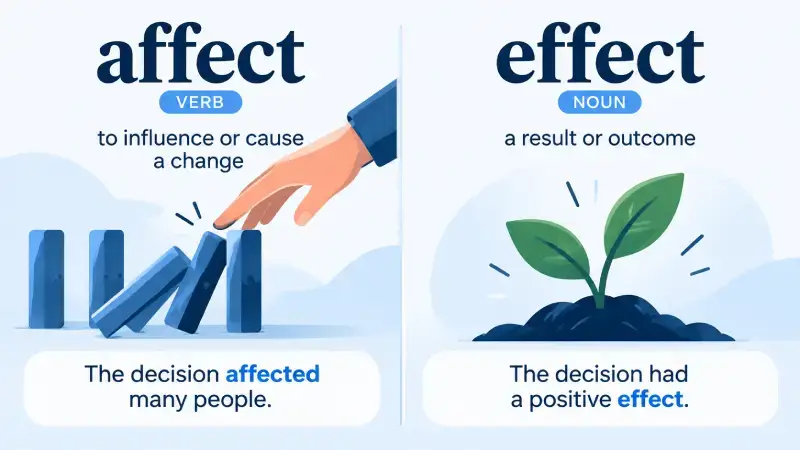
Affect vs. effect are both correct English words, but they usually serve different grammatical functions. Affect is most often a verb meaning “to influence,” while effect is most often a noun meaning “result.” However, both words have additional meanings and uses that can cause confusion.
Affect vs. Effect: The Quick Answer
Use affect when you mean to influence or change something:
Lack of sleep can affect your concentration.
Use effect when you mean the result or consequence of something:
Lack of sleep can have a negative effect on your concentration.
A useful basic pattern is:
Something affects something → something has an effect.
This rule handles most everyday uses, but it is not the whole story. Effect can also be a verb meaning “to bring about,” and affect has a specialized noun meaning a person’s observable emotional expression.
What Is the Difference Between Affect and Effect?
The main difference is word function.
Affect is usually a verb
As a verb, affect means to influence, change, or have an impact on something or someone.
The basic sentence structure is:
Subject + affect + object
Examples:
- Loud construction noise affected my ability to sleep.
- The new schedule affects everyone on the team.
- Rising prices may affect how families spend money.
- Her encouraging words affected his confidence.
- A delayed flight can affect your entire travel schedule.
In each sentence, affect describes an action or influence.
The American Heritage Dictionary also lists senses of affect involving influencing emotions and, in certain contexts, affecting the body through disease or other physical processes.
Effect is usually a noun
As a noun, effect means a result, consequence, or outcome produced by something.
Common structures include:
have + an effect
the effect of + noun
effect on + noun
Examples:
- The medication had a noticeable effect on her symptoms.
- The storm had a major effect on local businesses.
- We studied the effects of prolonged stress.
- The new policy had little effect on employee satisfaction.
- One unexpected effect of the delay was increased traffic.
Merriam-Webster defines effect as an event, condition, or state produced by a cause—that is, a result or outcome.
When to Use Affect
Use affect when you are describing something that influences or changes another thing.
1. Everyday situations
The cold weather affected our plans.
Missing breakfast can affect your energy level.
That conversation really affected me.
The noise from the street affected my sleep.
Here, replacing affect with influence works naturally:
The cold weather influenced our plans.
That substitution is a useful diagnostic test.
2. School and academic writing
Students often use affect when explaining how one factor changes another:
Screen time may affect students’ sleep patterns.
The experiment showed how temperature affects plant growth.
Economic conditions can affect college enrollment.
Because affect functions as a verb in these examples, it follows normal verb forms such as affects, affected, and affecting.
3. Professional writing
The software update may affect several older devices.
The staffing shortage has affected customer service.
Changes in demand could affect next quarter’s revenue.
In business writing, affect frequently appears when discussing consequences that a decision, event, policy, or condition may have.
4. Health and science
Lack of exercise can affect cardiovascular health.
Stress can affect memory and concentration.
The infection affected several organs.
The word can describe both physical and psychological influence.
When to Use Effect
Use effect when you are naming the result of an action, event, condition, or decision.
1. Everyday situations
The rain had little effect on our plans.
The new routine had a positive effect on my productivity.
The loud music had an unexpected effect on the baby.
The easiest test is often to substitute result:
The new routine had a positive result on my productivity.
Although “result” is not always the most natural replacement in the sentence, the underlying meaning is still clear: effect = result.
2. School writing
The study examined the effects of social media use.
Researchers measured the effect of temperature on the material.
One effect of poor nutrition can be reduced energy.
3. Professional writing
The price increase had a significant effect on sales.
We need to understand the long-term effects of this decision.
The policy had almost no effect on employee retention.
4. News and formal writing
The storm had a widespread effect on transportation.
The decision could have serious effects on the local economy.
The noun is especially common after phrases such as have an effect, take effect, side effect, and the effect of.
Affect vs. Effect Side by Side
| Feature | Affect | Effect |
|---|---|---|
| Most common part of speech | Verb | Noun |
| Main meaning | To influence or change | Result or consequence |
| Example | The heat affected the crops. | The heat had an effect on the crops. |
| Easy substitute | Influence | Result |
| Common structure | affect + object | effect on + object |
| Common phrase | affected by | have an effect |
| Plural | Usually not used as a plural in the main sense | effects |
The distinction is not absolute because effect can also function as a verb and affect can function as a noun in specialized contexts.
Effect as a Verb: The Important Exception
One of the most important advanced uses is effect as a verb.
As a verb, effect means to bring about, cause, or accomplish something.
For example:
The new law was designed to effect major changes.
This does not mean the law merely influenced existing changes. It means the law was intended to bring those changes about.
Compare:
The new law will affect businesses.
This means the law will influence or have an impact on businesses.
The new law will effect changes in the industry.
This means the law will bring about changes.
That distinction can matter in formal writing. American Heritage specifically distinguishes affect as “to cause a change” from the verb effect, meaning “to bring about or execute.”
Another example:
The manager hopes to effect a complete restructuring of the department.
Here, effect means the manager hopes to make the restructuring happen.
Affect as a Noun: The Specialized Use
There is also a noun affect, but it is much less common in ordinary conversation.
In psychology, psychiatry, and related professional contexts, affect refers to an observable emotional expression or emotional presentation.
For example:
The patient displayed a flat affect during the interview.
This specialized noun is different from the everyday verb affect.
In normal writing, do not replace effect with affect simply because both words can technically function as nouns. The noun affect has a specific meaning and is not the ordinary noun for “result” or “influence.”
Common Affect vs. Effect Mistakes
Mistake 1: Using effect when you need a verb meaning “influence”
Wrong:
The weather will effect our travel plans.
Right:
The weather will affect our travel plans.
Why? The sentence needs a verb meaning influence.
Mistake 2: Using affect when you mean “result”
Wrong:
The medicine had a strong affect on her condition.
Right:
The medicine had a strong effect on her condition.
Why? The phrase had a , on normally calls for the noun effect.
Mistake 3: Confusing “affect” with “effect” after “have”
Wrong:
The decision had a major affect on sales.
Right:
The decision had a major effect on sales.
The noun meaning “result” is effect.
Mistake 4: Assuming “effect” can never be a verb
Oversimplified:
Effect is always a noun.
Better:
Effect is usually a noun, but it can also be a verb meaning “to bring about.”
That distinction becomes particularly important in formal, legal, governmental, and business writing.
Mistake 5: Choosing based only on pronunciation
In many varieties of American English, the two words can sound extremely similar in ordinary speech. Because of that, listening alone may not tell you which spelling belongs in a sentence.
Instead, look at the job the word performs.
Ask:
- Is it describing an influence? → affect
- Is it naming a result? → effect
- Does it mean “bring about”? → effect as a verb
- Does it refer to observable emotional expression in a specialized context? → affect as a noun
How to Remember Affect vs. Effect Fast
Memory trick: Affect = Action
Think:
Affect = Action
When something affects something else, it acts on or influences it.
Exercise affects your health.
Then remember:
Effect = End result
The effect is what comes out of the situation.
Exercise has a positive effect on your health.
This is not a rule that covers every specialized use, but it works extremely well for the common everyday distinction.
The “influence or result” test
Try replacing the word mentally.
If influence fits, choose affect:
The delay may affect our schedule.
The delay may influence our schedule.
- If result fits, choose effect:
The delay had an unexpected effect.
The delay had an unexpected result.
- If neither test works, check whether you are dealing with one of the less common meanings.
Affect vs. Effect in Real-World Contexts
In a text exchange
Maya: Did the storm affect your plans?
Jordan: Definitely. The canceled flight had a huge effect on our weekend.
The first sentence uses affect as a verb because the storm influenced the plans. The second uses effect as a noun because the canceled flight produced a result.
In a professional email
The software update may affect older devices. We are testing the update now to determine whether it will have any significant effect on performance.
Both words can appear naturally in the same paragraph. The update affects devices, while its resulting impact is its effect.
In article-style writing
Rising temperatures can affect crop production in several regions. One major effect is reduced yield during periods of extreme heat.
Again, affect introduces the influence, while effect names the resulting consequence.
Related Confusions You Should Know
Affect vs. influence
Affect and influence can both function as verbs meaning that something changes or shapes another thing.
Social media can affect buying decisions.
Social media can influence buying decisions.
The two are often interchangeable in ordinary usage, although affect is especially common when discussing a measurable or direct impact.
Effect vs. result
As nouns, effect and result overlap substantially.
The effect of the decision was immediate.
The result of the decision was immediate.
However, effect often emphasizes the change produced by a cause, while result can refer more generally to what happened afterward.
Affect vs. impact
Affect is a verb:
The change will affect customers.
Impact can be a noun:
The change will have an impact on customers.
Impact can also function as a verb, but choosing affect is often the simpler option when you simply mean “influence.”
Cause vs. effect
A cause produces something, while an effect is what results from it.
The power outage was the cause; the dark offices were an effect.
This relationship explains why effect is associated with results.
FAQs
Is affect or effect correct?
Both are correct words. Affect is usually a verb meaning “to influence,” while effect is usually a noun meaning “result.”
Is it “affect” or “effect” my life?
Use affect: “This decision will affect my life.”
Is it “affect” or “effect” on something?
Use effect: “The change had an effect on the schedule.”
What is the easiest way to remember affect vs. effect?
Remember affect = action/influence and effect = end result.
Can affect be a noun?
Yes. In psychology, affect can refer to a person’s observable emotional expression.
Can effect be a verb?
Yes. Effect as a verb means “to bring about” or “to cause,” as in “The new policy will effect major changes.”
Conclusion
The most useful distinction between affect vs. effect is simple:
- Affect is usually a verb meaning to influence or change.
- Effect is usually a noun meaning a result or consequence.
- Effect can also be a verb meaning to bring about or accomplish.
- Affect can also be a specialized noun referring to observable emotional expression.
When you are unsure, ask what the word is doing in the sentence. If you mean influence, choose affect. If you mean result, choose effect. That quick test will solve the vast majority of everyday cases.