
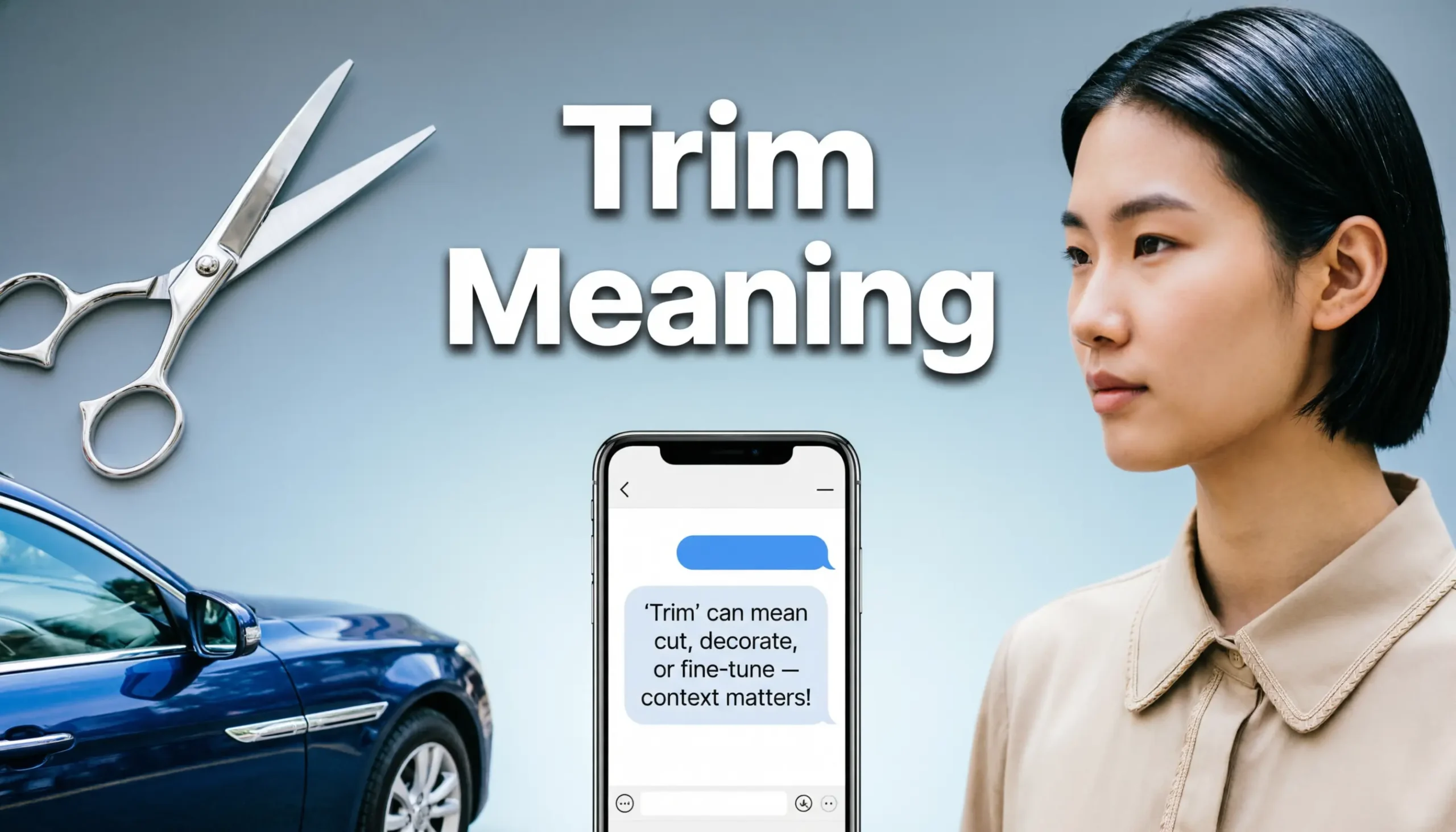
Trim generally means to cut, remove, reduce, or make something neater. The exact meaning depends on the context.
- Basic meaning: To cut away part of something or make it shorter.
- Grooming: To cut a small amount of hair, a beard, or nails.
- Fashion: Decorative material or detailing added to clothing.
- Cars: A vehicle’s equipment or version, such as a higher or lower trim level.
- Home improvement: Decorative finishing around doors, windows, walls, and ceilings.
- Texting/slang: Usually depends heavily on context and may have informal or suggestive meanings in some communities.
- Tone: Normally neutral, but the tone can become casual, humorous, or suggestive depending on how it is used.
The word trim looks simple, but it can have several different meanings. If you have seen it in a text message, social media post, product description, car advertisement, or grooming conversation, you may have wondered which definition applies.
In everyday English, to trim something usually means to cut away a small amount, shorten it, or make it neater. Someone can trim their hair, trim a beard, trim a plant, or trim excess material from an object. The word can also describe decorative details, such as trim on clothing or trim around a door.
Online, the situation can be more complicated. People sometimes use trim casually or as slang, and certain communities may give the word additional meanings. Because of that, reading the surrounding conversation is important.
This guide explains the trim meaning in simple language, including its use in texting, slang, social media, grooming, fashion, cars, home improvement, and everyday conversations. It also compares trim with related words such as cut, clip, shape, and groom.
What Does Trim Mean?
Core Definition of Trim
The most common meaning of trim is to cut away part of something, usually to make it shorter, cleaner, neater, or more suitable.
For example:
“I need to trim my hair.”
This means the person wants to cut some of their hair, usually without removing all of it.
Another example is:
“Trim the branches before they grow too large.”
Here, trim means cutting away unwanted or excessive parts of a plant.
The word can work as a verb, noun, or adjective, depending on the sentence.
As a verb:
“She trimmed the edges.”
As a noun:
“The curtains have beautiful trim.”
As an adjective:
“He has a trim figure.”
Although these meanings are different, they share an underlying idea of neatness, reduction, or finishing.
Trim in Standard English
In standard English, trim is often connected with making something more controlled or attractive.
You might trim:
- Hair
- A beard
- Plants
- Tree branches
- Paper
- Fabric
- Excess material
- A budget
- A document
For example, a company might say:
“We need to trim unnecessary expenses.”
Here, trim does not involve physically cutting anything. It means reduce or remove unnecessary costs.
This shows why context matters when understanding the word.
What Does Trim Mean in Texting, Slang, and Social Media?
Trim in Chat Messages
In texting, trim does not have one universal slang definition. Most of the time, people use it with its ordinary meaning.
For example:
“I need to trim my beard tomorrow.”
This simply means the person plans to shorten or tidy their beard.
Someone might also say:
“Can you trim this video?”
In this case, trim means shorten the video by removing unwanted sections.
Because slang can vary between online communities, a person should not automatically assume that trim has a hidden meaning. The words around it usually provide the answer.
Trim in Social Media
On social media, trim can appear in many different types of content.
A barber might post:
“Fresh trim today.”
Here, trim refers to a haircut or grooming session.
A content creator might write:
“I had to trim the beginning of the video.”
Here, it means editing or shortening the video.
A fitness creator might use the word to describe a lean appearance.
A fashion account might discuss decorative trim on clothing.
Therefore, the trim meaning on social media depends on the topic of the post.
Trim and Gen Z Usage
Trim is not one of the most universal Gen Z slang terms in the way abbreviations such as “LOL,” “FR,” or “POV” are. Its meaning is usually determined by the specific community using it.
Young people may use trim in casual conversations about:
- Haircuts
- Fashion
- Fitness
- Video editing
- Cars
- Online culture
Some communities may also use the word in slang with a more suggestive meaning. That usage is not universal, so context is essential.
Other Meanings of Trim
Trim in Grooming
One of the most common uses of trim relates to personal grooming.
When someone says:
“I need a trim.”
they often mean they need their hair cut slightly or their beard cleaned up.
A trim usually suggests removing some length rather than completely changing the hairstyle.
For example:
- “I only want a trim.”
- “He got a beard trim.”
- “She trimmed the ends of her hair.”
This is why “trim” is commonly associated with barbers and salons.
Trim in Fashion
In fashion, trim can mean decorative material or detailing added to clothing.
Examples include:
- Lace
- Ribbon
- Decorative stitching
- Braiding
- Borders
- Buttons
- Other ornamental details
For example:
“The dress has gold trim around the sleeves.”
Here, trim does not mean cutting. It refers to the decorative finishing material.
Trim in Cars
In the automotive world, trim has a specific meaning.
A car’s trim level refers to a particular version or configuration of a vehicle. Different trim levels may have different:
- Features
- Engines
- Interior materials
- Technology
- Safety equipment
- Wheels
- Exterior details
For example, a car manufacturer may offer a base trim and several upgraded trims.
If someone says:
“Which trim is this SUV?”
they are asking which version or equipment level the vehicle has.
Trim in Home Improvement
In construction and home design, trim refers to decorative or finishing materials around parts of a building.
Common examples include:
- Door trim
- Window trim
- Baseboards
- Crown molding
- Wall trim
For example:
“We replaced the old window trim.”
Here, trim refers to the material around the window rather than something being cut.
How Trim Is Used in Real Conversations
Everyday Situations
The word appears naturally in many conversations.
At a barbershop:
“Just a trim, please.”
The customer wants a small amount of hair removed.
In gardening:
“We should trim these bushes.”
The speaker wants to cut back the plants.
In editing:
“Can you trim the first few seconds?”
The speaker wants part of a video removed.
In budgeting:
“We need to trim our expenses.”
The speaker wants to reduce spending.
In fashion:
“The jacket has leather trim.”
The word refers to decorative material.
Platforms Where Trim Appears
You may see the word on:
- TikTok
- YouTube
- Messaging apps
- Online shopping websites
- Car forums
- Home improvement websites
The subject of the conversation usually reveals the intended meaning.
Examples of Trim in Conversations
Example 1: Hair
Person A: “How much are you cutting?”
Person B: “Nothing major. I just want a trim.”
Meaning: A small haircut or reduction in length.
Example 2: Beard
“I need to trim my beard before the interview.”
Meaning: Make the beard shorter and neater.
Example 3: Video Editing
“Can you trim the boring part out of the video?”
Meaning: Remove an unwanted section.
Example 4: Gardening
“We should trim the hedge this weekend.”
Meaning: Cut the hedge to control its size and shape.
Example 5: Budget
“The company is trying to trim costs.”
Meaning: Reduce expenses.
Example 6: Fashion
“This shirt has blue trim around the collar.”
Meaning: Blue decorative detailing around the collar.
Example 7: Cars
“I bought the higher trim because it has more features.”
Meaning: A higher-level vehicle configuration with additional equipment.
Example 8: Casual Social Media
“Fresh trim! Feeling like a new person.”
Meaning: The person has recently had a haircut or grooming session.
Tone and Intent Behind Trim
Emotional Meaning
Trim is generally a neutral word. It does not automatically express a particular emotion.
The emotion comes from the surrounding sentence.
For example:
“I finally got a fresh trim!”
sounds positive and excited.
But:
“We need to trim the budget again.”
may sound serious or concerning.
Positive, Negative, or Neutral Usage
Most uses are neutral.
Positive:
“That trim looks great.”
Neutral:
“I need a trim.”
Potentially negative:
“The company has to trim its workforce.”
Here, trim is being used as a softer way of saying that the company needs to reduce its workforce.
The word itself is not offensive, but the situation can affect how the message feels.
Sarcasm vs. Serious Meaning
Trim can also appear in jokes or sarcastic comments.
For example:
“That’s not a trim. That’s practically a new haircut!”
The speaker is joking about how much hair was removed.
As always, punctuation, emojis, and surrounding conversation can help reveal whether the statement is serious or humorous.
Origin and Background of Trim
The word trim has a long history in English and has developed several connected meanings over time.
One important idea behind the word is making something neat, orderly, or properly finished. That explains why it can describe cutting, decorating, grooming, and even appearance.
When you trim hair, you make it neater.
When you trim a plant, you control its shape.
When you add trim to clothing or a building, you add a finishing detail.
When you trim a budget, you reduce unnecessary expenses.
The word has therefore expanded beyond physical cutting while keeping the broader idea of adjusting, reducing, or refining something.
Is Trim Rude or Inappropriate?
In ordinary English, trim is not rude or inappropriate.
Words such as “hair trim,” “beard trim,” “video trim,” and “window trim” are completely normal.
However, some online communities use trim as slang with meanings that can be suggestive or adult-oriented. These interpretations are context-specific and should not be treated as the default definition.
If you see the word in a casual conversation and are unsure what someone means, look at the surrounding words rather than assuming a slang definition.
When Not to Use Trim
Formal Communication
Trim is perfectly acceptable in professional English when it accurately describes something.
For example:
“Please trim the video to two minutes.”
That is completely professional.
However, when discussing something sensitive or potentially ambiguous, it may be better to use a more specific word.
Instead of:
“We need to trim it.”
you could say:
“We need to shorten the document.”
Specific wording prevents confusion.
Wrong Contexts
Avoid assuming that trim always refers to cutting.
For example:
“The car has premium trim.”
This is about the vehicle’s configuration.
Similarly:
“The curtains have decorative trim.”
This refers to decoration.
The surrounding noun usually provides the clue.
Similar and Related Terms
Cut
Cut is a broad word for separating or removing part of something. It can involve a large or small amount.
Clip
Clip usually suggests cutting or removing a small amount, especially with scissors or clippers.
Shape
Shape means changing something’s form or outline. It does not necessarily involve removing material.
Groom
Groom has a broader connection with personal appearance. Trimming can be one part of grooming.
Shorten
Shorten specifically means making something less long.
These words overlap, but they are not always interchangeable.
Trim vs. Related Terms
Trim vs. Cut
Trim often suggests making something neater or removing a small amount.
Cut is more general and can involve removing a substantial amount.
For example:
“I trimmed my hair.”
usually suggests a small haircut.
“I cut my hair short.”
suggests a more significant change.
Trim vs. Clip
These words can overlap when discussing hair or plants.
“Clip” often emphasizes the cutting action, while “trim” can emphasize the result of making something neat or controlled.
Trim vs. Shape
Trimming may help shape something, but shaping focuses more on the final form.
You can trim a hedge to shape it, for example.
Trim vs. Groom
Grooming is broader. It can include washing, brushing, styling, shaving, and trimming.
A trim is therefore one possible part of grooming.
Trim Comparison Table
| Term | Meaning | Usage | Key Difference |
|---|---|---|---|
| Trim | Cut, reduce, or make neat | Hair, plants, videos, budgets | Often suggests controlled reduction or finishing |
| Cut | Remove or divide something | Hair, paper, food, materials | More general |
| Clip | Cut a small amount | Hair, plants, nails | Often focuses on the cutting action |
| Shape | Give something a particular form | Hair, plants, materials | Focuses on form rather than simply length |
| Groom | Maintain or improve appearance | Hair, beard, personal care | Broader than trimming |
Common Misunderstandings About Trim
One common misunderstanding is assuming that trim always means cutting.
That is not true.
In fashion, trim can mean decoration. In cars, it can refer to a vehicle’s configuration. In home improvement, it can mean finishing material.
Another misunderstanding involves slang. Because certain online communities may use trim differently, people sometimes assume that an unusual interpretation is the standard meaning. Usually, it is not.
Context is the most reliable way to understand the word.
Ask yourself:
What are people talking about?
If they are discussing hair, trim probably means a haircut.
If they are discussing a car, it probably means a vehicle version.
If they are discussing clothing, it may mean decoration.
If they are discussing video editing, it probably means shortening footage.
Frequently Asked Questions About Trim
What does trim mean?
Trim generally means to cut, reduce, shorten, or make something neater. It can also refer to decorative material or a vehicle’s configuration.
What does trim mean in texting?
In texting, trim usually keeps its ordinary meaning. It may refer to cutting hair, shortening a video, reducing something, or another context-specific use.
What does “I need a trim” mean?
When someone says “I need a trim,” they usually mean they want a small haircut or grooming adjustment.
Is trim slang?
Trim is primarily a standard English word rather than slang. Some communities may use it as slang, but those meanings are not universal.
What does trim mean in cars?
In the automotive world, trim refers to a particular version or equipment level of a vehicle.
What does trim mean in fashion?
In fashion, trim can refer to decorative details or materials added to clothing.
What does trim mean in home improvement?
In home improvement, trim refers to finishing or decorative materials around doors, windows, ceilings, floors, and other areas.
Is trim a rude word?
No. Trim is normally a neutral and completely ordinary English word. Context-specific slang may give it a different meaning.
Is trim the same as cut?
Not exactly. Trim often suggests controlled cutting to make something shorter or neater, while cut has a much broader meaning.
conclusion
The trim meaning changes with context, but its central idea is usually connected to cutting, reducing, refining, or finishing something.
You can trim your hair, beard, plants, a video, or a budget. In fashion, trim can mean decorative detailing. In home improvement, it can refer to finishing materials. In the automotive world, a trim level identifies a particular version of a vehicle.
In texting and social media, the word usually keeps one of these everyday meanings. While niche slang uses can exist, they are not automatically the intended interpretation.
The best way to understand trim is to look at the surrounding conversation. Once you know whether people are talking about grooming, editing, cars, fashion, home design, or something else, the meaning is usually clear.