
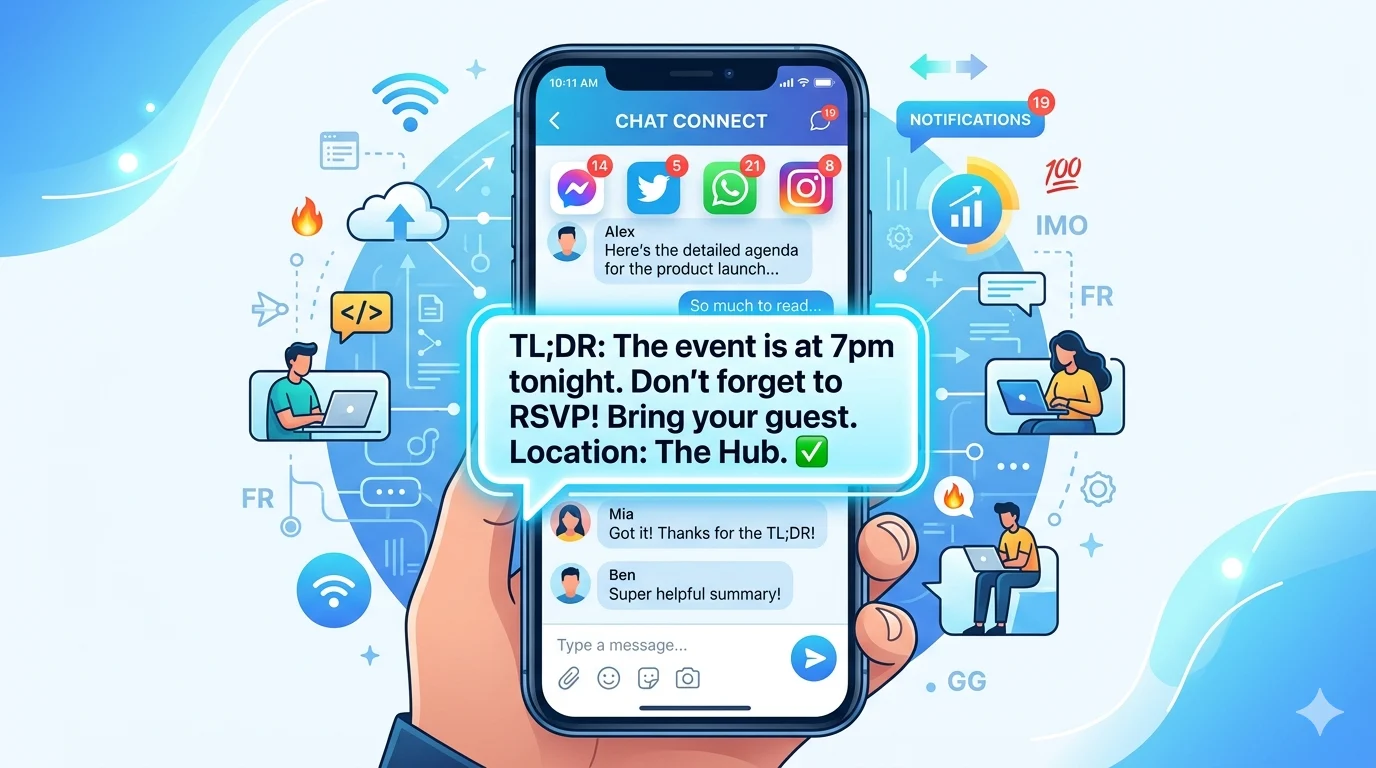
Meaning: Too Long; Didn’t Read
Full Form: Too Long; Didn’t Read
Context: Texting, social media, forums, blogs, emails
Tone: Casual, informal, sometimes humorous
If you’ve spent time online, reading social media posts, browsing forums, or chatting with friends, you’ve probably seen the abbreviation TL;DR. At first glance, it can seem confusing, especially if you’re unfamiliar with internet slang and texting shortcuts. Many people search for the TL;DR meaning because they encounter it in articles, Reddit discussions, online communities, and even workplace messages.
TL;DR is one of the most common internet abbreviations used today. It helps people quickly understand the main point of long content without reading every detail. Sometimes it appears as a response to a lengthy message, while other times writers include it intentionally to provide a short summary for readers who are short on time.
As online content continues to grow, people increasingly prefer quick and easy ways to consume information. That’s one reason TL;DR has become such a popular term across social media, blogs, newsletters, and discussion forums. Understanding what it means can help you follow conversations more easily and communicate more effectively online.
In this guide, you’ll learn the complete meaning of TL;DR, how it’s used in texting and social media, its origin, examples, related slang terms, and the situations where it’s appropriate to use.
What Does TL;DR Mean?
TL;DR stands for “Too Long; Didn’t Read.” It is an internet abbreviation used to indicate that a piece of content is lengthy and can be summarized in a shorter form.
Originally, people used TL;DR as a response to very long posts, suggesting that the content was too long to read completely. Over time, however, the phrase evolved and became a useful tool for providing summaries.
Today, many writers include a TL;DR section at the beginning or end of articles. This gives readers a quick overview of the key points without requiring them to read the entire piece.
In simple terms, TL;DR means:
- Give me the short version.
- Here’s a summary.
- The content is long, but here’s the main point.
- A quick overview of important information.
What Does TL;DR Mean in Texting, Slang, and Social Media?
In texting, TL;DR is commonly used when someone wants a quick summary of a long explanation.
For example, if a friend sends several paragraphs describing a situation, another person might reply with “TL;DR?” to ask for the condensed version.
On social media, the term appears frequently because online users often scroll quickly through content. Writers know that not everyone wants to read lengthy posts, so they provide a TL;DR section to improve readability.
The abbreviation is especially popular on:
- X (formerly Twitter)
- Discord
- Online forums
- Blogs
- Community discussion boards
Among younger internet users and Gen Z audiences, TL;DR has become a natural part of digital communication. It reflects modern browsing habits where people consume large amounts of information quickly.
Other Meanings of TL;DR
Although “Too Long; Didn’t Read” is the primary meaning, the phrase can be used in slightly different ways depending on the context.
Summary Label
Many writers use TL;DR simply as a label for a summary section.
Example:
TL;DR: The update improves performance and fixes bugs.
Request for a Summary
Someone may write “TL;DR?” when asking another person to summarize a long explanation.
Humorous Comment
Sometimes TL;DR is used jokingly to tease someone for writing an extremely long message.
Short Version Indicator
It can also mean “Here’s the short version” even if nobody actually skipped reading the content.
How TL;DR Is Used in Real Conversations
TL;DR appears in many everyday online interactions.
Personal Conversations
Friends often use it when discussing long stories.
Example:
“I just had the craziest day ever.”
“TL;DR?”
Online Discussions
Forum users frequently include a summary after lengthy posts.
Workplace Chats
In casual workplace communication, TL;DR may be used to summarize project updates.
Content Creation
Bloggers and writers use TL;DR sections to help readers find key information quickly.
Examples of TL;DR in Real Life
- “TL;DR: The meeting was postponed until next week.”
- “That’s a lot of text. Can I get a TL;DR?”
- “TL;DR: We won the game after overtime.”
- “I added a TL;DR at the top for busy readers.”
- “TL;DR: The software update fixes security issues.”
- “Can someone give me the TL;DR version of this discussion?”
- “The article is detailed, but the TL;DR covers the main points.”
- “TL;DR: Everything worked out in the end.”
Tone and Intent
The tone of TL;DR depends on how it is used.
Neutral Usage
Most of the time, TL;DR is completely neutral.
It simply indicates a summary or requests one.
Humorous Usage
Many people use it playfully when reacting to extremely long messages.
Slightly Negative Usage
In some situations, saying “TL;DR” can imply that content is unnecessarily long.
This interpretation depends heavily on context and tone.
Practical Usage
Today, TL;DR is often seen as a helpful feature rather than criticism.
Many readers appreciate summaries because they save time.
Origin and Background of TL;DR
TL;DR originated during the early days of internet forums and message boards.
Users often encountered lengthy posts that required significant time to read. To express that a post was too long, people began replying with “TL;DR.”
As internet culture evolved, writers started using the abbreviation proactively. Instead of waiting for readers to complain about length, they provided summaries themselves.
The popularity of TL;DR increased dramatically through platforms like Reddit, where long-form discussions are common.
Today, the abbreviation is recognized across much of the English-speaking internet.
Is TL;DR Rude or Inappropriate?
Generally, TL;DR is not considered rude.
When used as a summary label, it is widely accepted and appreciated.
However, it can sound dismissive if used as a direct response to someone’s detailed explanation.
For example:
Person A: “Let me explain everything that happened.”
Person B: “TL;DR.”
In this context, Person B may appear uninterested or impatient.
The safest approach is to use TL;DR respectfully and consider the situation.
When NOT to Use TL;DR
Although common online, TL;DR is not appropriate everywhere.
Formal Business Communication
Avoid using it in highly professional emails, legal documents, or official reports.
Academic Writing
Research papers and formal assignments usually require traditional summaries rather than internet slang.
Serious Discussions
Topics involving personal struggles, sensitive issues, or emotional conversations deserve more thoughtful responses.
Professional Presentations
Use terms such as “Executive Summary” or “Key Takeaways” instead.
Similar and Related Slang Terms
Several internet abbreviations serve similar purposes.
ELI5
Means “Explain Like I’m Five.”
Used when someone wants a simple explanation.
FYI
Means “For Your Information.”
Used to share useful information.
ICYMI
Means “In Case You Missed It.”
Used to highlight information others may have overlooked.
BTW
Means “By The Way.”
Used to introduce additional information.
Summary
A traditional alternative to TL;DR without internet slang.
TL;DR vs Related Terms
TL;DR vs Summary
A summary is a formal term. TL;DR is informal internet language.
IT vs ELI5
TL;DR focuses on shortening information. ELI5 focuses on simplifying information.
TL;DR vs FYI
TL;DR summarizes information. FYI introduces information.
TL;DR vs ICYMI
TL;DR condenses content. ICYMI highlights previously shared content.
Comparison Table
| Term | Meaning | Usage | Key Difference |
|---|---|---|---|
| TL;DR | Too Long; Didn’t Read | Summaries and online discussions | Focuses on shortening content |
| Summary | Brief overview | Formal and informal settings | More professional |
| ELI5 | Explain Like I’m Five | Simplified explanations | Focuses on simplicity |
| FYI | For Your Information | Sharing information | Not a summary |
| ICYMI | In Case You Missed It | News and updates | Highlights missed content |
| BTW | By The Way | Adding information | Changes topic slightly |
Common Misunderstandings
Thinking It Is Always an Insult
Many people assume TL;DR is rude. In reality, it is often just a summary tool.
Assuming It Means Nobody Read the Content
When writers add a TL;DR section themselves, they are helping readers rather than criticizing the content.
Confusing It With Other Acronyms
New internet users sometimes mix TL;DR with abbreviations like FYI or ELI5, even though their meanings are different.
Believing It Is Only for Social Media
While common online, TL;DR also appears in newsletters, blogs, and internal company communications.
Frequently Asked Questions
What does TL;DR stand for?
It stands for “Too Long; Didn’t Read.”
What does TL;DR mean in texting?
It usually means a summary or a request for a shorter explanation.
Is TL;DR rude?
Not usually. It depends on the context and tone.
Why do articles include TL;DR sections?
They help readers quickly understand the main points.
Is TL;DR popular on social media?
Yes. It is widely used across social media platforms and forums.
Can I use TL;DR in emails?
You can use it in casual emails, but avoid it in highly formal communication.
What is the difference between TL;DR and a summary?
TL;DR is informal internet slang, while summary is a standard term.
Is TL;DR popular with Gen Z?
Yes. Many younger internet users use it regularly.
Where did TL;DR originate?
It originated on early internet forums and discussion boards.
How do you pronounce TL;DR?
Most people say the individual letters: “tee-el-dee-are.”
conclusion
TL;DR is one of the most widely recognized internet abbreviations. It stands for “Too Long; Didn’t Read” and is commonly used to summarize lengthy content or request a shorter explanation. While it started as a reaction to long online posts, it has evolved into a practical tool that helps readers quickly understand important information. Whether you encounter TL;DR in texting, social media, forums, or blog articles, understanding its meaning makes it easier to participate in modern online conversations and communicate more effectively.