
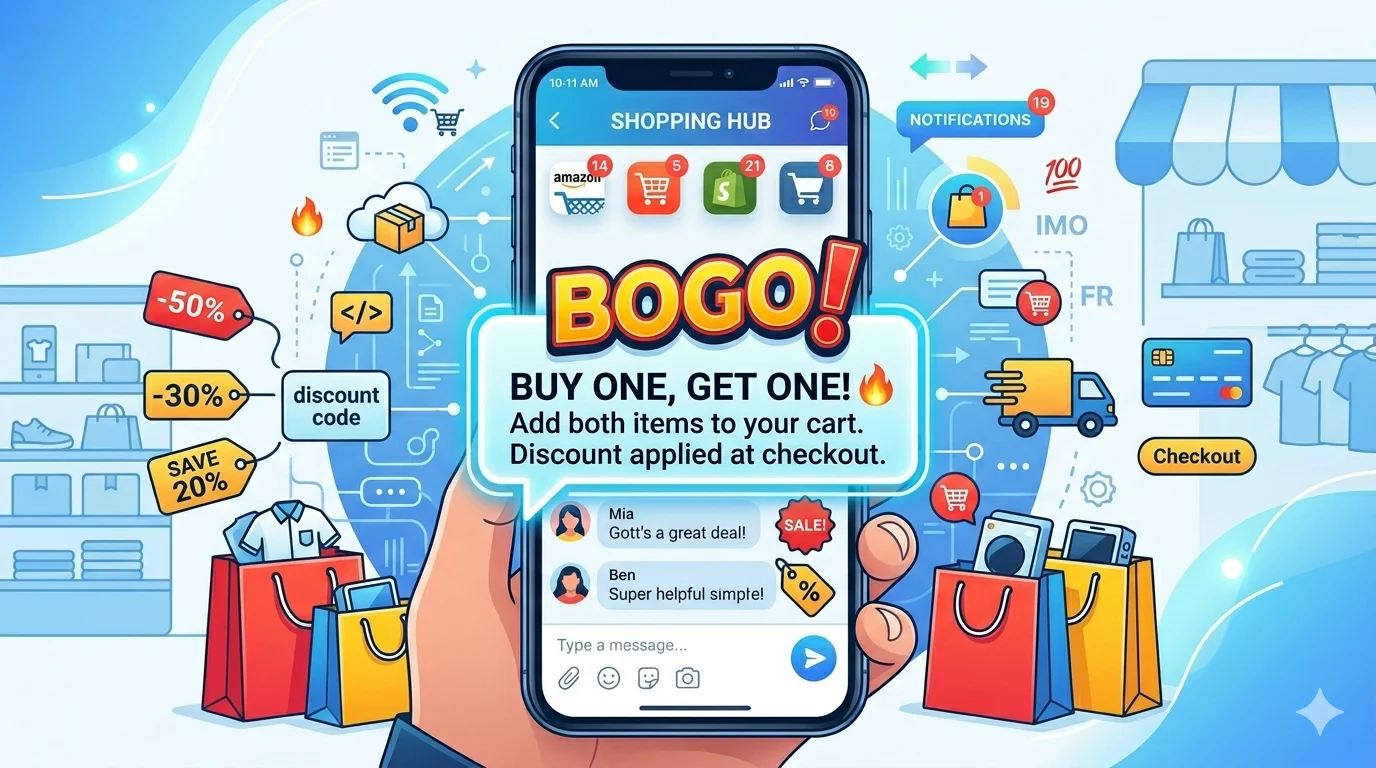
Meaning: Buy One, Get One
Full Form: Buy One, Get One
Context: Retail stores, online shopping, marketing promotions, social media deals
Tone: Promotional, casual, money-saving
If you’ve ever seen a big sale banner saying BOGO while shopping online or in stores, you might have wondered what it actually means. Many people search for the BOGO meaning because the term is widely used in marketing but not always clearly explained. At first glance, it looks like a random abbreviation, but it actually represents one of the most popular shopping deals used by retailers around the world.
BOGO stands for “Buy One, Get One,” a promotional offer where customers receive an additional item after purchasing a product. Sometimes the second item is free, and other times it comes at a discounted price. This simple idea has become a powerful marketing strategy because it attracts buyers and creates a sense of extra value.
You will often see BOGO deals in supermarkets, clothing stores, restaurants, and online shopping platforms. It is commonly highlighted in advertisements to grab attention and encourage quick purchases. Understanding how BOGO works helps shoppers make smarter decisions and recognize whether a deal is truly beneficial.
In this guide, we’ll explore the full meaning of BOGO, how it works in real shopping situations, different types of BOGO offers, and why businesses use it so frequently in modern marketing.
What Does BOGO Mean?
BOGO stands for “Buy One, Get One.” It is a promotional offer used by retailers to encourage customers to purchase products by providing an additional item either free of charge or at a discounted price.
The most common version is Buy One, Get One Free, often abbreviated as BOGO. In this promotion, a customer purchases one qualifying item and receives a second item without paying for it.
For example:
- Buy one pizza, get one free.
- Buy one pair of shoes, get another pair free.
- Buy one shampoo, get one free.
Retailers use BOGO promotions because they attract attention, increase sales volume, and encourage customers to purchase more items than they originally intended.
In simple terms, BOGO means you receive an extra product when you buy a qualifying item.
What Does BOGO Mean in Texting, Slang, and Social Media?
Although BOGO is primarily a retail term, it frequently appears in text messages and social media conversations.
Friends often use it when sharing discounts or special promotions.
For example:
“There’s a BOGO deal on burgers today.”
“Did you see the BOGO sale at the grocery store?”
On social media platforms, businesses use BOGO promotions to attract customers and increase engagement. Shoppers also share these deals in coupon groups and bargain-hunting communities.
You may see BOGO mentioned on:
- TikTok
- X
- Shopping forums
- Deal websites
- Coupon communities
Unlike many internet abbreviations, BOGO is not really a slang term used for personal communication. Instead, it is a marketing abbreviation that has become part of everyday shopping language.
Other Meanings of BOGO
The primary meaning of BOGO is always related to promotions and discounts. However, businesses use several variations of the offer.
Buy One, Get One Free
This is the most common form of BOGO.
Example:
Buy one coffee and receive another coffee free.
Buy One, Get One 50% Off
Instead of receiving a free item, customers receive a discount on the second item.
Buy One, Get One Half Price
Similar to BOGO 50% off, the second product is sold at a reduced price.
Buy One, Get One Deal
Some retailers use BOGO as a general marketing phrase without specifying the exact discount until customers review the details.
How BOGO Is Used in Real Conversations
BOGO appears frequently in conversations about shopping and saving money.
Shopping Discussions
People often mention BOGO deals when recommending products or stores.
Example:
“I bought two shirts because they were part of a BOGO offer.”
Family Conversations
Family members may share promotions with each other.
Example:
“The grocery store has a BOGO deal on cereal this week.”
Online Communities
Deal hunters regularly post BOGO promotions online.
Example:
“New BOGO offer available on skincare products.”
Marketing and Advertising
Retailers frequently advertise BOGO promotions to encourage purchases.
Example:
“Weekend BOGO sale starts Friday.”
Examples of BOGO in Real Life
- “The restaurant is offering a BOGO burger deal today.”
- “I bought one pair of sunglasses and got another free through a BOGO promotion.”
- “Check the app—there’s a BOGO coupon available.”
- “The store’s BOGO sale helped me save a lot of money.”
- “My favorite coffee shop has a BOGO offer every Tuesday.”
- “We shared a BOGO pizza deal for dinner.”
- “The online retailer launched a BOGO promotion for new customers.”
- “I only purchased it because the BOGO offer made it worth the price.”
Tone and Intent
BOGO generally carries a positive and promotional tone.
Promotional Tone
Businesses use BOGO offers to attract attention and increase sales.
Positive Tone
Customers often associate BOGO promotions with savings and value.
Informational Tone
Friends and family may simply share information about a deal.
Excited Tone
People often become enthusiastic when discussing good bargains.
The overall tone is almost always positive because the term is linked to discounts and special offers.
Origin and Background of BOGO
The concept behind BOGO promotions has existed for decades.
Retailers have long understood that customers are attracted to offers that appear to provide additional value. Instead of lowering the price of a single item, businesses found that giving away a second product often felt more appealing to shoppers.
As retail marketing evolved, the phrase “Buy One, Get One” became widely used across stores, newspapers, and promotional flyers.
The abbreviation BOGO became increasingly popular with the rise of online shopping and digital marketing. Today, major retailers, restaurants, supermarkets, and e-commerce companies regularly use the term in advertisements.
The popularity of BOGO continues because it benefits both consumers and businesses. Customers feel they are receiving extra value, while retailers increase sales volume.
Is BOGO Rude or Inappropriate?
No. BOGO is not rude, offensive, or inappropriate.
It is a standard retail and marketing term used by businesses worldwide.
However, confusion can occur when shoppers assume all BOGO promotions offer a completely free item. Some promotions include restrictions, conditions, or discounts rather than free products.
That’s why it’s important to read the terms carefully before making a purchase.
When NOT to Use BOGO
Although BOGO is widely understood in retail settings, it may not fit every situation.
Formal Business Documents
When writing professional reports or documents, it may be clearer to write “Buy One, Get One promotion” instead of using the abbreviation.
Audiences Unfamiliar with Retail Terms
Some people may not recognize the abbreviation immediately.
Non-Shopping Conversations
Using BOGO outside retail discussions may confuse listeners because the term is strongly connected to promotions and sales.
International Contexts
While many English-speaking countries recognize BOGO, it is not universally understood everywhere.
Similar and Related Terms
Several promotional terms are related to BOGO.
Discount
A reduction in the original price.
Sale
A temporary price reduction on products.
Coupon
A voucher that provides savings.
Cashback
Money returned after a purchase.
Promo Code
A special code used to unlock discounts online.
Clearance
Products sold at heavily reduced prices to clear inventory.
BOGO vs Related Terms
BOGO vs Discount
A discount lowers the item’s price directly. A BOGO promotion usually provides an additional item.
BOGO vs Coupon
A coupon requires activation or redemption. Many BOGO promotions apply automatically.
BOGO vs Cashback
Cashback rewards customers after purchase, while BOGO savings happen immediately.
BOGO vs Promo Code
Promo codes require entering a code, while many BOGO deals activate automatically at checkout.
Comparison Table
| Term | Meaning | Usage | Key Difference |
|---|---|---|---|
| BOGO | Buy One, Get One | Retail promotions | Includes an extra item |
| Discount | Price reduction | General sales | Directly lowers cost |
| Coupon | Savings voucher | Retail and online shopping | Requires redemption |
| Cashback | Money returned after purchase | Rewards programs | Savings occur later |
| Promo Code | Discount code | Online shopping | Requires code entry |
| Sale | Temporary reduced pricing | Retail marketing | Focuses on lower prices |
Common Misunderstandings
Assuming Every BOGO Means Free
Not all BOGO promotions offer a completely free item. Some provide partial discounts instead.
Ignoring the Fine Print
Many offers contain specific terms and conditions.
Confusing BOGO with Standard Discounts
BOGO promotions provide additional products, while standard discounts reduce prices directly.
Believing Every Product Qualifies
Retailers often limit BOGO promotions to selected items.
Assuming It Is Internet Slang
Unlike abbreviations such as LOL or BRB, BOGO is primarily a marketing and shopping term.
Frequently Asked Questions
What does BOGO stand for?
BOGO stands for “Buy One, Get One.”
What does BOGO mean in shopping?
It refers to a promotion where purchasing one item qualifies you to receive another item free or at a discount.
Does BOGO always mean free?
No. Some BOGO offers provide discounts rather than free items.
Is BOGO the same as a discount?
Not exactly. BOGO typically includes an additional product rather than a direct price reduction.
Why do stores offer BOGO deals?
Businesses use them to increase sales and attract customers.
Can BOGO promotions be used online?
Yes. Many online retailers offer BOGO promotions.
What is BOGO 50% off?
It means the second qualifying item receives a 50% discount.
How do I know if a BOGO deal is worth it?
Compare the total cost with other available discounts and consider whether you actually need both items.
Is BOGO popular in retail marketing?
Yes. It is one of the most widely used promotional strategies.
What are the benefits of BOGO promotions?
They help shoppers save money and encourage retailers to increase sales.
conclusion
BOGO stands for “Buy One, Get One” and is one of the most popular promotional terms in retail and online shopping. Whether it appears in a store advertisement, social media post, email promotion, or text message, the term generally refers to an offer that provides an additional item after purchasing a qualifying product. Understanding how BOGO promotions work can help you recognize genuine savings, compare deals effectively, and make smarter purchasing decisions. While the abbreviation is simple, knowing the different variations and conditions behind BOGO offers ensures you get the most value from every promotion.