
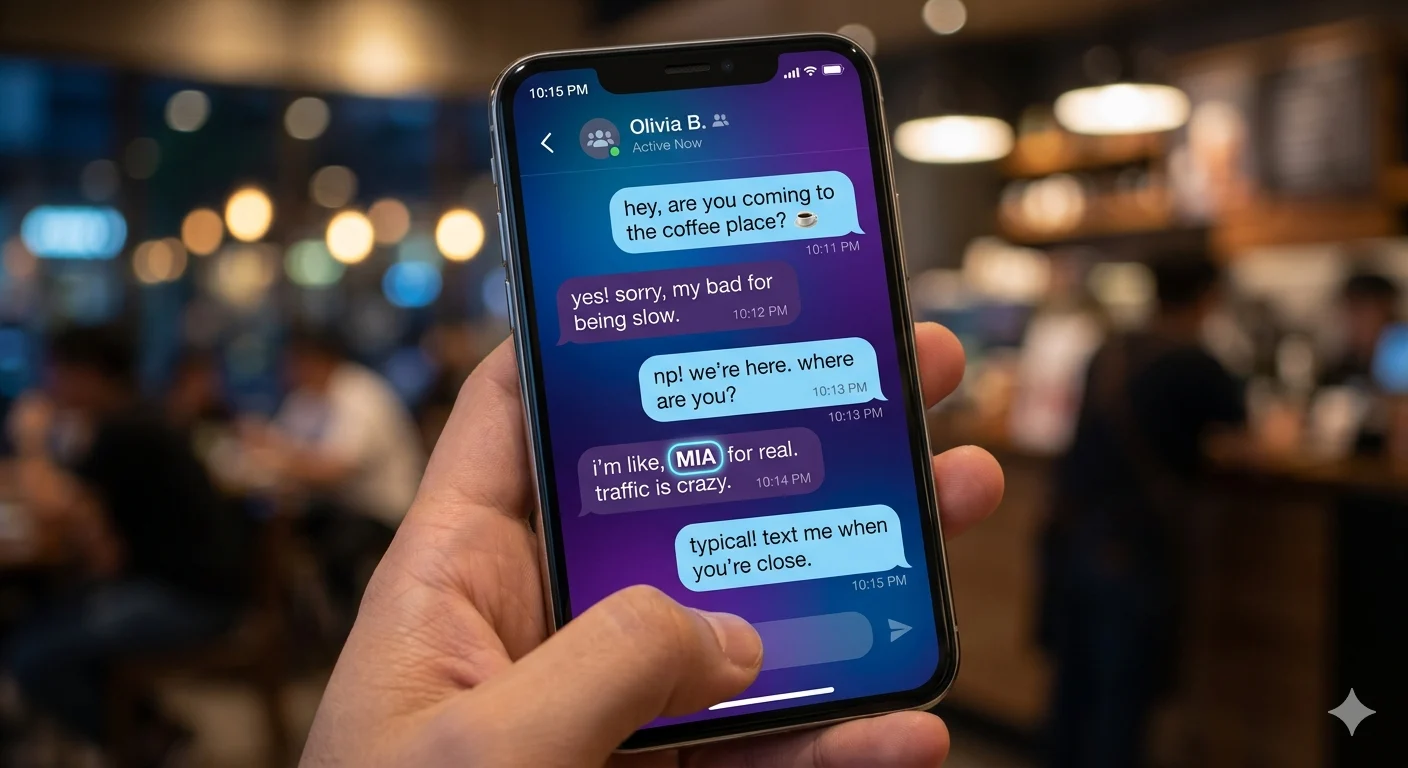
Meaning: Absent, not responding, or disappeared.
Full form: Missing In Action.
Context: Texting, social media, casual conversations.
Tone: Neutral, sometimes playful or slightly concerned.
If you’ve seen “MIA” in a message and paused for a second, you’re not alone. Many people come across this short term in chats, comments, or captions and wonder what it actually means. It looks simple, but like many internet slang terms, its meaning depends on context. That’s where the confusion begins.
In today’s fast-moving digital world, people prefer short and quick expressions. Instead of typing full sentences, they use abbreviations to save time and keep conversations casual. “MIA” is one of those terms that has been around for a long time but is still widely used today, especially on platforms like WhatsApp, Snapchat, Instagram, and even gaming chats.
What makes “MIA” interesting is that it didn’t start as internet slang. It has a deeper background, which adds to its meaning. Over time, people adapted it into everyday online conversations, giving it a lighter and more casual feel.
In this article, you’ll learn exactly what “MIA” means in texting, how people use it in real conversations, what tone it carries, and how it compares with similar slang. By the end, you’ll understand it clearly and use it with confidence.
What does MIA mean?
At its core, “MIA” means that someone is missing, absent, or not available. It describes a situation where a person has disappeared from communication or is not responding.
In simple terms, if someone stops replying to messages, goes offline for a while, or suddenly becomes inactive, you can say they are “MIA.”
It doesn’t always mean something serious. Most of the time, it’s just a casual way of saying that someone hasn’t been around or hasn’t replied yet.
For example, if your friend hasn’t answered your messages all day, you might say, “You’ve been MIA today.” It simply means they were not available or didn’t respond.
What does MIA mean in texting / slang / social media?
Chat meaning
In texting, “MIA” is used when someone is not replying or has gone silent. It’s a quick way to point out that a person is missing from the conversation.
People often use it in a light tone, not as a complaint but as an observation.
Social media usage
On social media, “MIA” is commonly used in captions and comments. For example, someone might post after a long break and say, “Sorry, I was MIA for a week.” This means they were inactive or not posting.
It can also be used to describe others, like “Where have you been? You’ve been MIA.”
Gen Z context
Among younger users, “MIA” is often used casually and sometimes jokingly. It doesn’t usually carry a serious meaning. Instead, it adds a relaxed tone to conversations.
For example, someone might disappear for a few hours and come back with, “I went MIA for a bit.”
Other meanings of MIA
While “MIA” is popular in texting, it has other meanings depending on context.
- Missing In Action: This is the original meaning from the military, referring to someone who is unaccounted for during a mission.
- Miami International Airport: In travel contexts, “MIA” can refer to the airport code.
- Names or abbreviations: Sometimes, it can be used as a name or part of a brand or organization.
In everyday texting, however, the slang meaning (absent or not responding) is the most common.
How MIA is used in real conversations
Situations
“MIA” is used in many everyday situations. It can describe someone who hasn’t replied, someone who disappeared from a group chat, or someone who hasn’t posted on social media for a while.
It often appears when people notice a lack of activity.
Platforms
You’ll commonly see “MIA” on platforms like WhatsApp, Instagram, Snapchat, and even online games. It works the same everywhere, which makes it easy to understand once you know the meaning.
Examples
Here are some natural examples of how “MIA” is used:
- “You’ve been MIA all day. Everything okay?”
- “Sorry, I was MIA yesterday. I was busy.”
- “Why did you go MIA in the group chat?”
- “He’s been MIA since last week.”
- “I went MIA for a few hours to finish my work.”
- “Don’t go MIA on me again!”
- “She disappeared and went totally MIA.”
These examples show that the term is flexible and easy to use in different situations.
Tone and intent
The tone of “MIA” depends on how it is used. Most of the time, it is neutral or slightly playful.
Sometimes, it can show concern, especially if someone has been absent for a long time. In other cases, it can be used jokingly among friends.
It is rarely negative, but tone matters. If used in a serious situation, it can sound more concerned than casual.
Origin or background
“MIA” originally comes from military language, where it stands for “Missing In Action.” It was used to describe soldiers who could not be found during or after a mission.
Over time, the term moved into everyday language. People started using it to describe anyone who was absent or missing in a non-serious way.
With the rise of texting and social media, “MIA” became part of internet slang. Its meaning softened and became more casual.
Is it rude or inappropriate?
In most cases, “MIA” is not rude or inappropriate. It is widely accepted in casual conversations.
However, it depends on tone and context. If someone is going through a serious situation, using “MIA” might feel insensitive.
In normal conversations with friends, it is perfectly fine to use.
When NOT to use it
You should avoid using “MIA” in formal or professional situations. For example, it is not suitable for emails, business communication, or official messages.
It’s also better not to use it in serious or emotional situations where a more respectful tone is needed.
Similar and related slang terms
There are several slang terms similar to “MIA,” including:
- Ghosting: Suddenly cutting off communication
- AFK: Away from keyboard
- Offline: Not active online
- BRB: Be right back
Each of these has a slightly different meaning but relates to being unavailable.
MIA vs related terms
“MIA” is different from similar slang because it focuses on absence, not intent.
For example, “ghosting” implies that someone intentionally stopped replying, while “MIA” can simply mean they are not around.
“AFK” is usually temporary, while “MIA” can be for a longer time.
Comparison Table
| Term | Meaning | Usage | Key Difference |
|---|---|---|---|
| MIA | Missing or not responding | Casual chats | General absence |
| Ghosting | Ignoring intentionally | Relationships, texting | Intentional silence |
| AFK | Away temporarily | Gaming, chats | Short-term absence |
| Offline | Not active online | Social media | Technical status |
| BRB | Be right back | Chat conversations | Very short absence |
Common misunderstandings
Many people misunderstand “MIA” as something serious. In reality, it is often casual and light.
Some confuse it with location codes like airports. Others think it always means someone is in trouble, which is not true in most texting situations.
Understanding context helps avoid confusion.
FAQ Section
1. What does MIA mean in texting?
It means someone is absent or not responding.
2. Is MIA a serious term?
Not usually. In texting, it is mostly casual.
3. Can I use MIA with friends?
Yes, it is commonly used in casual conversations.
4. Does MIA mean ignoring someone?
Not always. It can simply mean being unavailable.
5. Is MIA rude?
No, but tone and situation matter.
6. What is the full form of MIA?
Missing In Action.
7. Where is MIA used most?
In texting, social media, and online chats.
8. Can MIA be used in professional messages?
No, it is not suitable for formal communication.
conclusion
“MIA” is a simple but useful slang term that means someone is missing, absent, or not responding. It started as a military phrase but has become a common part of everyday texting.
In most cases, it is casual, friendly, and easy to use. The key is to understand the context and tone before using it.
Once you know how it works, “MIA” becomes a natural part of online conversations.