
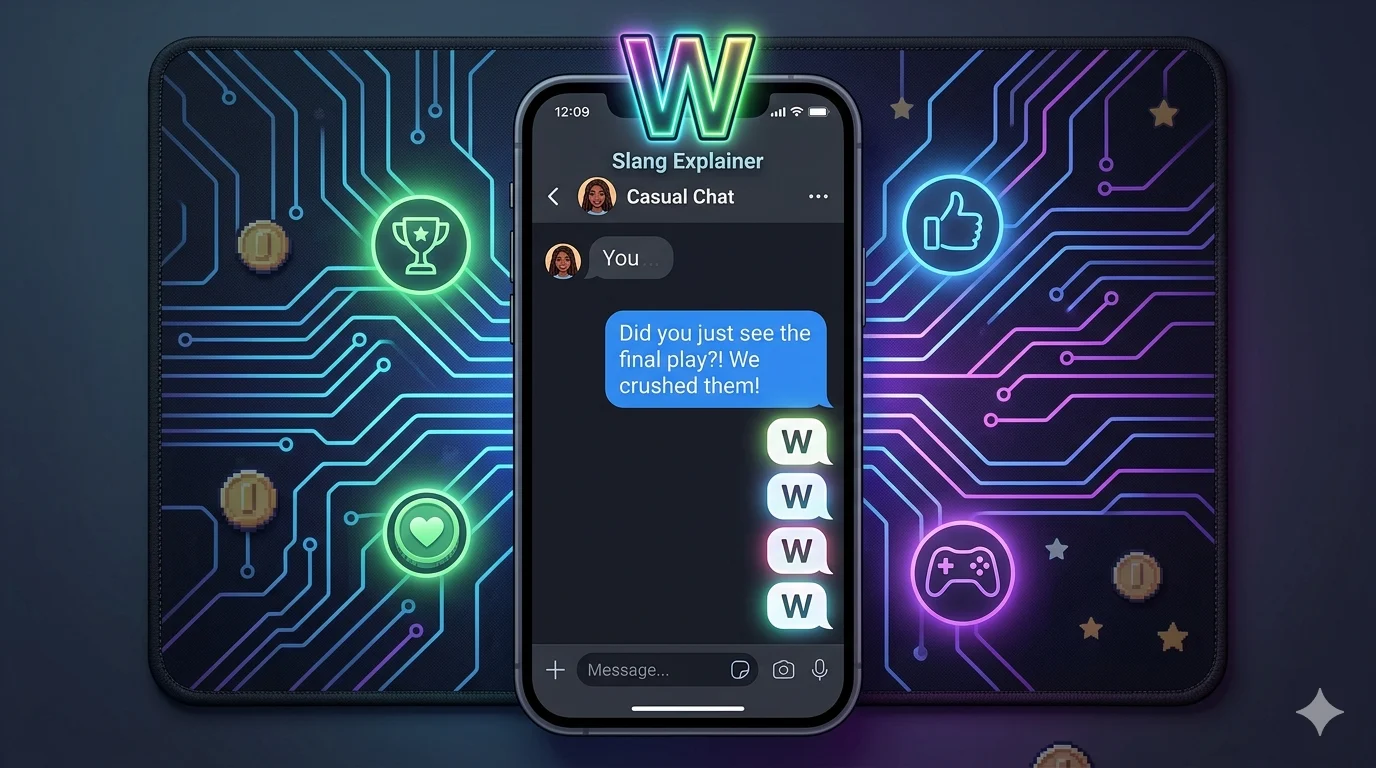
| Term | Meaning |
|---|---|
| W | Win, success, or something positive |
| Full Form | Usually stands for “Win” |
| Context | Texting, gaming, social media, sports, online culture |
| Tone | Positive, supportive, celebratory |
If you’ve spent time on TikTok, Instagram, X, YouTube, Discord, or gaming platforms, you’ve probably seen people comment with a simple letter: “W.” At first glance, it may seem confusing. How can a single letter carry so much meaning?
The answer lies in internet culture. Today, W is one of the most popular slang expressions used online. People use it to celebrate success, praise someone’s actions, support a decision, or react positively to an achievement. In many cases, typing a single “W” is enough to communicate approval and respect.
Because the term appears in so many places, people often search for the meaning of W in texting, social media, and slang. While the most common meaning is “win,” the letter can also have other interpretations depending on context. Understanding when and how people use W can help you better understand online conversations and communicate more naturally on social platforms.
This guide explains the meaning of W, how it is used in texting and internet slang, where it came from, examples of real conversations, and how it compares to similar terms like “L” and “dub.”
What Does W Mean?
The most common meaning of W is win.
When someone says “W,” they are describing a success, achievement, good decision, or positive outcome. It is essentially a shorthand way of saying, “That’s a win.”
People use it to show approval or congratulate someone.
For example:
- Passing an exam can be a W.
- Getting a promotion can be a W.
- Making a smart decision can be a W.
- Receiving good news can be a W.
The term is simple but powerful because it quickly communicates positivity.
In everyday language, you can think of W as meaning:
Success + approval + positivity.
What Does W Mean in Texting, Slang, or Social Media?
The meaning of W remains fairly consistent across texting and social media platforms.
Texting Meaning
In text messages, W is often used as a quick reaction.
For example:
Friend: “I got the job!”
Reply: “Huge W!”
The response means congratulations and recognizes the achievement as a major success.
Another example:
Friend: “I finally finished my project.”
Reply: “W.”
The sender is expressing support and approval.
Social Media Usage
On social media, W is everywhere.
Users often comment “W” under posts they agree with or admire.
Examples include:
- A creator announces good news.
- An athlete achieves a milestone.
- Someone shares a kind act.
- A company launches a popular product.
Commenters may simply write:
- W
- Big W
- Massive W
- Common W
All of these express approval.
Gen Z Usage
Gen Z helped popularize W across social media.
The term became especially common on TikTok, Twitch, YouTube, and gaming communities where short reactions are preferred.
Instead of typing long messages, users can write “W” to instantly communicate positivity.
Other Meanings of W
Although “win” is the most popular meaning, W can have other interpretations depending on context.
W as Win
This is by far the most common meaning online.
Example:
“That’s a W.”
Meaning:
“That’s a success.”
W in Sports
In sports standings, W represents a win.
Teams often have records such as:
- 10 W, 2 L
- 15 Wins, 5 Losses
This usage existed long before internet slang.
W as a Letter
Sometimes W simply refers to the twenty-third letter of the English alphabet.
In these situations, it has no slang meaning.
Specialized Meanings
Certain industries and fields may use W differently.
Examples include:
- Statistics
- Mathematics
- Science
- Business abbreviations
However, when used in online conversations, W almost always means win.
How W Is Used in Real Conversations
The popularity of W comes from its flexibility.
Everyday Conversations
Friends often use W when celebrating achievements.
Examples:
- “You got accepted? W!”
- “That’s a huge W for you.”
- “Big W today.”
Online Discussions
Social media users frequently use W to support opinions.
Examples:
- “This update is a W.”
- “W decision by the developers.”
- “Major W from the company.”
Gaming Communities
Gaming culture helped make W famous.
Players often use it after victories.
Examples:
- “Easy W.”
- “That’s a team W.”
- “Big W boys.”
In gaming, W often represents victory and success.
Examples of W in Sentences
Here are some natural examples:
- “Passing the driving test was a huge W.”
- “The team’s comeback was a massive W.”
- “Getting a scholarship is definitely a W.”
- “That new feature is a W for users.”
- “He apologized and fixed the issue. W.”
- “This collaboration is a big W for both creators.”
- “Finding tickets at that price was a W.”
- “The update improved everything. Common W.”
Tone and Intent
The tone behind W is usually positive.
Emotional Meaning
People use W to express:
- Support
- Approval
- Respect
- Excitement
- Celebration
It creates a feeling of encouragement.
Positive, Negative, or Neutral?
W is almost always positive.
Unlike many slang terms that can have multiple emotional meanings, W generally represents success and positivity.
Serious vs Sarcastic Usage
Most uses are genuine.
However, sarcasm can occur.
Example:
“Another three-hour server outage. Huge W.”
The speaker clearly does not mean it literally.
Instead, they are mocking the situation.
Context helps determine whether W is sincere or sarcastic.
Origin and Background of W
The slang meaning of W comes from the word “win.”
Sports Origin
For decades, sports records used W to represent wins and L to represent losses.
Examples include:
- 20 W
- 5 L
Fans became familiar with the shorthand long before social media existed.
Gaming Influence
Gaming communities expanded the meaning.
Players began calling victories “Ws.”
Eventually phrases like:
- Easy W
- Big W
- Massive W
became common.
Internet Adoption
As gaming culture influenced mainstream internet culture, W spread to social media platforms.
Today it is recognized by millions of users worldwide.
The rise of short-form communication helped make the term even more popular.
Is W Rude or Inappropriate?
No.
W is generally considered safe, friendly, and appropriate.
It does not contain offensive language and is commonly used in public discussions.
You can use it in:
- Text messages
- Social media comments
- Gaming chats
- Casual conversations
However, it is best suited to informal communication.
When NOT to Use W
Although W is widely understood online, there are situations where it may not be appropriate.
Formal Writing
Professional reports, academic papers, and official business documents usually require complete words.
Instead of writing:
“This project was a W.”
You should write:
“This project was a success.”
Common Mistakes
One mistake is assuming everyone understands internet slang.
Older audiences or formal audiences may not recognize the meaning immediately.
Another mistake is using W without context.
Not every reader will know what is being praised.
Similar and Related Slang Terms
Several slang terms are closely related to W.
- Win
- Dub
- Big W
- Common W
- Huge W
- Massive W
- L
- Success
- Victory
These terms often appear together in online conversations.
W vs Related Terms
W vs Win
Both have the same core meaning.
W is simply a shorter slang version.
W vs Dub
Dub is another slang term for win.
Many people use the two interchangeably.
W vs L
These are opposites.
W means success.
L means loss or failure.
W vs Success
Success is more formal.
W is casual internet slang.
Comparison Table
| Term | Meaning | Usage | Key Difference |
| W | Win or success | Social media, texting, gaming | Short slang form |
| Win | Victory or achievement | General English | Full word |
| Dub | Win | Internet slang | Informal alternative |
| L | Loss or failure | Online slang | Opposite of W |
| Success | Positive outcome | Formal and informal contexts | More professional |
| Victory | Winning result | Sports and competition | Often tied to contests |
Common Misunderstandings
One common misunderstanding is believing that W always refers to sports.
While it originated from win-loss records, the slang meaning is much broader today.
Another misconception is that W only appears in gaming communities.
Although gaming helped popularize it, the term is now common across nearly all social media platforms.
Some users also assume W must refer to a major achievement.
In reality, even small positive moments can be called a W.
Finding a parking spot, finishing a task, or receiving good news can all be considered Ws.
FAQ
What does W mean in texting?
In texting, W usually means win, success, or something positive.
What does W mean on social media?
It is often used to show approval, support, or celebration.
Does W mean win?
Yes. In most online contexts, W stands for win.
What is the opposite of W?
The opposite is L, which means loss or failure.
Why do gamers use W?
Gamers use it to celebrate victories and successful outcomes.
What does common W mean?
It refers to someone who regularly makes good decisions or achieves success.
Is W a Gen Z slang term?
Gen Z popularized it online, but people of all ages now use it.
Can W be used in professional communication?
It is generally better to use “success” or “achievement” in formal settings.
What does big W mean?
A big W refers to a major success or significant achievement.
Is W always positive?
Almost always, although it can occasionally be used sarcastically.
conclusion
The meaning of W is simple but powerful. In texting, social media, gaming, and internet culture, W usually stands for “win.” It is used to celebrate success, show approval, support achievements, and react positively to good news. Whether someone comments “W,” “Big W,” or “Massive W,” the message is essentially the same: something good happened. As online communication continues to favor short and expressive language, W remains one of the most popular and widely understood slang terms on the internet.