
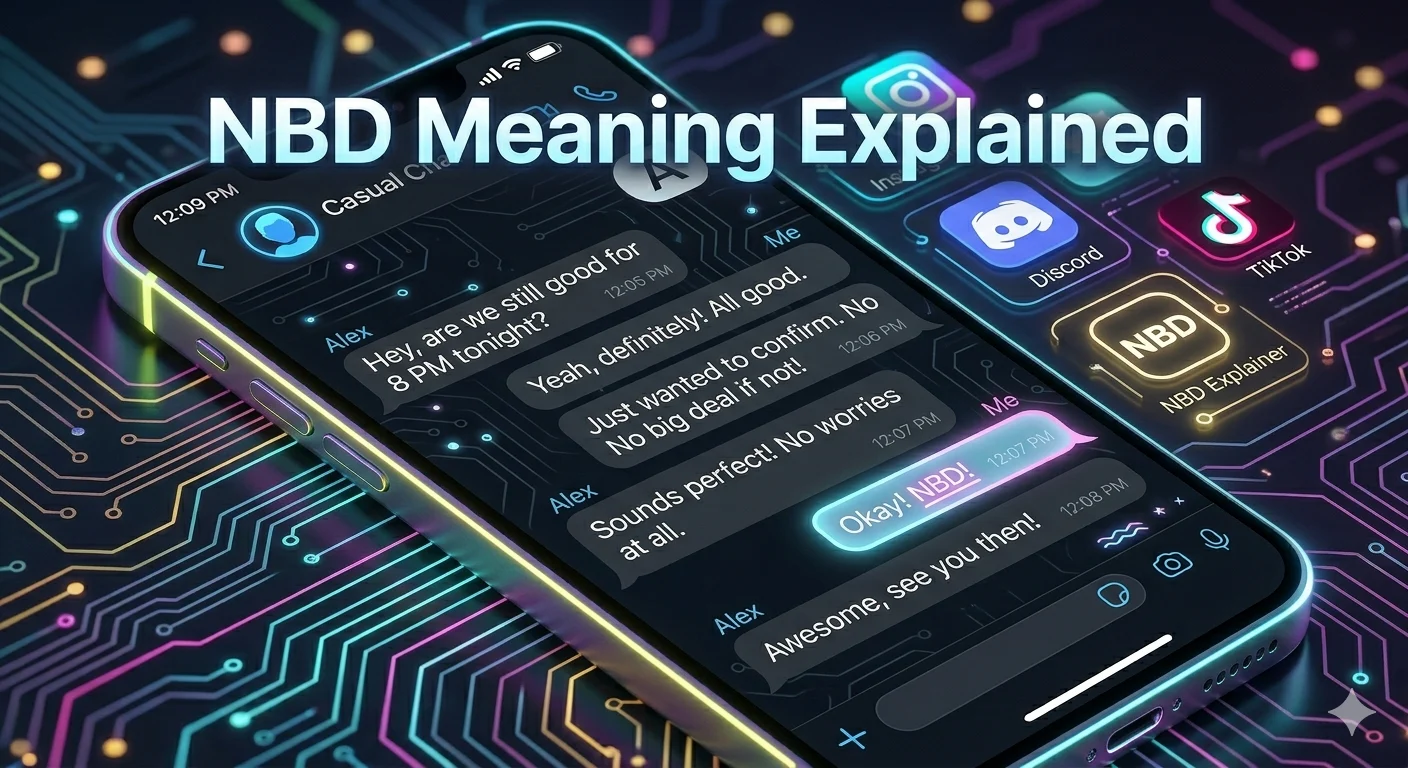
Meaning: NBD means “No Big Deal.”
Full Form: No Big Deal.
Context: Texting, social media, online chats, and casual conversations.
Tone: Relaxed, casual, friendly, and sometimes sarcastic.
If you’ve spent time on social media, texting apps, or online forums, you’ve probably come across the abbreviation “NBD.” Like many internet slang terms, it is short, convenient, and widely used in digital conversations. However, if you’re unfamiliar with online abbreviations, NBD can seem confusing at first.
The term appears in text messages, Instagram captions, TikTok comments, Snapchat chats, and even workplace messaging platforms where informal communication is common. People use it to make conversations feel more relaxed and effortless.
What makes NBD interesting is that it can carry slightly different meanings depending on context. Sometimes it genuinely means that something is not important. Other times, it is used humorously to downplay a major achievement or event. Understanding the context helps you recognize whether someone is being serious, modest, playful, or sarcastic.
In this guide, you’ll learn exactly what NBD means, how people use it online, where it came from, and when you should or should not use it.
What Does NBD Mean?
Core Definition
NBD stands for “No Big Deal.” It is a casual phrase used to indicate that something is not important, not difficult, or not worth worrying about.
People often use NBD to reassure others that a situation is fine or that a favor was easy to do. Instead of saying, “It’s not a problem,” they simply write “NBD.”
For example:
- “Thanks for helping me move!”
- “NBD, happy to help.”
In this situation, NBD means the favor was not a burden.
Common Interpretation
The phrase often minimizes the significance of something. It tells others not to stress, worry, or make a situation seem larger than it is.
For example:
- “Sorry I was five minutes late.”
- “NBD.”
The response communicates that the delay wasn’t important.
What Does NBD Mean in Texting, Slang, and Social Media?
Chat Meaning
In texting, NBD is commonly used as a quick response to apologies, concerns, or expressions of gratitude.
It often replaces phrases such as:
- No problem
- Don’t worry about it
- It’s okay
- Not a big issue
Because texting favors speed and convenience, abbreviations like NBD help people communicate efficiently.
Social Media Usage
On social media, NBD frequently appears in captions and comments. People use it both seriously and humorously.
For example:
- “Just finished my first marathon. NBD.”
- “Met my favorite celebrity today. NBD.”
In these examples, the accomplishment is actually significant. The person uses NBD as a playful way to pretend it isn’t.
This style is often called a “humble brag,” where someone shares an achievement while acting casual about it.
Gen Z Context
Gen Z users frequently use NBD as part of their everyday online vocabulary. It fits naturally with modern internet communication because it is short, expressive, and easy to understand.
You may see it in memes, reaction posts, group chats, and comment sections where users want to appear relaxed or humorous.
Other Meanings of NBD
While “No Big Deal” is by far the most common meaning, NBD can occasionally represent other phrases in specific industries or organizations.
These alternative meanings are relatively rare and usually appear only in specialized professional environments. For the average internet user, NBD almost always means “No Big Deal.”
Whenever you see NBD in a text message, Instagram comment, Snapchat chat, or online discussion, you can safely assume it refers to “No Big Deal.”
How NBD Is Used in Real Conversations
Everyday Situations
NBD appears in many common situations.
Someone may use it when:
- Accepting an apology
- Responding to thanks
- Reassuring a friend
- Minimizing a mistake
- Downplaying an achievement
The phrase helps create a relaxed atmosphere and prevents conversations from becoming overly serious.
Online Platforms
You can commonly find NBD on:
- Snapchat
- TikTok
- Discord
- Facebook Messenger
- SMS text messages
- Online gaming chats
Its simplicity makes it useful across nearly every communication platform.
Examples of NBD in Conversations
Here are some natural examples of how people use NBD;
1
- “Sorry for bothering you.”
- “NBD.”
2
- “Thanks for covering my shift.”
- “NBD, anytime.”
3
- “I accidentally spilled some water.”
- “NBD, I’ll clean it up.”
4
- “Just got promoted at work. NBD.”
- 5
- “Sorry I’m late.”
- “NBD, I just got here too.”
6
- “Finished a 500-page book in one day. NBD.”
7
- “Forgot to text you back.”
- “NBD.”
These examples show how flexible the abbreviation can be.
Tone and Intent
Emotional Meaning
NBD usually communicates calmness and reassurance. It often reduces tension and helps people feel comfortable.
The phrase signals that a situation is under control and doesn’t deserve excessive concern.
Positive, Neutral, and Negative Usage
Positive Usage
- Reassuring friends
- Accepting apologies
- Showing kindness
Neutral Usage
- Casual conversation
- Everyday communication
Negative Usage
- Rarely negative
- May sound dismissive if used carelessly
Sarcasm vs Serious Usage
Context plays a huge role.
Serious example:
- “Sorry for interrupting.”
- “NBD.”
Sarcastic or humorous example:
- “Just won a national competition. NBD.”
In the second example, the speaker clearly knows it is a big deal but is jokingly pretending otherwise.
Origin or Background
Early Internet and Texting Culture
NBD emerged during the rise of internet chat rooms, online forums, and SMS texting.
As mobile phones became popular, people looked for ways to communicate faster. Abbreviations like LOL, BRB, IDK, and NBD became part of digital language.
Shortening common phrases saved time and reduced typing effort.
Popularity on Social Media
The rise of platforms like Twitter, Instagram, and Snapchat helped NBD become even more widespread.
Social media users embraced the phrase because it works well in captions and humorous posts. Its humble-brag style became particularly popular among younger users.
Today, NBD remains a recognizable and frequently used internet slang term.
Is NBD Rude or Inappropriate?
Generally Acceptable Usage
NBD is generally considered safe, friendly, and non-offensive.
Most people view it as a casual way to reassure someone or downplay a situation.
In normal conversation, it rarely causes problems.
Situations Where It May Sound Dismissive
Although NBD is usually harmless, it can sometimes seem dismissive.
For example, if someone is discussing a serious emotional issue and you respond with “NBD,” it may appear insensitive.
Consider the situation before using it.
When NOT to Use It
Formal Communication
Avoid using NBD in:
- Business emails
- Academic papers
- Professional reports
- Job applications
- Official correspondence
Formal writing typically requires complete words and professional language.
Sensitive Situations
NBD may not be appropriate when discussing:
- Personal loss
- Serious health concerns
- Financial difficulties
- Emotional struggles
In these cases, a more thoughtful response is usually better.
Similar and Related Slang Terms
Common Related Terms
NP (No Problem)
Used when responding to thanks.
DW (Don’t Worry)
Used to reassure someone.
IDC (I Don’t Care)
Shows indifference rather than reassurance.
TYSM (Thank You So Much)
An expression of gratitude.
Similar Expressions
You may also see people use:
- No worries
- All good
- It’s fine
- Not a problem
- You’re good
These phrases often serve a similar purpose to NBD.
it vs Related Terms
NBD vs NP
NBD minimizes the importance of something.
NP specifically responds to gratitude or requests.
NBD vs DW
NBD suggests something is unimportant.
DW actively reassures someone not to worry.
NBD vs IDC
NBD means something isn’t a major issue.
IDC suggests a lack of interest or concern.
The emotional tone is very different.
Comparison Table
| Term | Meaning | Usage | Key Difference |
|---|---|---|---|
| NBD | No Big Deal | Downplaying importance | Minimizes significance |
| NP | No Problem | Response to thanks | Focuses on helpfulness |
| DW | Don’t Worry | Reassurance | Calms concerns directly |
| IDC | I Don’t Care | Expressing indifference | Shows lack of interest |
| TYSM | Thank You So Much | Expressing gratitude | Shows appreciation |
Common Misunderstandings
Assuming NBD Is Always Positive
While NBD is usually friendly, it can sometimes sound dismissive if used in the wrong context.
Confusing NBD With Other Acronyms
Some users mistake NBD for a company name, organization abbreviation, or technical term.
In most texting and social media situations, it simply means “No Big Deal.”
Missing the Humble-Brag Usage
One of the most common misunderstandings occurs when people take NBD literally in social media posts.
When someone writes, “Bought my dream house. NBD,” they are often joking and intentionally downplaying a major achievement.
FAQ
What does NBD stand for?
NBD stands for “No Big Deal.”
What does NBD mean in texting?
It means something is not important, serious, or worth worrying about.
Is NBD rude?
Usually no. However, it can sound dismissive in sensitive situations.
What does NBD mean on Instagram?
It often means “No Big Deal” and may be used humorously to downplay achievements.
Is NBD still popular?
Yes. It remains common in texting, social media, and online chats.
Can NBD be sarcastic?
Absolutely. Many users employ it humorously or as a humble brag.
Is NBD professional?
No. It is best suited for casual communication.
What should I reply to NBD?
You can continue the conversation normally or simply acknowledge the response.
conclusion
NBD is a popular internet abbreviation that stands for “No Big Deal.” It is commonly used in texting, social media, and online conversations to show that something is not important, not difficult, or not worth worrying about. The term often creates a relaxed and friendly tone, making it useful for responding to thanks, accepting apologies, or reassuring others.
While NBD is generally positive and harmless, context matters. It can sometimes sound dismissive if used during serious conversations. Understanding when and how to use NBD will help you communicate naturally in modern online discussions and recognize its meaning whenever it appears in chats, captions, or comments.
