
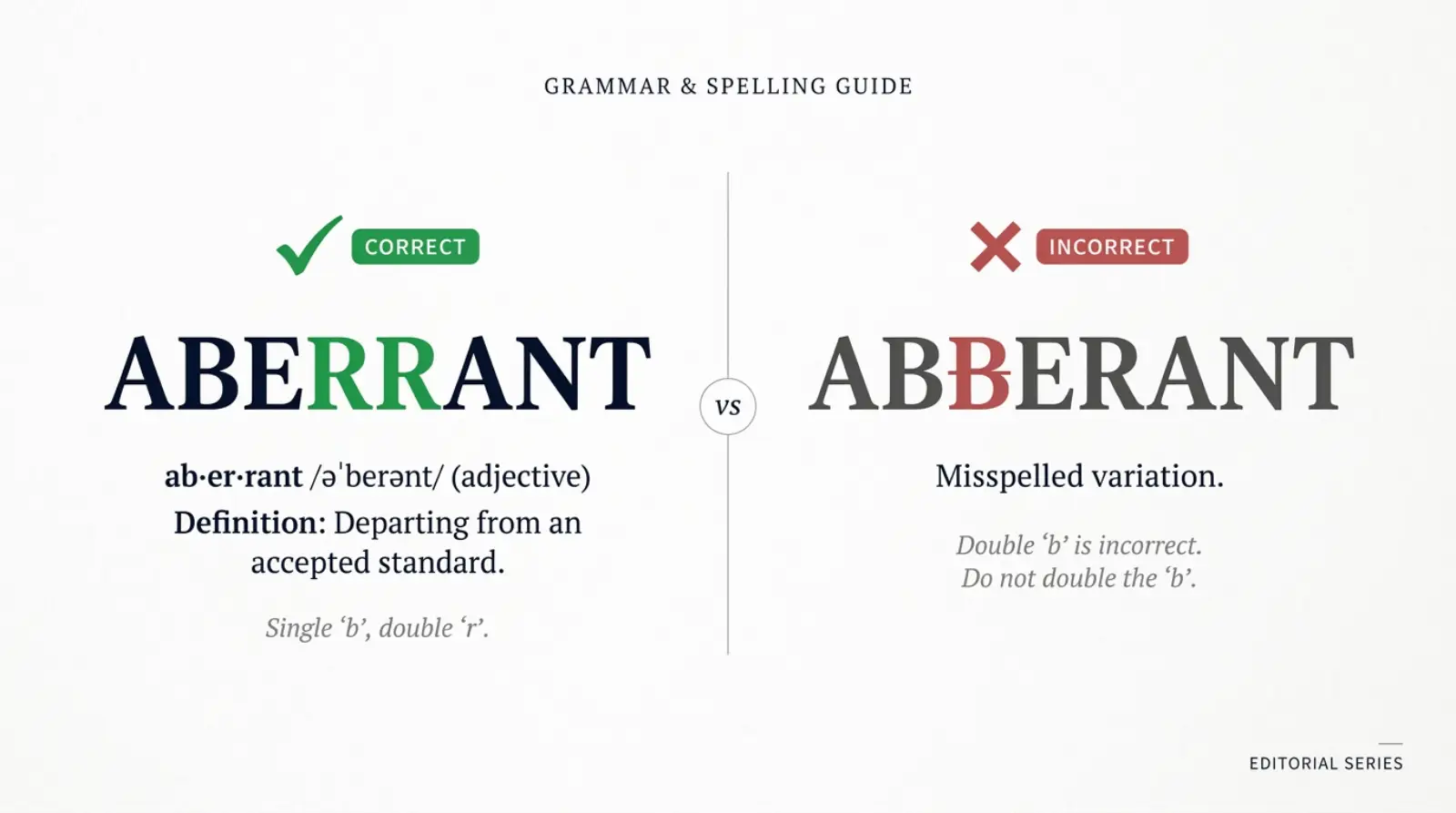
Have you ever wondered whether aberrant or abberant is the correct spelling? These two words look almost identical, making it easy to add an extra letter by mistake. However, only one spelling is accepted in standard English, and knowing the difference can help you avoid common writing errors.
Aberrant is the correct spelling. It means unusual, abnormal, or different from what is normally expected. On the other hand, abberant is a common misspelling that adds an extra B.
Although the difference may seem small, using the correct spelling matters in academic writing, professional reports, emails, and everyday communication. In this guide, you’ll learn the correct spelling, meaning, pronunciation, sentence examples, and easy tips to remember aberrant vs abberant without confusion.
Quick Answer: Aberrant vs Abberant
Aberrant is the correct spelling in American English. It means different from what is normal, usual, or expected.
Abberant is a common spelling mistake. It contains an extra b and is not the standard English spelling.
- Correct spelling: Aberrant
- Incorrect spelling: Abberant
- Meaning: Unusual, abnormal, or deviating from the norm
- Part of speech: Adjective
- Pronunciation: uh-BERR-unt
If you are writing an essay, email, report, or professional document, always use aberrant.
What Is the Difference Between Aberrant and Abberant?
The main difference between aberrant and abberant is spelling. Aberrant is the standard English word, while abberant is an incorrect spelling.
The correct word describes something that differs from an accepted pattern, standard, or expectation. It can refer to unusual behavior, unexpected results, abnormal patterns, or something that does not follow the usual course.
For example:
- Correct: The scientist noticed an aberrant result during the experiment.
- Incorrect: The scientist noticed an abberant result during the experiment.
The first sentence uses the accepted spelling. The second contains a spelling error.
Aberrant vs Abberant: Comparison Table
| Feature | Aberrant | Abberant |
|---|---|---|
| Spelling status | Correct | Incorrect |
| Meaning | Unusual or abnormal | No standard dictionary meaning |
| Part of speech | Adjective | Not a standard English word |
| Pronunciation | Uh-BERR-unt | Intended pronunciation is usually the same |
| Usage | Standard English writing | Spelling mistake |
| Example | Aberrant behavior | Incorrect spelling |
Remember: Use aberrant with one b after the initial letter and two consecutive r letters.
What Does Aberrant Mean?
Aberrant is an adjective that describes something that is different from what is normal, typical, or expected.
It is commonly used when something does not follow an established pattern or standard. The word can describe a person’s behavior, scientific observations, unusual events, or unexpected changes.
For example:
- His aberrant behavior surprised everyone.
- The laboratory discovered an aberrant result in the test.
- The unusual weather pattern was considered aberrant.
- The company investigated an aberrant trend in its sales data.
Depending on the context, aberrant can have a neutral, technical, or negative tone. It does not automatically mean something is dangerous or harmful. It simply indicates a deviation from what is expected.
Why Is Abberant Incorrect?
Abberant is incorrect because the standard spelling of the English word is aberrant.
People often make this mistake because they are unsure how many letters to use when spelling the word. The repeated sounds and letters can make the spelling confusing, especially for people who have only heard the word spoken.
Compare the two spellings:
- A B E R R A N T: Correct
- A B B E R A N T: Incorrect
The easiest way to remember it is that aberrant begins with one a followed by one b, then two r letters.
How to Use Aberrant in a Sentence
You can use aberrant when describing something unusual or different from an established pattern.
Here are some natural examples:
- The teacher noticed an aberrant pattern in the student’s answers.
- Scientists studied the aberrant behavior of the cells.
- His reaction was considered aberrant in that situation.
- The computer system detected an aberrant signal.
- The company investigated an aberrant increase in expenses.
- An aberrant result led researchers to repeat the experiment.
- The unusual event was an aberrant occurrence.
- Her actions seemed aberrant compared with her usual behavior.
These examples show how the word works in everyday, academic, and professional English.
Aberrant: Meaning, Synonyms, and Related Words
Understanding synonyms can help you use aberrant more naturally and avoid repeating the same word.
Common synonyms include:
- Abnormal: Different from what is usual or expected.
- Unusual: Not commonly seen or experienced.
- Deviant: Different from accepted standards or behavior.
- Irregular: Not following a regular pattern.
- Unconventional: Different from traditional or common practices.
- Atypical: Not representing the usual type or pattern.
- Anomalous: Inconsistent with what is expected.
Although these words have similar meanings, they are not always interchangeable. For example, anomalous is often used for unusual data or observations, while unconventional can describe creative or nontraditional choices.
Aberrant vs Abnormal: What’s the Difference?
Aberrant and abnormal both describe something that differs from what is expected, but their usage can vary.
Aberrant often emphasizes a deviation from an established pattern, standard, or normal behavior. It is common in technical, scientific, and formal writing.
Abnormal is a more general word that describes something outside the usual range or standard.
Examples:
- The researchers identified an aberrant pattern in the data.
- The doctor explained that the test showed an abnormal result.
Both words can describe something unusual, but the best choice depends on the sentence and context.
Common Spelling Mistakes Related to Aberrant
Some English words are frequently misspelled because of repeated letters or confusing pronunciation. Here are a few examples:
| Incorrect Spelling | Correct Spelling |
|---|---|
| Abberant | Aberrant |
| Acommodate | Accommodate |
| Occured | Occurred |
| Definately | Definitely |
| Seperate | Separate |
| Recieve | Receive |
Learning these common spelling differences can improve your writing accuracy and help you avoid mistakes in professional and academic communication.
How to Remember the Correct Spelling of Aberrant
A simple spelling trick can help you remember aberrant.
Think of the word as:
A + B + E + R + R + A + N + T
Remember these three points:
- Start with one A.
- Use one B after the A.
- Include two R letters together.
You can also remember this sentence:
“An aberrant pattern has two Rs, not two Bs.”
This simple reminder can help you avoid writing abberant by mistake.
Is Aberrant Formal or Informal?
Aberrant is generally considered a formal English word. It is more common in academic writing, scientific reports, professional discussions, and detailed descriptions than in casual everyday conversations.
For example:
- Formal: The study identified an aberrant pattern in the collected data.
- Casual: The results looked unusual.
Both sentences communicate a similar idea, but the first sounds more technical and formal.
If you are writing a research paper, business report, or academic assignment, aberrant may be an appropriate choice when describing a genuine deviation from an expected pattern.
When Should You Use Aberrant?
Use aberrant when you want to describe something that differs from a normal or established pattern.
It is especially useful in these contexts:
- Science: Describing unusual experimental results or biological patterns.
- Education: Discussing unexpected behavior or performance.
- Business: Identifying unusual trends in sales or financial data.
- Technology: Describing irregular signals or system activity.
- General writing: Explaining something that does not match expectations.
Avoid using aberrant simply as a fancy replacement for every instance of unusual. Choose a simpler word when it makes your sentence clearer.
Common Misunderstandings About Aberrant vs Abberant
Several mistakes can make this spelling choice confusing:
- Thinking both spellings are correct: Only aberrant is the standard spelling.
- Adding an extra B: The correct word has one B, not two.
- Confusing meaning with spelling: Both forms may look similar, but abberant is not the accepted spelling.
- Assuming aberrant always means harmful: It describes a deviation from the norm, which is not necessarily dangerous or negative.
- Using it in every situation: Sometimes words like unusual, abnormal, or atypical are clearer.
Remembering the correct spelling and meaning will help you use the word confidently.
FAQ Section
1. Is aberrant or abberant correct?
Aberrant is correct. Abberant is a misspelling and should not be used in standard English writing.
2. What does aberrant mean?
Aberrant means unusual, abnormal, or different from what is normal or expected.
3. How do you spell aberrant correctly?
The correct spelling is A-B-E-R-R-A-N-T. It has one B and two consecutive Rs.
4. Is abberant a real word?
Abberant is not a standard English word. It is a common misspelling of aberrant.
5. What is another word for aberrant?
Common alternatives include abnormal, unusual, atypical, irregular, deviant, and anomalous. The best synonym depends on the context.
6. Is aberrant a positive or negative word?
Aberrant is generally neutral to negative. It describes something that differs from the expected pattern, but it does not always suggest something harmful.
7. What part of speech is aberrant?
Aberrant is an adjective. It describes a noun, such as aberrant behavior, aberrant results, or aberrant patterns.
8. How do you pronounce aberrant?
It is commonly pronounced uh-BERR-unt.
9. Can I use aberrant in academic writing?
Yes. Aberrant is suitable for academic and scientific writing when describing an unusual result, behavior, or deviation from an established pattern.
10. What is the opposite of aberrant?
Depending on the context, opposites include normal, typical, regular, standard, and conventional.
Conclusion
When comparing aberrant vs abberant, the correct choice is aberrant. It is a standard English adjective meaning unusual, abnormal, or different from what is normally expected.
The spelling abberant is incorrect because it adds an extra B. Remember that aberrant has one B and two Rs.
Whether you are writing an academic paper, professional report, or everyday sentence, using the correct spelling makes your communication clearer and more accurate. If you are ever unsure, choose aberrant and avoid the misspelling abberant.