
Updated: October 16, 2026
Have you ever wondered whether the correct spelling is committed or comited? These words look similar, but only one is correct in standard American English. If you are writing an email, completing a school assignment, preparing a report, or posting on social media, choosing the correct spelling helps make your writing clear and professional.
In this guide, you will learn the difference between committed and comited, understand the spelling rule, explore real-world examples, and discover common mistakes to avoid.
Quick Answer: Committed vs Comited
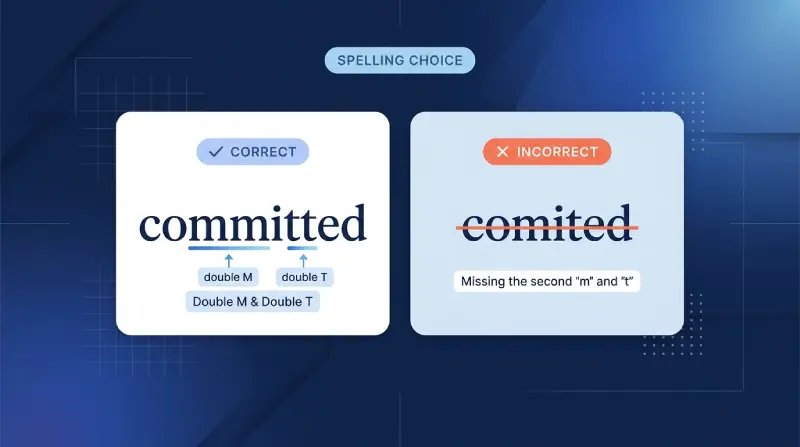
Committed is the correct spelling. Comited is a misspelling and should not be used in standard English.
- Committed: Correct spelling of the past tense and past participle of commit.
- Comited: Incorrect spelling because it contains only one t after the i.
- Example: She committed herself to improving her English.
What Does Committed Mean?
The word committed means dedicated to a person, goal, responsibility, decision, or course of action. It can also mean that someone performed an action, including a crime or mistake.
Committed is the past tense and past participle of the verb commit. It is also used as an adjective to describe someone who is devoted or determined.
Examples of Committed
- She is committed to learning a new language.
- He committed himself to the project.
- The company is committed to customer satisfaction.
- The suspect committed a serious crime.
- They have committed to helping their community.
In each example, committed is spelled with two t letters after the i.
What Does Comited Mean?
Comited is an incorrect spelling of committed. It is not the standard spelling of the past tense or past participle of commit.
The mistake usually happens when writers forget to double the final consonant before adding -ed.
Incorrect: She comited herself to the project.
Correct: She committed herself to the project.
If you see comited in a message, essay, article, or other piece of writing, replace it with committed.
Committed vs Comited: 7 Key Differences
| Feature | Committed | Comited |
|---|---|---|
| Spelling status | Correct | Incorrect |
| Standard English usage | Yes | No |
| Number of t letters | Two consecutive t letters | One t |
| Meaning | Dedicated or performed an action | No standard meaning as a spelling variant |
| Grammar | Past tense, past participle, or adjective | Misspelling |
| Formal writing | Appropriate | Should be corrected |
| Example | He committed to the plan. | He comited to the plan. |
The most important difference is simple: committed is the correct spelling, while comited is a spelling error.
Why Is Committed Spelled With Two Ts?
The spelling of committed follows a common English spelling rule.
The base verb is commit. When you add the suffix -ed, you double the final consonant t:
commit + ed = committed
The final consonant is doubled because commit ends in a consonant-vowel-consonant pattern in its final syllable, with the stress on that final syllable.
Compare these examples:
- Commit → Committed
- Permit → Permitted
- Admit → Admitted
- Omit → Omitted
These verbs follow the same general consonant-doubling pattern when forming their past tense.
Remember that this rule has exceptions and depends on factors such as syllable stress and word structure. However, for commit, the correct form is always committed in standard English.
Committed vs Comited: Example Sentences
Seeing the correct spelling in context makes it easier to remember.
Examples in Everyday English
- She committed to exercising three times a week.
- He remained committed to his personal goals.
- They committed their time to helping others.
- The manager committed to improving workplace communication.
- The student committed a serious error in the report.
Incorrect vs Correct Examples
| Incorrect | Correct |
|---|---|
| She comited to the plan. | She committed to the plan. |
| He comited a mistake. | He committed a mistake. |
| They comited themselves to the cause. | They committed themselves to the cause. |
| The company comited to better service. | The company committed to better service. |
| I comited to finishing the work. | I committed to finishing the work. |
Usage note: In everyday English, people often say “made a mistake” rather than “committed a mistake.” The phrase “committed a mistake” is understandable, but “made a mistake” is generally more natural.
Common Uses of Committed
Committed appears in several contexts. Understanding these uses can help you choose the right word in your writing.
1. Commitment to a Goal
Use committed when someone is determined to achieve something.
Example: She is committed to improving her writing skills.
2. Relationships
Committed can describe someone who is dedicated to a relationship.
Example: They are in a committed relationship.
3. Work and Professional Life
The word can describe dedication to a job, organization, or responsibility.
Example: He is a committed employee who consistently supports his team.
4. Crime or Wrongdoing
Committed can describe carrying out an unlawful or wrongful act.
Example: The individual committed fraud.
5. Promises and Responsibilities
Committed can describe someone who has agreed to do something or take responsibility.
Example: The team committed to delivering the project by Friday.
How to Remember the Correct Spelling
Use these simple tips to avoid writing comited by mistake.
- Remember the base word: Start with commit and add -ed to form committed.
- Double the final T: The correct spelling has two consecutive t letters.
- Compare similar verbs: Remember admitted, permitted, and omitted.
- Use spell-check: A spelling checker can help identify comited in documents and emails.
- Proofread carefully: Look for missing letters before publishing or submitting your writing.
A useful memory trick is to think: Commit has two parts of the final consonant pattern, and committed keeps both Ts.
Committed vs Comited in American English
In American English, committed is the accepted spelling. Comited is not a recognized alternative spelling.
The same standard spelling is used in British English. Unlike some words that differ between American and British English, such as color and colour, committed does not have a regional spelling variation.
Whether you are writing for school, work, a website, or social media, use committed.
Frequently Asked Questions
1. Is committed or comited correct?
Committed is correct. Comited is a misspelling that should be corrected in standard English.
2. Why does committed have two Ts?
The final consonant t is doubled when the suffix -ed is added to commit. Therefore, the correct spelling is committed.
3. Is comited a real word?
Comited is not a standard English spelling. It is generally treated as a misspelling of committed.
4. What is the past tense of commit?
The past tense of commit is committed.
Example: She committed to completing the assignment.
5. What is the difference between commit and committed?
Commit is the base verb, while committed is its past tense and past participle. Committed can also function as an adjective.
Examples:
- Present: I commit to my goals.
- Past: I committed to my goals.
- Adjective: I am a committed learner.
6. Is committed spelled the same in American and British English?
Yes. Both American and British English use committed.
7. How can I avoid misspelling committed?
Remember that the base verb is commit and that the final t doubles before adding -ed. You can also use spell-check and proofread your writing.
Conclusion
When comparing committed vs comited, the decision is straightforward: committed is the correct spelling, and comited is incorrect.
Use committed when describing dedication, responsibility, a promise, or an action that someone performed. Remember the double t to avoid this common spelling mistake in everyday communication and professional writing.
Final decision: Always write committed, never comited, in standard English.
1 thought on “Committed vs Comited: 7 Clear Differences, Correct Spelling, and Examples”