
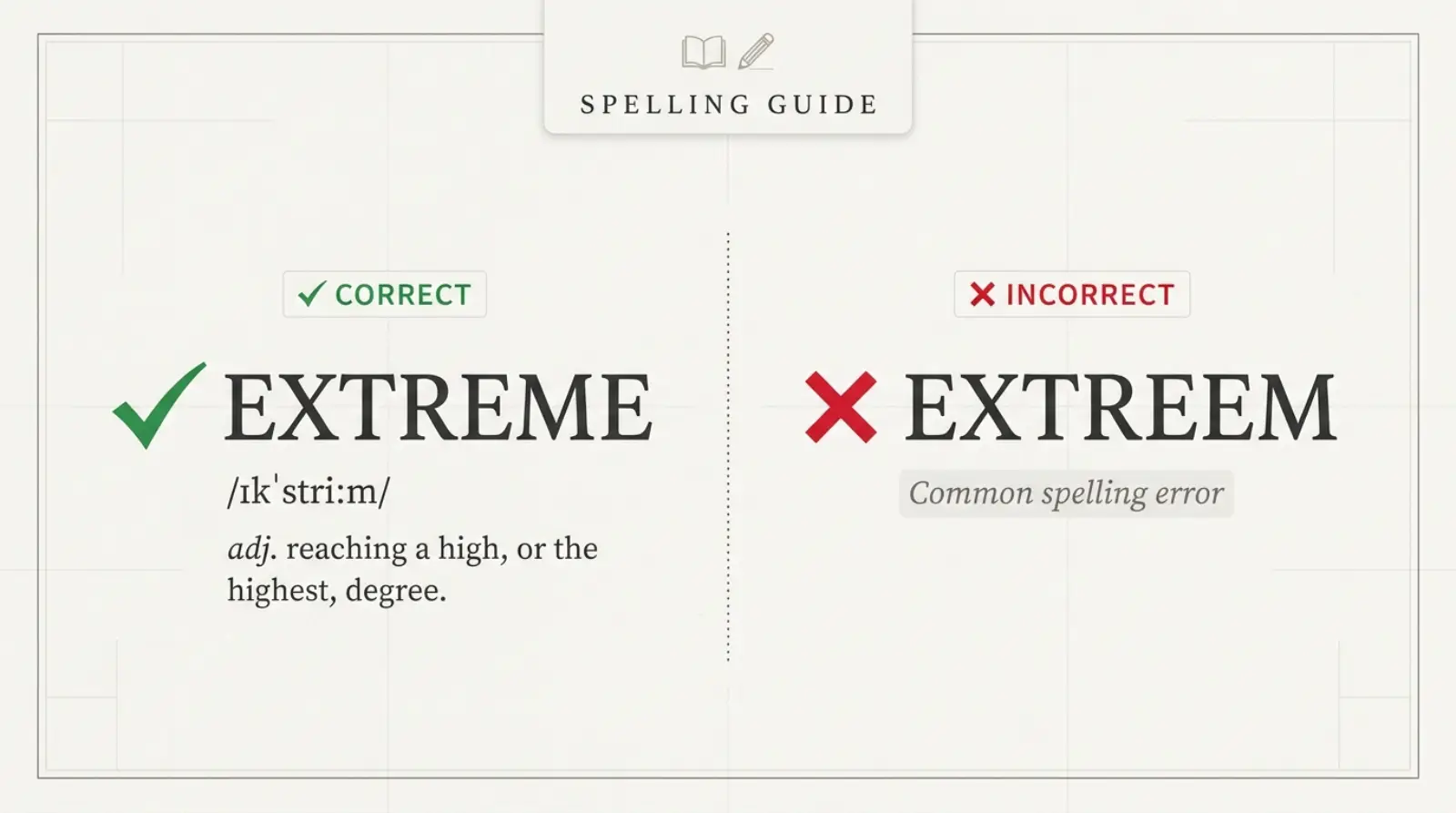
Extreme vs. extreem is a spelling comparison that helps you identify the correct English word and avoid a common typing mistake. The correct spelling is extreme, while extreem is a misspelling in standard English.
The word extreme describes something that is very great, intense, severe, unusual, or far beyond what is considered normal. You can use it to describe extreme weather, extreme sports, extreme emotions, or an extreme situation.
Although extreem may appear in online searches, informal messages, or usernames, it is not the standard spelling you should use in school assignments, professional writing, emails, or published articles.
Quick Answer: Use extreme, not extreem. For example, write “The city experienced extreme heat,” not “The city experienced extreem heat.”
What Is the Difference Between Extreme and Extreem?
The main difference is spelling and correctness. Extreme is the accepted English word, whereas extreem is an incorrect spelling of the same intended word in standard English.
| Feature | Extreme | Extreem |
|---|---|---|
| Correct spelling | Yes | No |
| Standard English word | Yes | No |
| Part of speech | Adjective and noun | Misspelling |
| Meaning | Very intense, severe, or far beyond normal | No standard dictionary meaning |
| Formal writing | Appropriate | Avoid |
| Example | Extreme weather | InCorrect spelling |
| Best choice | Use this spelling | Correct it to extreme |
Remember this simple rule: Extreme is always the correct choice when you mean something unusually intense, severe, or great in degree.
1. Extreme Meaning, Definition, and Usage
Extreme is an English word that means very intense, unusually great, severe, or far beyond the usual limit. It is commonly used when something is stronger, more serious, or more unusual than normal.
Examples of Extreme in Sentences
- The region experienced extreme temperatures during the summer.
- She enjoys extreme sports such as rock climbing and skydiving.
- His reaction to the news was extreme.
- The company took extreme measures to protect its data.
- We faced extreme difficulty while completing the project.
In each sentence, extreme describes something that goes beyond an ordinary level.
What Does Extreme Mean in Different Contexts?
The meaning of extreme can change slightly depending on the context.
| Context | Meaning | Example |
|---|---|---|
| Weather | Very severe conditions | Extreme heat affected the city. |
| Sports | Activities involving high risk or intensity | He enjoys extreme sports. |
| Emotions | Very strong feelings | She felt extreme disappointment. |
| Opinions | Views far from the usual or moderate position | They disagreed over his extreme views. |
| Situations | Serious or unusual circumstances | Extreme measures became necessary. |
| Degree | A very high or low level | The test required extreme precision. |
2. Extreem Meaning: Is It a Correct Word?
Extreem is not a standard English spelling. It is usually a spelling mistake made when someone intends to write extreme.
For example:
- Incorrect: The weather is extreem today.
- Correct: The weather is extreme today.
- Incorrect: That was an extreem reaction.
- Correct: That was an extreme reaction.
- Incorrect: He participates in extreem sports.
- Correct: He participates in extreme sports.
You may encounter extreem in social media profiles, gaming usernames, brand names, or creative writing. In those situations, it may be an intentional name or stylized spelling. However, that does not make it the correct spelling of the ordinary English word.
3. Why Do People Confuse Extreme and Extreem?
There are several reasons people may type extreem instead of extreme.
Similar Pronunciation
In standard English, extreme is generally pronounced /ɪkˈstriːm/. Its final syllable sounds like “streem,” which can lead some writers to use the letter combination ee instead of eme.
Spelling Patterns
English has many words that use ee to represent a long “e” sound, such as green, screen, and between. Writers may incorrectly apply the same pattern to extreme.
Typing Errors
People often type quickly on phones, keyboards, or social media platforms. A spelling mistake can occur even when the writer knows the correct word.
Limited Proofreading
When writing messages, comments, or articles, people may overlook small spelling errors. Spell-checking tools and proofreading can help catch these mistakes.
4. How to Remember the Correct Spelling
Use these simple techniques to remember extreme.
- Memorize the ending: The correct word ends in -eme, not -eem.
- Connect it with familiar words: Remember extreme, extremely, and extremity.
- Use a sample sentence: “The storm was extreme.”
- Check the spelling before publishing: Search for extreem in your document and replace it when you intended to write extreme.
A useful memory trick is to remember the phrase “Extreme has an E before the final M.” This helps you recognize the correct ending.
5. Extreme vs. Extreem: Correct and Incorrect Examples
The following examples show how to use the correct spelling in everyday English.
| Incorrect Sentence | Correct Sentence |
|---|---|
| The heat was extreem. | The heat was extreme. |
| This is an extreem example. | This is an extreme example. |
| She experienced extreem stress. | She experienced extreme stress. |
| The road conditions were extreem. | The road conditions were extreme. |
| He has extreem confidence. | He has extreme confidence. |
| The team faced an extreem challenge. | The team faced an extreme challenge. |
| They made an extreem decision. | They made an extreme decision. |
In each example, changing extreem to extreme corrects the spelling without changing the intended meaning.
6. Extreme as an Adjective and a Noun
The word extreme can function as both an adjective and a noun, although its adjective use is more common in everyday English.
Extreme as an Adjective
An adjective describes a person, thing, condition, or situation. When extreme is used as an adjective, it means unusually intense, severe, or great.
Examples:
- The hikers prepared for extreme weather.
- He showed extreme patience during the meeting.
- The organization faced extreme pressure to meet its deadline.
- She prefers to avoid extreme opinions.
Extreme as a Noun
As a noun, extreme refers to one of two ends or limits of a range, or to a position far from what is considered normal.
Examples:
- The temperature moved from one extreme to another.
- Good decision-making often requires avoiding both extremes.
- The two proposals represent opposite extremes of the debate.
Notice that the spelling remains extreme in both uses. The alternative extreem is not correct in either case.
7. Related Words: Extremely, Extremity, and Extremism
Learning related words can help you recognize the correct spelling and understand how the word family works.
| Word | Part of Speech | Meaning | Example |
|---|---|---|---|
| Extreme | Adjective or noun | Very intense or a far limit | The conditions were extreme. |
| Extremely | Adverb | To a very high degree | The instructions were extremely helpful. |
| Extremity | Noun | The farthest point, a limit, or a serious condition | They reached the extremity of the region. |
| Extremism | Noun | Support for views or actions far outside accepted norms, often in a political or ideological context | The report discussed political extremism. |
| Extremist | Noun or adjective | A person who supports extreme views, or something associated with such views | The article examined extremist movements. |
These related words have different meanings and grammatical functions, but they share the extrem- spelling pattern.
Frequently Asked Questions
1. Is Extreme or Extreem Correct?
Extreme is correct in standard English. Extreem is a misspelling unless it is being used as an intentional name, username, or creative spelling.
2. What Does Extreme Mean in Simple English?
Extreme means very strong, severe, great, or unusual. For example, extreme heat means very high temperatures, while extreme fear means a very strong feeling of fear.
3. Why Is Extreem Incorrect?
Extreem uses an incorrect letter pattern for the standard English word. The correct spelling is extreme, which ends with -eme.
4. How Do You Spell Extreme?
The correct spelling is E-X-T-R-E-M-E.
5. Is Extreem Ever Acceptable?
It can be used as a deliberately invented name, username, brand style, or creative spelling. However, it is not the correct spelling in ordinary formal or informal English when you mean extreme.
6. What Is the Difference Between Extreme and Extremely?
Extreme is usually an adjective or noun, while extremely is an adverb. For example, “The weather is extreme” uses the adjective, while “The weather is extremely hot” uses the adverb.
7. What Is the Plural of Extreme?
When extreme is used as a countable noun, its plural form is extremes. For example, “The two policies represent opposite extremes.” When used as an adjective, it does not take a plural ending.
8. What Is the Opposite of Extreme?
Depending on the context, possible opposites include moderate, mild, ordinary, and average. For example, moderate weather is not as severe as extreme weather.
9. How Can I Avoid Writing Extreem by Mistake?
Remember that the standard spelling is extreme. Use spell-checking tools, proofread your writing, and practice the word in sentences to reinforce the correct spelling.
Conclusion: Extreme vs. Extreem, Which One Should You Use?
The final decision is simple: extreme is the correct spelling, and extreem is a misspelling in standard English. Use extreme when describing something unusually intense, severe, great, or far beyond normal limits.
Whether you are writing a school assignment, a professional email, a social media caption, or a website article, choosing the correct spelling makes your writing clearer and more credible. Remember the -eme ending, and you will be less likely to confuse extreme with extreem.