
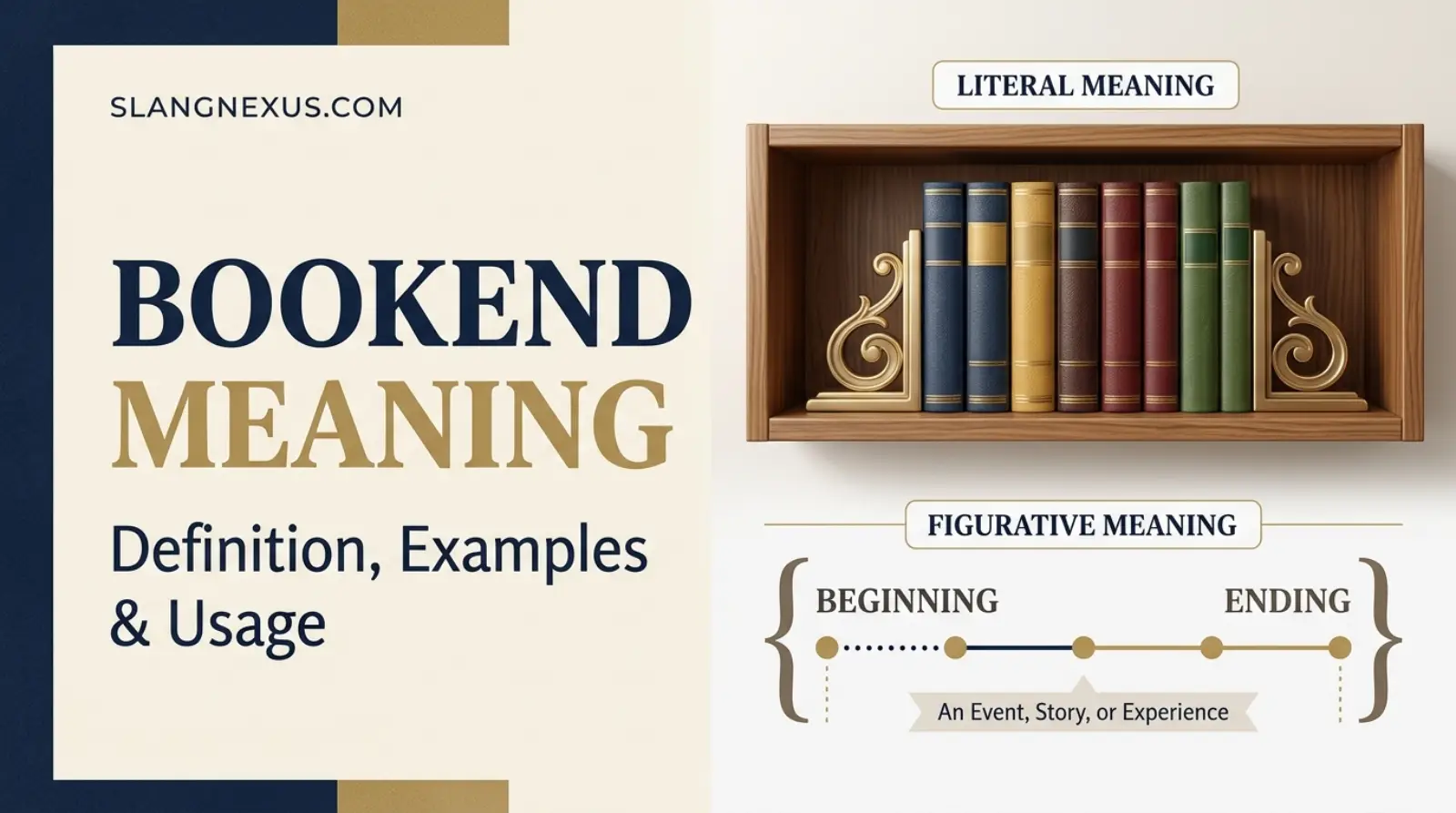
Have you come across the word bookend and wondered what it means? The term has both a literal and a figurative meaning. Literally, a bookend is an object used to keep books upright on a shelf. Figuratively, bookend describes something that marks the beginning and end of an event, period, experience, or story.
Understanding the context makes it easier to recognize how the word is used in everyday conversations, writing, education, and professional settings.
Quick Answer: What Does Bookend Mean?
Bookend (pronounced BOOK-end) is a noun or verb with two main uses:
- Literal meaning: An object that holds books upright at the end of a row.
- Figurative meaning: Something that marks, frames, or connects the beginning and end of an event, experience, or period.
For example, two major events might bookend someone’s career, meaning one happened near the beginning and the other near the end.

definition in the Cambridge English Dictionary
+1
Bookend Definition and Meaning
The word bookend has a straightforward physical meaning and a broader figurative meaning.
1. Bookend as a Noun
As a noun, a bookend is a support placed at the end of a row of books to keep them standing upright. Bookends are commonly used in pairs, one on each side of a collection of books.
They can be made from metal, wood, stone, or other sturdy materials. Some are simple and practical, while others are decorative.
Example: She placed a pair of wooden bookends on her bookshelf.
Meaning: The wooden supports keep the books organized and prevent them from falling over.
2. Bookend as a Figurative Expression
Figuratively, bookend refers to two things that mark the beginning and end of something or frame a period, story, or experience.
For example, a graduation ceremony and a retirement celebration could bookend someone’s professional life. The first marks an important beginning, while the second marks a later ending.
Example: Two family reunions bookended his summer vacation.
Meaning: One reunion took place near the beginning of the vacation, and the other took place near its end.
This figurative use is common in storytelling, journalism, everyday conversation, and descriptions of events.
Dictionary.com
+1
What Does Bookend Mean as a Verb?
As a verb, to bookend means to place something at both ends of another thing or to begin and end an event, story, or period with particular elements.
The verb can describe physical arrangements or figurative connections.
Examples include:
- The opening and closing scenes bookend the movie. The scenes frame the story.
- She bookended her speech with two personal stories. She began and ended her speech with personal stories.
- Two parks bookend the neighborhood. A park is located at each end of the neighborhood.
The past-tense form is bookended, and the present participle is bookending.
| Word form | Example |
|---|---|
| Bookend | These scenes bookend the film. |
| Bookends | The two events bookend the season. |
| Bookended | The conference was bookended by keynote speeches. |
| Bookending | The team is bookending the presentation with demonstrations. |
Bookend Meaning in Everyday Conversation
In everyday English, people often use bookend to explain how two events, experiences, or moments frame a larger period.
The word can make a description more precise by showing that two things are connected through their positions at the beginning and end.
For example:
- “Those two trips bookend my college years.”
- “The wedding and anniversary party bookended a wonderful year.”
- “Her first job and final promotion bookended a successful career.”
In each sentence, bookend highlights the relationship between two endpoints rather than simply listing two unrelated events.
Bookend Meaning in Writing and Storytelling
Writers use bookends to create a sense of structure, closure, or connection.
A story might begin with a character standing at a train station and end with that same character returning to the station years later. The repeated setting acts as a pair of narrative bookends.
Common examples include:
- Books: The introduction and conclusion frame the main discussion.
- Movies: Similar scenes at the beginning and end connect the storyline.
- Speeches: An opening anecdote is repeated or revisited at the end.
- Articles: An introductory question is answered in the conclusion.
Bookending can help an audience recognize how the ending relates to the beginning. It is a descriptive term for this structure, not a requirement that every story follow the same pattern.
Bookend Meaning in Business and Professional Settings
In professional settings, bookend can describe the events or activities that mark the beginning and end of a meeting, project, work period, or career.
Examples:
- “The project was bookended by planning and evaluation meetings.” A planning meeting started the process, and an evaluation meeting closed it.
- “Her first promotion and her retirement bookended her career.” These milestones marked important endpoints in her working life.
- “We bookend the workweek with team meetings.” Meetings take place at the beginning and end of the week.
The word can also describe two physical locations positioned at opposite ends of a site or structure.
Bookend Examples in Sentences
Here are eight original examples showing how bookend works in different contexts.
| Example sentence | Meaning |
|---|---|
| I bought two bookends for my new bookshelf. | Supports that hold books upright. |
| Two memorable concerts bookended the festival. | One concert opened the festival, and another closed it. |
| The film is bookended by scenes from the main character’s childhood. | Similar scenes frame the movie. |
| Her first day at school and graduation bookended twelve years of education. | The events mark the beginning and end of that period. |
| The speaker bookended the presentation with a personal story. | The story appeared at both the start and end. |
| Two apartment buildings bookend the public garden. | Buildings stand at opposite ends of the garden. |
| The season was bookended by unexpected victories. | A victory occurred near both the beginning and end. |
| His childhood memories bookend the memoir. | Memories frame the narrative. |
Bookend vs. Bookend Effect: Is There a Difference?
The term bookend effect describes the impression created when two similar or related things appear at the beginning and end of a larger sequence.
For example, if a presentation opens with a question and closes by answering that same question, the repeated idea creates a bookend effect.
The distinction is simple:
- Bookend: The object, event, or element that frames something.
- Bookend effect: The structural or rhetorical impact created by those beginning and ending elements.
The expression bookend effect is a contextual phrase rather than a separate physical object.
What Is the Origin of the Word Bookend?
The word bookend combines book and end, describing an object placed at the end of a row of books.
Dictionary.com dates the word’s first recorded use to approximately 1905–1910. Merriam-Webster records its noun use from 1907 and its verb use from 1956.
Dictionary.com
+1
The figurative meaning follows naturally from the physical arrangement: just as bookends support a row of books at its two ends, figurative bookends mark or frame the beginning and ending of something else.
Synonyms and Related Expressions
The best alternative to bookend depends on how the word is being used.
| Related word or phrase | Meaning | Best context |
|---|---|---|
| Frame | To surround or provide a structure for something | Stories, discussions, and events |
| Bracket | To mark or enclose a period or sequence | Time periods and activities |
| Mark the beginning and end | To identify both endpoints explicitly | General writing |
| Flank | To be positioned on either side of something | Physical locations or objects |
| Open and close | To begin and end an event or presentation | Speeches, shows, and ceremonies |
| Book support | An object that keeps books upright | Literal meaning |
These expressions overlap with bookend but are not always interchangeable. For instance, flank usually emphasizes position on either side, while bookend can emphasize a connection between a beginning and an ending.
Is Bookend One Word or Two?
In standard American English, bookend is commonly written as one word when used as a noun or verb.
- Correct: She bought a new bookend.
- Correct: The two events bookend the year.
- Also seen in some dictionaries or regional usage: book-end or book end.
For ordinary American English writing, bookend is a clear and widely accepted choice.
definition in the Cambridge English Dictionary
+1
FAQs
1. What does bookend mean in simple terms?
A bookend is an object that holds books upright. Figuratively, it is something that marks or frames the beginning and end of an event, period, or story.
2. What does it mean to bookend something?
To bookend something means to place related elements at its beginning and end. For example, two personal stories can bookend a speech.
3. Is bookend a noun or a verb?
It can be both. As a noun, it refers to a support for books or something that frames a sequence. As a verb, it means to mark or frame the beginning and end of something.
4. What does bookend mean in a relationship or in life?
In discussions about relationships or life experiences, bookend can describe two important moments that mark the beginning and end of a period. The precise meaning depends on the context.
5. What is an example of bookending a story?
A story that begins and ends with the same location, character, question, or situation uses bookending to connect its opening with its conclusion.
6. What is the plural of bookend?
The plural is bookends. For example, “The metal bookends keep my textbooks upright.”
7. What is the difference between a bookend and a bookmark?
A bookend supports books from the side and helps keep them upright on a shelf. A bookmark marks a particular page so a reader can return to it later.
Final Thoughts
The meaning of bookend depends on context. It can refer to a physical support that keeps books upright or, figuratively, to something that marks the beginning and end of an event, story, or period. As a verb, it describes the act of framing something with elements at either end.
When you see the word in a sentence, look at whether the writer is discussing physical objects, events, or storytelling. That simple clue will help you understand its intended meaning.
1 thought on “Bookend Meaning: Definition, Examples, and How to Use It”