
Updated: October 16, 2026
Have you ever wondered whether the correct spelling is disastrous or disasterous? These two words look similar, but only one is accepted as the standard spelling in American English.
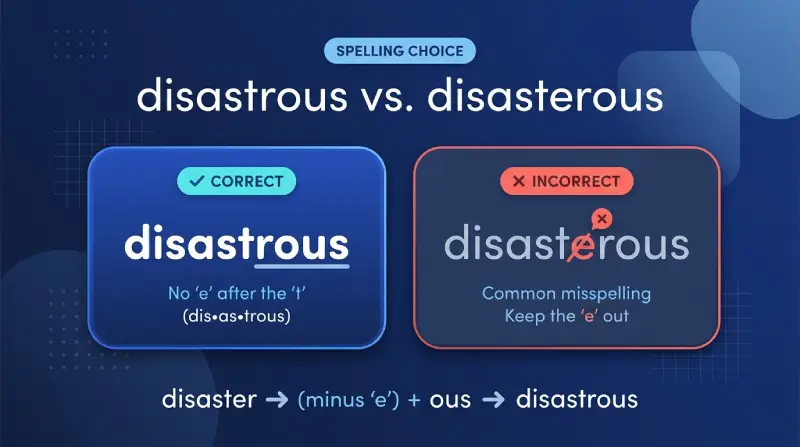
The correct spelling is disastrous, meaning extremely harmful, damaging, unsuccessful, or disastrous in its results. Disasterous is a common misspelling that adds an unnecessary letter e.
In this guide, you will learn the difference between disastrous and disasterous, understand how to spell the word correctly, and explore practical examples to help you avoid this common spelling mistake.
Quick Answer: Disastrous vs. Disasterous
Disastrous is the correct spelling. Disasterous is incorrect in standard American English.
- Correct: The company suffered a disastrous financial loss.
- Incorrect: The company suffered a disasterous financial loss.
Easy rule: Remember that the correct word is disastrous, not disasterous. Although the noun disaster contains an e, the adjective drops that letter before adding -ous.
What Does Disastrous Mean?
Disastrous is an adjective that describes something causing serious damage, harm, failure, or extremely negative consequences.
It can refer to a natural event, a poor decision, a failed business plan, an unsuccessful performance, or any situation with a very bad outcome.
Examples of Disastrous in Sentences
- The hurricane had a disastrous effect on the coastal community.
- Missing the deadline was a disastrous mistake for the project.
- The team’s disastrous performance disappointed its fans.
- Poor financial planning led to disastrous results.
- The new manager made a disastrous decision that affected the entire company.
In everyday American English, disastrous is commonly used in news reports, business discussions, academic writing, and casual conversations.
What Does Disasterous Mean?
Disasterous is a misspelling of disastrous. It is not the standard spelling used in American English.
People often make this mistake because they try to preserve the spelling of the noun disaster when forming the adjective. However, the correct adjective is formed as disastrous, without the letter e.
Incorrect Examples
- The storm caused disasterous damage.
- Her decision was disasterous for the business.
- The experiment produced disasterous results.
Corrected Examples
- The storm caused disastrous damage.
- Her decision was disastrous for the business.
- The experiment produced disastrous results.
Remember: Use disaster when referring to the noun and disastrous when describing something that causes or involves a disaster.
Disastrous vs. Disasterous: Key Differences
| Feature | Disastrous | Disasterous |
|---|---|---|
| Spelling status | Correct | Incorrect |
| Part of speech | Adjective | Nonstandard misspelling |
| Meaning | Causing serious harm or failure | Intended to mean disastrous |
| Standard American English | Yes | No |
| Appropriate for formal writing | Yes | No |
| Example | A disastrous outcome | Incorrect spelling |
The essential difference is spelling, not meaning. When you want to describe something that causes serious damage or has a terrible result, choose disastrous.
Why Is Disastrous the Correct Spelling?
The word disastrous comes from disaster and uses the adjective-forming suffix -ous. In the standard spelling, the final e in disaster is dropped before the suffix is added.
Disaster + -ous = disastrous
The result is disastrous, not disasterous.
Similar spelling patterns appear in other English words where a final e is dropped before a suffix beginning with a vowel. Learning these patterns can help you recognize correct spellings more easily.
7 Examples of Disastrous in Everyday English
Here are seven practical examples showing how to use disastrous correctly.
- Business: The company made a disastrous investment that cost millions of dollars.
- Weather: Heavy flooding had a disastrous impact on local farms.
- Education: A disastrous exam result encouraged him to change his study habits.
- Relationships: Their disastrous argument damaged their friendship.
- Technology: A disastrous software update caused the system to stop working.
- Sports: The team’s disastrous first half made winning the game difficult.
- Daily life: Forgetting her passport was a disastrous start to the vacation.
These examples show that disastrous can describe different situations, provided the outcome is seriously negative.
Common Mistakes to Avoid
Even experienced writers sometimes misspell words that resemble their base forms. Keep these points in mind:
- Do not copy the entire spelling of disaster: The adjective is disastrous.
- Do not add an extra e: Write disastrous, not disasterous.
- Check your spelling before publishing: Spell-checking tools can help identify the error.
- Learn the word as a complete unit: Memorizing disastrous makes it easier to recognize in writing.
- Use context appropriately: Reserve disastrous for situations with seriously harmful, damaging, or unsuccessful outcomes.
Memory Trick: How to Remember Disastrous
Use this simple trick to remember the correct spelling:
DISASTR + OUS = DISASTROUS
Think of the word as disastr followed by ous. The extra e in disaster does not remain in the adjective.
You can also memorize this sentence:
A disaster can have disastrous consequences.
Reading and repeating this sentence reinforces the correct spelling and demonstrates the relationship between the noun and adjective.
Disastrous vs. Disasterous: Which One Should You Use?
The final decision is straightforward: always use disastrous in standard American English.
Choose disastrous in school assignments, professional emails, business reports, articles, blog posts, and everyday writing. Avoid disasterous because it is a spelling error and may make your writing appear less polished.
If you are writing about a disastrous event, a disastrous decision, or disastrous consequences, the correct spelling remains the same.
Frequently Asked Questions
1. Is disastrous or disasterous correct?
Disastrous is correct. Disasterous is a common misspelling and should be avoided in standard American English.
2. Why is disasterous spelled incorrectly?
The mistake often happens because writers retain the final e from disaster. The correct adjective drops that letter before adding -ous.
3. What does disastrous mean?
Disastrous means causing serious damage, harm, failure, or very negative consequences.
4. Is disastrous an adjective?
Yes. Disastrous is an adjective used to describe a person, event, decision, or situation with extremely negative consequences.
5. How do you use disastrous in a sentence?
Example: “The company’s disastrous decision resulted in significant financial losses.”
6. Is disastrous the correct American English spelling?
Yes. Disastrous is the standard spelling in American English and is also the accepted spelling in standard British English.
7. What is the difference between disaster and disastrous?
Disaster is a noun referring to an event or situation that causes great damage or suffering. Disastrous is an adjective describing something that causes or involves such an outcome.
Example: “The earthquake was a disaster, and its effects were disastrous.”
Conclusion
When comparing disastrous vs. disasterous, only disastrous is correct in standard English. The incorrect version, disasterous, results from keeping the extra e in disaster.
Remember the spelling rule: disaster + -ous = disastrous.
Use disastrous whenever you describe something that causes serious harm, damage, failure, or negative consequences. With this simple rule and the examples above, you can avoid this common spelling mistake and write with greater confidence.