
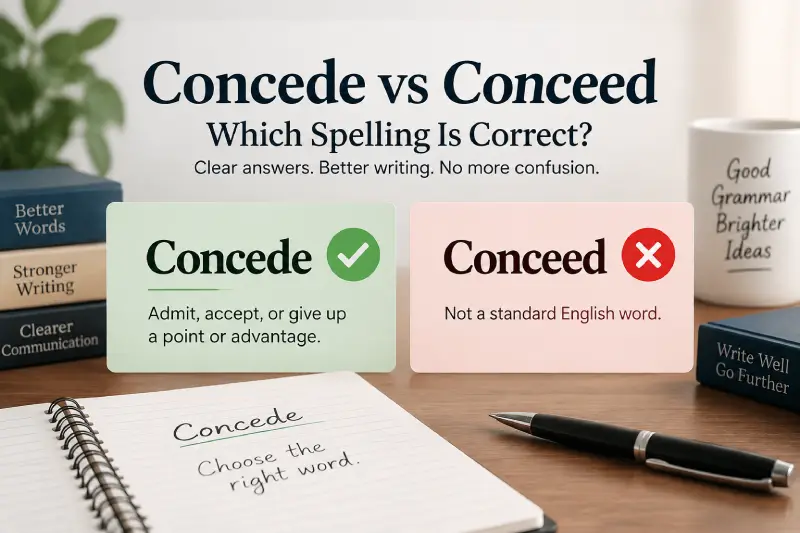
When choosing between concede vs conceed, the correct spelling is simple: concede is the standard English word. Conceed is not a standard spelling.
The confusion happens because many English words use similar letter patterns, especially words ending in -ceed. However, concede follows a different spelling pattern.
Writers often make this mistake when they remember words like “proceed” or “succeed” and assume concede follows the same pattern. It does not.
Quick Answer
Concede is correct.
Conceed is incorrect.
Use concede when you mean:
- to admit something is true
- to accept that someone else is right
- to accept defeat
- to give up a point, right, or advantage
Examples:
- I concede that your argument is stronger.
- The team conceded two goals.
- She conceded defeat after the final results.
Do not use conceed in standard writing.
Why People Confuse Them
People confuse these spellings because English contains many words with similar endings.
Examples:
- proceed
- succeed
- exceed
These words contain -ceed, which makes conceed look believable.
However, concede uses -cede:
- concede ✅
- conceed ❌
The pronunciation also sounds similar to other words with related endings, which can make the spelling harder to remember.
A useful memory trick is:
con + cede = concede
Key Differences At A Glance
| Context | Best Choice | Why |
|---|---|---|
| Standard English writing | Concede | It is the accepted spelling |
| Formal writing | Concede | It is the recognized word form |
| Past tense | Conceded | The correct past form |
| Incorrect spelling | Conceed | Not a standard English word |
| Feature | Concede | Conceed |
|---|---|---|
| Correct spelling | Yes | No |
| Standard word | Yes | No |
| Meaning | Admit, yield, accept | None in standard English |
| Common use | Everyday and formal writing | Spelling mistake |
Are They the Same Word?
No.
They are not two spellings of the same word. Only concede is a standard English word.
Unlike spelling pairs such as color/colour, concede and conceed are not regional variations.
Concede has several related meanings:
- admitting something is true
- accepting another person’s point
- accepting loss in a competition
- allowing something to happen
Conceed does not carry a separate meaning. It is simply an incorrect spelling of concede.
US vs UK Preference
There is no meaningful American versus British spelling difference for this word.
Both American English and British English use:
concede
Examples:
- US English: The candidate conceded the race.
- UK English: The candidate conceded the race.
The spelling does not normally change based on location.
Which Spelling Should You Use?
Use concede every time.
Choose concede when writing:
- school assignments
- workplace messages
- reports
- articles
- emails
- professional documents
Examples:
- I concede that your solution works better.
- The company conceded several points during negotiations.
- The player conceded a goal during the match.
Avoid writing:
- I conceed that you are correct. ❌
Write:
- I concede that you are correct. ✅
When One Spelling Looks Wrong
The spelling conceed looks wrong because it adds an extra “e.”
Correct:
C-O-N-C-E-D-E
Incorrect:
C-O-N-C-E-E-D
The extra “e” changes the word into a form that standard English does not recognize.
The same mistake can appear in related forms.
Correct:
- conceded
- conceding
- concedes
Incorrect:
- conceeded
- conceeding
Common Mistakes (and Quick Fixes)
Mistake 1: Writing “conceed” because of similar words
Wrong:
She conceeded the argument.
Correct:
She conceded the argument.
Mistake 2: Adding an extra letter in the past tense
Wrong:
The team conceeded three goals.
Correct:
The team conceded three goals.
Mistake 3: Treating it as a regional spelling
Wrong idea:
Conceed is the British version.
Correct:
Concede is used in both major varieties of English.
Everyday Examples
Here are common ways to use concede:
- After reviewing the evidence, I concede that you were right.
- The manager conceded that the original plan needed changes.
- The losing team conceded defeat.
- The goalkeeper conceded a goal near the end of the game.
- The company refused to concede control of the project.
These examples show that concede works in conversations, business, sports, and public discussions.
Dictionary-Style Word Details
Verb
• Concede: A standard verb meaning to admit, acknowledge, accept, yield, or allow.
Examples:
- She conceded that the report was accurate.
- They conceded defeat after the final round.
• Conceed: Not a standard verb in English. It is an incorrect spelling.
Noun
• Concede: Not used as a noun.
• Conceed: Not used as a noun.
The related noun is concession, which refers to something granted or accepted.
Synonyms
• Concede: Closest plain alternatives include:
- admit
- acknowledge
- accept
- allow
- yield
The best alternative depends on context.
For example:
- “Admit” works when accepting a fact.
- “Yield” works when giving up a position.
• Conceed: No synonyms apply because it is not a standard word.
Example Sentences
• Concede:
- I concede that the second option is better.
- The candidate conceded the election.
- The team conceded two points.
• Conceed:
- No standard example exists because the spelling is incorrect.
Word History
• Concede: The word comes from older language roots connected with ideas of yielding, allowing, or giving way.
• Conceed: No separate word history exists because it is not a standard English spelling.
Phrases Containing
Common phrases with concede include:
- concede a point
- concede defeat
- concede an argument
- concede a goal
- concede that something is true
Conceed does not appear in standard phrases.
Frequently Asked Questions
Is it concede or conceed?
The correct spelling is concede. Conceed is a common misspelling and should not be used in standard English.
What does concede mean?
Concede means to admit that something is true, accept that you have lost, or give something up or grant it to someone.
Is conceed a word?
No. Conceed is not the standard spelling of the English verb. Use concede instead.
How do you use concede in a sentence?
You can use concede when someone admits a fact or accepts an outcome. For example: “She conceded that her original estimate was wrong.”
Why do people spell concede as conceed?
The mistake usually comes from the pronunciation and the spelling pattern of similar words. Remember that the standard spelling is concede, ending in -cede.
What is the easiest way to remember concede?
Remember concede = con + cede. The ending is -cede, not -ceed, which makes concede the correct spelling.
Conclusion
The correct choice is clear: use concede, not conceed.
Concede is the accepted English spelling used in American and British English. It means to admit something, accept defeat, give ground, or allow something.
Conceed is only a spelling mistake, often caused by confusion with words like proceed and succeed.
Remember:
Concede = correct
Conceed = incorrect