
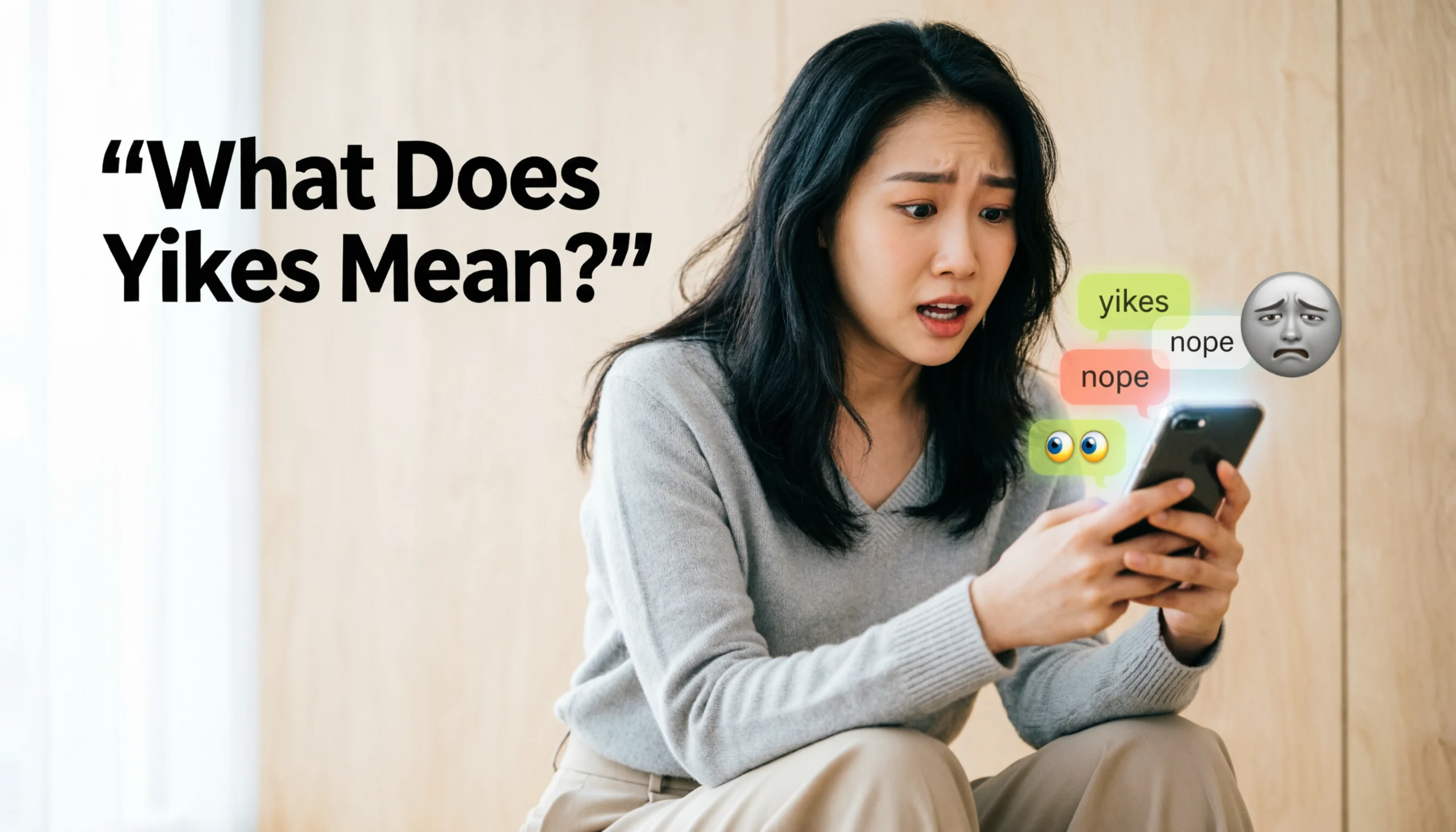
Meaning: An expression used to react to something awkward, embarrassing, uncomfortable, surprising, unpleasant, or concerning.
Full Form: Yikes is not an acronym, so it has no full form.
Context: Common in texting, social media, memes, comments, and casual conversations.
Tone: Usually expresses concern, discomfort, surprise, or secondhand embarrassment; it can also be playful or sarcastic.
Example: “You sent that message to your boss? Yikes! 😬”
Have you ever seen someone reply “yikes” to a text, social media post, or comment and wondered exactly what they meant? This small word can communicate a surprisingly wide range of emotions.
You might see yikes in a TikTok comment, Instagram caption, Reddit discussion, meme, group chat, or ordinary conversation. It is especially common when someone encounters something awkward, embarrassing, shocking, uncomfortable, or concerning.
For example, imagine your friend tells you that they accidentally sent a private message to their boss instead of their partner. You might simply respond:
“Yikes 😬.”
You don’t need to write a long explanation. That one word communicates that you understand how uncomfortable the situation is.
However, yikes doesn’t always mean the same thing. Sometimes it expresses genuine concern. Sometimes it is humorous. It can even be sarcastic or mildly judgmental.
The word is also older than modern internet slang. Although social media has made yikes extremely common online, people have used it as an exclamation in spoken English for much longer.
So, what does yikes mean in texting and slang? Let’s break down its meaning, examples, tone, history, and differences from similar expressions.
What Does Yikes Mean?
Yikes is an exclamation used to react to something unpleasant, uncomfortable, surprising, awkward, or concerning.
In simple English, it can mean:
- “Oh no!”
- “That’s awkward.”
- “That doesn’t look good.”
- “Wow, that’s uncomfortable.”
- “I wouldn’t want to be in that situation.”
- “That was a bad idea.”
- “This is concerning.”
The exact meaning depends on what happened.
For example:
“I just realized I emailed the wrong attachment to my teacher. Yikes.”
Here, yikes expresses embarrassment and concern.
Another example:
“The car repair is going to cost $3,000. Yikes!”
In this situation, it communicates surprise and concern about the expensive price.
The word doesn’t necessarily mean that something is disastrous. It can describe something mildly awkward or genuinely serious.
That’s what makes yikes useful in casual communication. It lets someone react emotionally without having to explain everything.
What Does Yikes Mean in Texting, Slang, and Social Media?
Yikes in Text Messages
In texting, yikes is often used as a quick reaction.
Instead of writing:
“Wow, that’s a really awkward situation.”
someone might simply text:
“Yikes 😬”
The meaning is understood from the previous message.
For example:
Friend: “I accidentally called my teacher ‘Mom.’”
You: “Yikes 😂”
Here, you’re probably not seriously concerned. You’re reacting to an embarrassing moment and finding it funny.
In another conversation:
Friend: “The doctor wants me to come back for another test.”
You: “Yikes. I hope everything is okay.”
Here, yikes expresses genuine concern.
So, the same word can have a playful or serious meaning depending on the conversation.
Yikes on Social Media
On social media, yikes is often used in comments and replies to express an immediate reaction.
For example:
“Yikes, that comment did not age well.”
Or:
“Yikes 😬 this whole situation is awkward.”
It can also appear in memes and captions where users want to emphasize an uncomfortable situation without writing a long explanation.
Sometimes the word is used to criticize someone’s behavior:
“He really thought posting that was a good idea. Yikes.”
In this case, yikes carries a slightly judgmental tone.
Yikes in Modern Internet Culture
Yikes works particularly well online because it is short, expressive, and easy to understand.
Internet users often communicate emotions through individual words, abbreviations, emojis, GIFs, and memes. Yikes fits naturally into this style of communication.
Although younger users may use it frequently, yikes isn’t exclusively a Gen Z slang term. It is understood by many English speakers across different age groups.
Other Meanings of Yikes
Unlike some abbreviations, yikes doesn’t have several completely unrelated meanings. Its main purpose is to express a reaction.
However, the emotional meaning can change depending on the situation.
“Yikes!”
A simple:
“Yikes!”
usually signals immediate surprise, discomfort, or concern.
“Yikes 😬”
Adding the grimacing emoji often emphasizes awkwardness or discomfort.
“Yikes…”
The three dots can make the reaction feel more serious, uncomfortable, or disappointed.
“Yikes on Bikes”
“Yikes on bikes” is a playful extended version of yikes. It doesn’t introduce a new meaning. Instead, it adds humor and emphasis.
For example:
“Yikes on bikes, that was expensive!”
The speaker is simply emphasizing how surprising or unpleasant the situation is.
How Yikes Is Used in Real Conversations
People use yikes in many different situations.
Embarrassing Situations
“She accidentally called her ex while talking about him.”
“Yikes.”
The word communicates secondhand embarrassment.
Bad News
“The flight was canceled and there are no more seats today.”
“Yikes.”
Here, it expresses concern or frustration.
Awkward Conversations
“He asked her out five minutes after meeting her.”
“Yikes.”
This suggests that the speaker finds the situation awkward or uncomfortable.
Questionable Decisions
“He spent his entire paycheck on a phone.”
“Yikes.”
The speaker is reacting to what they see as a questionable choice.
Surprising Information
“The repair bill is $2,500.”
“Yikes!”
Here, the word communicates shock.
You can encounter yikes in:
- Text messages
- Group chats
- Instagram comments
- TikTok comments
- X
- YouTube comments
- Memes
- Casual conversations
- Everyday speech
Yikes Meaning Examples
Here are some natural examples that show how people use the word.
Example 1: Embarrassment
“I accidentally sent my private joke to my boss. Yikes.”
Meaning: The speaker is embarrassed and uncomfortable about what happened.
Example 2: Bad News
“They said the repairs could take three weeks. Yikes.”
Meaning: The speaker is concerned or disappointed by the situation.
Example 3: Awkward Moment
“He asked her to marry him on their second date. Yikes.”
Meaning: The speaker thinks the situation is unusually intense or awkward.
Example 4: Humor
“I ate the entire cake by myself. Yikes 😂.”
Meaning: The speaker is joking about their behavior.
Example 5: Social Media
“Yikes, those comments are getting out of control.”
Meaning: The speaker is concerned about the direction of the discussion.
Example 6: Surprising Cost
“That tiny coffee machine costs $900? Yikes!”
Meaning: The speaker is surprised by the price.
Example 7: Secondhand Embarrassment
“He posted a romantic message meant for his girlfriend in the family group chat. Yikes 😬.”
Meaning: The speaker feels embarrassed for him.
Example 8: Concern
“She hasn’t slept properly for three days. Yikes, I hope she’s okay.”
Meaning: The speaker is genuinely concerned.
Tone and Intent of Yikes
The tone of yikes can change dramatically depending on the situation.
Concerned
Someone may use yikes when they hear something worrying.
“You haven’t slept all night? Yikes.”
This suggests genuine concern.
Embarrassed
It can also express embarrassment.
“I accidentally called my manager by the wrong name. Yikes.”
Surprised
Sometimes yikes simply means the speaker is shocked.
“That phone costs $2,000? Yikes!”
Amused
Friends may use it jokingly.
“I ate six slices of pizza. Yikes 😂.”
Here, the word is playful rather than serious.
Judgmental
Yikes can sometimes imply that the speaker thinks someone’s behavior was inappropriate or questionable.
“He said that during the interview? Yikes.”
The speaker is indirectly criticizing what happened.
Sarcastic
It can also be sarcastic.
“Yikes, imagine having to wait five minutes for your coffee.”
Here, the speaker may be joking about someone complaining over a very minor inconvenience.
Punctuation and emojis can help clarify the intended tone:
- “Yikes!” — stronger reaction
- “Yikes…” — uncomfortable or disappointed
- “Yikes 😬” — awkwardness
- “Yikes 😂” — humorous reaction
- “Yikes…” — potentially serious concern
Origin and Background of Yikes
Yikes is not a word invented by social media.
It has been used as an English interjection for a long time. Like other reaction words, it developed as a quick way to express an emotional response without forming a complete sentence.
Its meaning is related to expressions of surprise, alarm, discomfort, or apprehension.
Modern internet culture helped make the word even more visible. Texting and social media favor short expressions that can communicate an entire reaction quickly, and yikes fits that purpose perfectly.
Instead of explaining:
“That situation makes me feel extremely uncomfortable and I don’t know what to say.”
someone can simply write:
“Yikes.”
The rise of memes, reaction comments, and emoji-based communication has also helped reinforce its modern informal use.
Is Yikes Rude or Inappropriate?
Yikes is generally not considered a rude or offensive word. It is not profanity, and people commonly use it in everyday casual conversation.
However, the way you use it can make it sound judgmental.
For example:
“Yikes, that’s unfortunate.”
may sound sympathetic.
But:
“Yikes. What were you thinking?”
can sound critical or insulting.
It can also be insensitive if someone is sharing something deeply personal or painful.
If a person tells you about a serious loss, medical crisis, or traumatic experience, responding only with “Yikes” may sound dismissive.
In sensitive situations, a more empathetic response is usually better.
When Not to Use Yikes
Although yikes is harmless in many casual situations, there are times when another response is more appropriate.
Serious Personal Problems
If someone is sharing serious emotional or personal difficulties, simply saying “yikes” may seem too casual.
Instead, try:
“I’m sorry you’re dealing with that.”
Professional Communication
Yikes is informal. It may not be appropriate in a formal email, business report, or professional presentation.
Instead of:
“Yikes, that’s a big problem.”
you might say:
“That could be a significant issue.”
Sensitive News
When someone shares serious news, a quick reaction word may not communicate enough empathy.
Think about the situation before responding.
When You Don’t Want to Sound Judgmental
Yikes can sometimes imply that you disapprove of someone’s behavior.
If you’re trying to remain completely neutral, a more direct and thoughtful response may be better.
Similar and Related Slang Terms
Several words can express reactions similar to yikes, but each has a slightly different feeling.
Oof
Oof often expresses sympathy, disappointment, pain, or the impact of a difficult situation.
“I failed my driving test.”
“Oof.”
Cringe
Cringe describes something embarrassing, awkward, or uncomfortable, especially when you experience secondhand embarrassment.
“That video is so cringe.”
Whoa
Whoa usually communicates surprise, shock, or amazement. It isn’t necessarily negative.
“Whoa, that’s a huge house!”
Ouch
Ouch can describe physical pain or emotional hurt.
“She rejected him in front of everyone.”
“Ouch.”
OMG
OMG means “Oh my God” and can express surprise, excitement, shock, disbelief, or concern.
“OMG, you actually won!”
Unlike yikes, OMG can easily be positive.
Yikes vs Related Terms
Yikes vs Oof
Both can react to an uncomfortable situation, but oof often expresses sympathy or the feeling that something hurts.
“I lost my job.”
“Oof.”
Yikes may sound more concerned or alarmed:
“You lost your job? Yikes.”
Yikes vs Cringe
Yikes is a reaction word.
Cringe more specifically describes something embarrassing, awkward, or uncomfortable.
For example:
“Yikes, he forgot her name.”
is a reaction.
“That was cringe.”
is a description of the behavior or moment.
Yikes vs Whoa
Whoa is generally associated with surprise or amazement and can be positive.
“Whoa! That’s beautiful.”
Yikes usually suggests that the surprise is uncomfortable, concerning, or negative.
“Yikes! That’s expensive.”
Yikes vs OMG
OMG can express almost any strong reaction, including excitement.
“OMG! We won!”
Yikes is more commonly associated with discomfort, concern, awkwardness, or an unfavorable situation.
Yikes Meaning Comparison Table
| Term | Meaning | Usage | Key Difference |
|---|---|---|---|
| Yikes | Reaction to something awkward, concerning, or unpleasant | Texting, social media, casual speech | Usually carries discomfort or concern |
| Oof | Reaction to pain, disappointment, or difficulty | Casual conversations and online comments | Often expresses sympathy |
| Cringe | Embarrassing or uncomfortable | Social media and casual speech | Describes awkwardness more directly |
| Whoa | Surprise, shock, or amazement | Everyday speech and texting | Can be positive or negative |
| OMG | Strong surprise or emotion | Texting and social media | Can express excitement as well as shock |
| Ouch | Physical or emotional pain | Casual speech and online conversations | More directly associated with hurt |
Common Misunderstandings About Yikes
One common misunderstanding is that yikes always means something terrible happened. That’s not necessarily true.
Someone might say:
“Yikes, this coffee is expensive.”
The situation isn’t serious. The speaker is simply surprised.
Another misunderstanding is that yikes always means anger. It doesn’t. The speaker may be concerned, amused, embarrassed, surprised, or mildly judgmental.
Some people also assume that yikes is exclusively internet slang. While social media has helped popularize it, the word has been used as an English exclamation outside the internet for many years.
Finally, yikes doesn’t always mean the speaker is criticizing someone. Consider:
“Yikes, I hope you’re okay.”
This clearly communicates concern rather than judgment.
Frequently Asked Questions About Yikes
What does yikes mean in texting?
In texting, yikes is a reaction to something awkward, embarrassing, surprising, uncomfortable, or concerning. The exact emotion depends on the conversation.
Is yikes a slang word?
Yikes is commonly used as an informal expression and is often treated as slang in online communication. However, it is also an established English interjection and isn’t limited to internet culture.
Is yikes a bad word?
No. Yikes is generally not considered a bad word or profanity. It is a mild expression of surprise, discomfort, or concern.
What does yikes mean on social media?
On social media, yikes is often used as a quick reaction to awkward, embarrassing, concerning, or questionable content.
Can yikes be positive?
Usually, yikes has a negative or uncomfortable feeling. However, people sometimes use it playfully or sarcastically, especially when reacting to something minor.
What is the difference between yikes and oof?
Yikes often communicates discomfort, concern, or awkwardness, while oof more commonly expresses sympathy, disappointment, or the impact of something difficult.
What does “yikes 😬” mean?
“Yikes 😬” usually emphasizes awkwardness or discomfort. The grimacing emoji makes the reaction feel more visibly uneasy.
Is yikes rude?
Yikes itself is not rude, but it can sound judgmental or dismissive depending on how it is used. Context matters.
conclusion
So, what does yikes mean? It is an informal reaction word used when something feels awkward, embarrassing, surprising, uncomfortable, unpleasant, or concerning.
In texting and social media, it is often used as a quick emotional response. A simple “Yikes 😬” can communicate an entire reaction without a lengthy explanation.
The meaning isn’t always negative or serious. It can show genuine concern, playful humor, surprise, secondhand embarrassment, or mild judgment. The surrounding conversation, punctuation, and emojis usually reveal the speaker’s intended tone.
Compared with related expressions, yikes is closest to a reaction of discomfort or concern. Oof leans toward sympathy, cringe focuses on embarrassment, whoa emphasizes surprise, and OMG can express a much broader range of emotions.
In short, when someone says “yikes,” they’re usually reacting to a situation that makes them think: “Oh no, that’s awkward!” 😬