
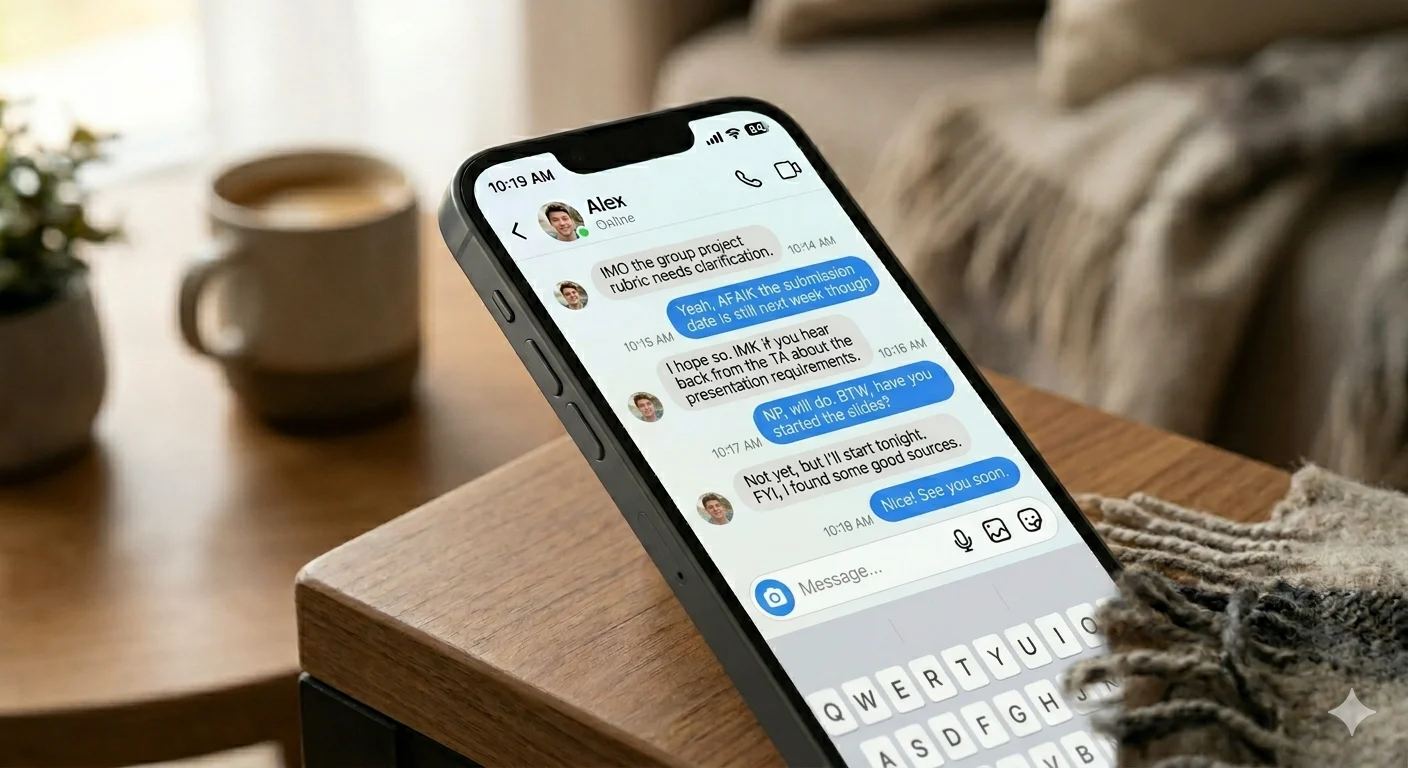
Meaning: “IMK” usually means In My Knowledge.
Full form: In My Knowledge.
Context: Text messages, social media discussions, online forums.
Tone: Informal, neutral, slightly cautious.
If you’ve seen “IMK” in a chat or comment and paused for a second, you’re not alone. Internet slang moves fast. New abbreviations appear all the time, and not all of them are widely known. “IMK” is one of those terms that can feel unfamiliar, even if you’re used to texting shortcuts.
People often search for “IMK meaning in texting” because it looks similar to other popular abbreviations like “IMO” or “IMHO.” That similarity can make it confusing. Is it an opinion? A fact? A guess? Without context, it’s not always clear.
You’ll usually find “IMK” in casual conversations—WhatsApp chats, Instagram comments, Reddit threads, or even gaming discussions. It’s not as common as some other slang terms, but it still shows up enough to cause confusion.
The key to understanding “IMK” is knowing how it shapes the message. It doesn’t just give information—it also shows how confident the speaker is. In this guide, you’ll learn what “IMK” means, how people use it in real life, and how it compares to similar terms.
What does “IMK” mean?
“IMK” stands for In My Knowledge. It’s used when someone shares information based on what they personally know or believe to be true.
In simple words, it means:
- “As far as I know”
- “From what I understand”
- “Based on my knowledge”
It’s a way of saying something without claiming absolute certainty. Instead of sounding 100% sure, the speaker leaves room for correction.
For example, instead of saying “This is the correct answer,” someone might say, “IMK, this is the correct answer.” That small change makes the statement softer and more open.
What does “IMK” mean in texting / slang / social media?
Chat meaning
In texting, “IMK” is used when someone wants to explain something but isn’t completely sure. It helps avoid sounding too confident or arrogant.
It’s often used in:
- Explanations
- Advice
- Corrections
Social media usage
On social media, “IMK” appears in comments and discussions. People use it when they share information, especially in debates or conversations where facts matter.
For example, someone might reply to a post with “IMK, that feature was added last year.” This shows they are sharing knowledge but not claiming to be an expert.
Gen Z context
Gen Z users often prefer language that feels flexible and non-absolute. Terms like “IMK,” “IMO,” and “AFAIK” fit this style. They allow people to speak without sounding too rigid or confrontational.
Other meanings of “IMK”
While “In My Knowledge” is the most common meaning in texting, “IMK” can have other meanings depending on context.
Some less common interpretations include:
- Internet Message Key (technical context)
- Institute of Management Knowledge (organizational use)
- Initials of a name or group
These meanings are rare in everyday chat. In most cases, if you see “IMK” in a message, it refers to “In My Knowledge.”
How “IMK” is used in real conversations
“IMK” is used when someone wants to share information while staying polite and open to correction.
You’ll see it in situations like:
- Answering a question
- Explaining something
- Correcting someone gently
- Giving advice
It’s common on platforms like:
- Facebook comments
- Instagram replies
- Reddit discussions
- Online forums
It helps keep conversations respectful, especially when there’s a chance the information might not be fully accurate.
Examples
Here are some natural examples of how “IMK” is used:
- “IMK, the store closes at 9.”
- “IMK, this phone has a better battery.”
- “IMK, he moved to another city last year.”
- “IMK, that feature is only on premium accounts.”
- “IMK, you need a license for that.”
- “IMK, this method works better.”
- “IMK, they already announced the update.”
Each example shows how the speaker shares information without sounding too certain.
Tone and intent
The tone of “IMK” is usually neutral and informative. It doesn’t express strong emotions. Instead, it focuses on clarity and caution.
It can feel:
- Polite: Because it avoids sounding bossy
- Careful: Because it shows uncertainty
- Helpful: Because it still provides information
In some cases, it may sound slightly unsure. But that’s not a weakness—it’s often intentional. It shows honesty about limits in knowledge.
Origin or background
“IMK” comes from the phrase “In My Knowledge,” which is similar to expressions like “As far as I know.” Over time, internet users shortened these phrases into quick abbreviations.
It follows the same pattern as:
- IMO (In My Opinion)
- IMHO (In My Honest Opinion)
- AFAIK (As Far As I Know)
These abbreviations became popular because they save time and reflect the casual nature of online communication.
Is it rude or inappropriate?
“IMK” is not rude or offensive. It’s actually quite polite.
It softens statements and shows respect for other viewpoints. Instead of forcing an opinion, it leaves space for discussion.
However, in some situations, it may sound:
- Too uncertain
- Not confident enough
So while it’s safe to use, it may not always be the best choice when strong confidence is required.
When NOT to use it
You should avoid using “IMK” in formal or professional settings, such as:
- Job emails
- Business communication
- Academic writing
- Official reports
In these situations, it’s better to use clear and direct language. If you’re unsure, it’s better to verify the information instead of using casual abbreviations.
Similar and related slang terms
There are several similar terms that serve a similar purpose:
- IMO (In My Opinion)
- IMHO (In My Honest Opinion)
- AFAIK (As Far As I Know)
These terms are more widely used and easier for most people to understand.
“IMK” vs related terms
“IMK” is close in meaning to “AFAIK,” but slightly different.
- “IMK” focuses on personal knowledge
- “AFAIK” emphasizes uncertainty
- “IMO” focuses on opinion, not facts
Choosing the right one depends on what you want to express.
Comparison Table
| Term | Meaning | Usage | Key Difference |
|---|---|---|---|
| IMK | In My Knowledge | Sharing info cautiously | Focus on personal knowledge |
| IMO | In My Opinion | Expressing opinions | Not about facts |
| IMHO | In My Honest Opinion | Stronger opinion | Adds emphasis |
| AFAIK | As Far As I Know | Uncertain info | Highlights possible inaccuracy |
Common misunderstandings
“IMK” is often misunderstood because:
- It’s not as popular as similar terms
- It looks like other abbreviations
- People may confuse it with “IMO”
Some may think it means opinion, while others may not recognize it at all. This can lead to confusion in conversations.
FAQ Section
1. What does “IMK” mean in texting?
It means “In My Knowledge.”
2. Is “IMK” the same as “AFAIK”?
They are similar, but “AFAIK” is more commonly used.
3. Is “IMK” an opinion?
Not exactly. It’s based on knowledge, not just opinion.
4. Can I use “IMK” in professional emails?
No, it’s better to avoid slang in formal communication.
5. Why do people use “IMK”?
To share information without sounding too certain.
6. Is “IMK” widely used?
It’s less common than similar abbreviations but still used online.
7. Can “IMK” be misunderstood?
Yes, especially by people unfamiliar with it.
8. Is “IMK” polite?
Yes, it often sounds polite and respectful.
conclusion
“IMK” means “In My Knowledge” and is used to share information in a careful, non-absolute way. It’s useful in casual conversations where you want to be helpful without sounding too confident.
While it’s safe and polite, it’s not the most common abbreviation. If clarity is important, you may want to use more familiar terms like “AFAIK.” Still, in the right context, “IMK” fits naturally and adds a thoughtful tone to your message.
1 thought on “Meaning of “IMK” in Texting, Slang, and Online Chat”