
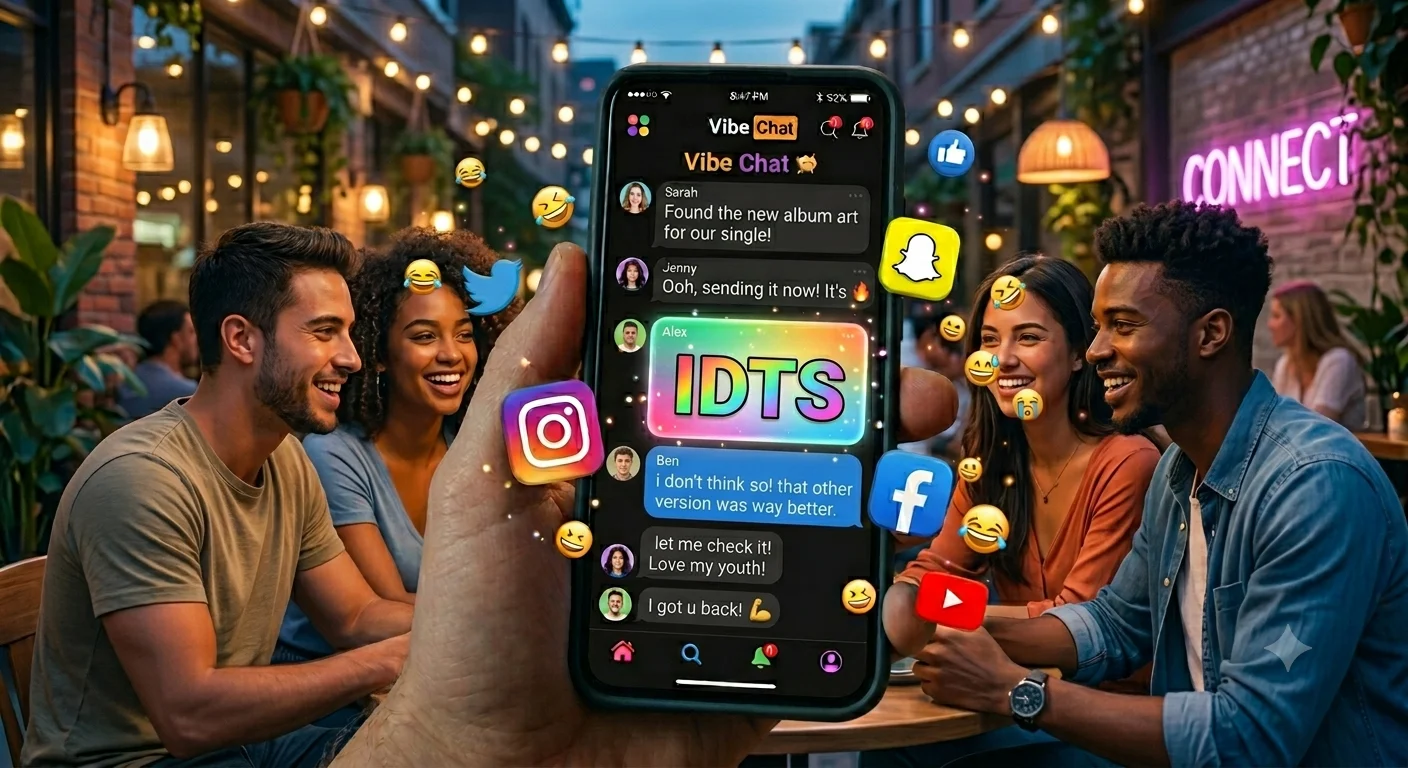
Meaning: IDTS means “I Don’t Think So.”
Full Form: I Don’t Think So
Context: Text messages, social media, online chats, gaming communities, and casual conversations.
Tone: Doubtful, skeptical, casual, and usually polite.
If you’ve recently seen the abbreviation IDTS in a text message, social media comment, TikTok reply, Snapchat chat, or online discussion, you may be wondering what it means. Internet slang is constantly evolving, and many common phrases are shortened into abbreviations to make conversations faster and more convenient.
IDTS is one of those abbreviations that appears frequently in casual digital communication. While it may seem confusing at first, its meaning is usually straightforward once you understand the context. In most cases, IDTS stands for “I Don’t Think So.”
People use IDTS when they disagree with a statement, express doubt about something, or indicate that they believe something is unlikely. The abbreviation helps users communicate opinions quickly without typing a complete sentence.
This guide explains the IDTS meaning, how it is used in texting and social media, real-life examples, tone, origin, comparisons with similar slang terms, and common misunderstandings.
What Does IDTS Mean?
IDTS most commonly stands for “I Don’t Think So.”
It is a shorthand way of expressing doubt, disagreement, or uncertainty.
For example:
“Do you think it will rain today?”
“IDTS.”
In this conversation, the person believes rain is unlikely.
The abbreviation often functions as a softer alternative to saying “No.”
Instead of completely rejecting an idea, the speaker expresses an opinion that something is probably not true or unlikely to happen.
Depending on the context, IDTS can mean:
- I don’t think that’s correct.
- I don’t think it will happen.
- I doubt it.
- Probably not.
- That’s unlikely.
The exact interpretation depends on the surrounding conversation.
What Does IDTS Mean in Texting, Slang, and Social Media?
In texting, IDTS is commonly used when responding to questions, opinions, predictions, or assumptions.
Examples include:
“Will they finish the project today?”
“IDTS.”
Or:
“Do you think he forgot?”
“IDTS.”
The abbreviation helps people express skepticism quickly while maintaining a casual tone.
On social media, IDTS frequently appears in:
- TikTok comments
- Instagram replies
- Snapchat messages
- Facebook discussions
- Discord chats
- X posts
- Online forums
For example:
“This movie is winning every award.”
“IDTS.”
In this situation, the commenter is expressing disagreement or doubt.
Many younger users prefer abbreviations like IDTS because they make conversations shorter and more efficient.
Other Meanings of IDTS
Although “I Don’t Think So” is the most common meaning, IDTS can occasionally represent different phrases in specialized industries, organizations, or internal systems.
Possible alternative meanings include:
- Technical abbreviations
- Company-specific terminology
- Internal project codes
- Specialized professional jargon
However, these meanings are relatively uncommon.
When used in texting, social media, online chats, and gaming communities, IDTS almost always means “I Don’t Think So.”
This is why context remains important when interpreting abbreviations.
How IDTS Is Used in Real Conversations
IDTS is often used when people want to express doubt without sounding overly aggressive.
Common situations include:
- Disagreeing with a prediction
- Questioning a rumor
- Responding to assumptions
- Expressing uncertainty
- Debating opinions
- Discussing future events
For example:
“Will the team win the championship?”
“IDTS.”
Another example:
“Do you think the store is open?”
“IDTS. It’s pretty late.”
The abbreviation helps communicate skepticism quickly while keeping conversations informal.
Common platforms where IDTS appears include:
- Text messages
- Messenger
- Snapchat
- TikTok
- Discord
- Gaming chats
- Reddit discussions
Examples of IDTS in Sentences
Here are some natural examples of IDTS in everyday conversations:
- Do you think they’ll arrive on time? IDTS.
- Will this trend last all year? IDTS.
- Do you think she forgot our meeting? IDTS.
- Can we finish everything tonight? IDTS.
- Will that phone drop in price soon? IDTS.
- Do you think the rumor is true? IDTS.
- Will it snow tomorrow? IDTS.
- Do you think he’s serious? IDTS.
These examples show how IDTS is commonly used to express doubt or disagreement.
Tone and Intent
The tone of IDTS is generally casual and conversational.
Unlike a direct “No,” it often sounds softer and less confrontational.
People use IDTS when they want to:
- Express doubt
- Share an opinion
- Disagree politely
- Show skepticism
- Indicate uncertainty
Positive, Negative, or Neutral?
IDTS is usually neutral.
It is not necessarily negative, although it often reflects skepticism.
The abbreviation simply communicates that the speaker does not believe something is likely or true.
Sarcastic vs Serious Usage
Most of the time, IDTS is used sincerely.
However, it can also be used sarcastically.
For example:
“Sure, he’s going to become a millionaire overnight.”
“IDTS.”
Here, the abbreviation may carry a humorous or sarcastic tone.
The surrounding context usually makes the intended meaning obvious.
Origin and Background of IDTS
IDTS originated from internet shorthand culture.
As texting and instant messaging became popular, users began shortening common phrases to save time and typing effort.
Many widely recognized abbreviations emerged, including:
- LOL (Laughing Out Loud)
- BRB (Be Right Back)
- IDK (I Don’t Know)
- IMO (In My Opinion)
- IDTS (I Don’t Think So)
The phrase “I Don’t Think So” has long been used in spoken English.
As online communication evolved, users shortened it to IDTS.
The abbreviation spread through:
- SMS messaging
- Chat rooms
- Online forums
- Social media platforms
- Gaming communities
Today, it remains a common way to express doubt in digital conversations.
Is IDTS Rude or Inappropriate?
Generally, IDTS is not considered rude.
In fact, it is often less harsh than directly saying “No.”
Because it suggests personal opinion rather than absolute rejection, it can soften disagreements.
Most users view IDTS as:
- Casual
- Respectful
- Informal
- Non-offensive
- Appropriate for friendly conversations
However, tone matters.
If used repeatedly or without explanation, it may sound dismissive.
Adding context can make it friendlier:
“IDTS, but we’ll see what happens.”
This sounds more conversational than a simple one-word response.
When NOT to Use IDTS
Although IDTS works well in casual conversations, it is not appropriate for every situation.
Avoid using IDTS in:
- Professional emails
- Business reports
- Academic writing
- Official documents
- Workplace communication
- Formal presentations
For example:
“Will the proposal succeed? IDTS.”
This may appear unprofessional.
Instead, use complete sentences such as:
“I don’t believe the proposal is likely to succeed.”
Formal settings generally require clearer and more professional language.
Similar and Related Slang Terms
Several abbreviations and phrases have meanings similar to IDTS.
IDK
IDK means “I Don’t Know.”
It expresses uncertainty rather than disagreement.
IMO
IMO means “In My Opinion.”
It introduces a personal viewpoint.
TBH
TBH means “To Be Honest.”
It often precedes a candid opinion.
Probably Not
This phrase communicates doubt in a direct way.
I Doubt It
This phrase carries a meaning very close to IDTS.
IDTS vs Related Terms
IT vs IDK
IDTS expresses doubt.
IDK expresses lack of knowledge.
IDTS vs TBH
IDTS communicates skepticism.
TBH introduces an honest statement or opinion.
IDTS vs I Don’t Think So
Both have exactly the same meaning.
IDTS is simply the abbreviated version.
Comparison Table
| Term | Meaning | Usage | Key Difference |
|---|---|---|---|
| IDTS | I Don’t Think So | Expressing doubt | Indicates skepticism |
| IDK | I Don’t Know | Expressing uncertainty | Lack of knowledge |
| IMO | In My Opinion | Sharing views | Focuses on personal opinion |
| TBH | To Be Honest | Honest statements | Introduces candid remarks |
| Probably Not | Unlikely | Casual conversations | More direct wording |
| I Doubt It | Skeptical response | Expressing disbelief | Stronger doubt |
Common Misunderstandings
One common misunderstanding is assuming IDTS means a definite “No.”
In reality, it usually expresses doubt rather than certainty.
Another misunderstanding is confusing IDTS with IDK.
While both abbreviations involve uncertainty, their meanings are different.
IDK means the person lacks information.
IDTS means the person has an opinion that something is unlikely.
Some users may also misinterpret IDTS as being rude when it is often intended as a polite expression of disagreement.
Frequently Asked Questions
What does IDTS stand for?
IDTS stands for “I Don’t Think So.”
What does IDTS mean in texting?
It means the sender doubts something or believes it is unlikely.
Is IDTS rude?
No. It is generally considered a casual and polite expression of skepticism.
Is IDTS the same as saying “I don’t think so”?
Yes. The abbreviation and full phrase have the same meaning.
Is IDTS popular on social media?
Yes. It appears frequently in comments, chats, and online discussions.
Can IDTS have different meanings?
Occasionally, but “I Don’t Think So” is by far the most common meaning.
Can I use IDTS at work?
It is better to use complete phrases in professional communication.
When should I use IDTS?
Use IDTS when expressing doubt, skepticism, or disagreement in informal conversations.
conclusion
IDTS is a popular internet abbreviation that stands for “I Don’t Think So.” It is commonly used in texting, social media, gaming communities, and online discussions when someone wants to express doubt, skepticism, or polite disagreement.
The abbreviation is simple, efficient, and easy to understand once you know its meaning. Whether you’re responding to a prediction, questioning a rumor, or sharing your opinion, IDTS provides a quick way to communicate uncertainty without sounding overly harsh. Understanding the context ensures that you can both recognize and use IDTS correctly whenever you encounter it online.