
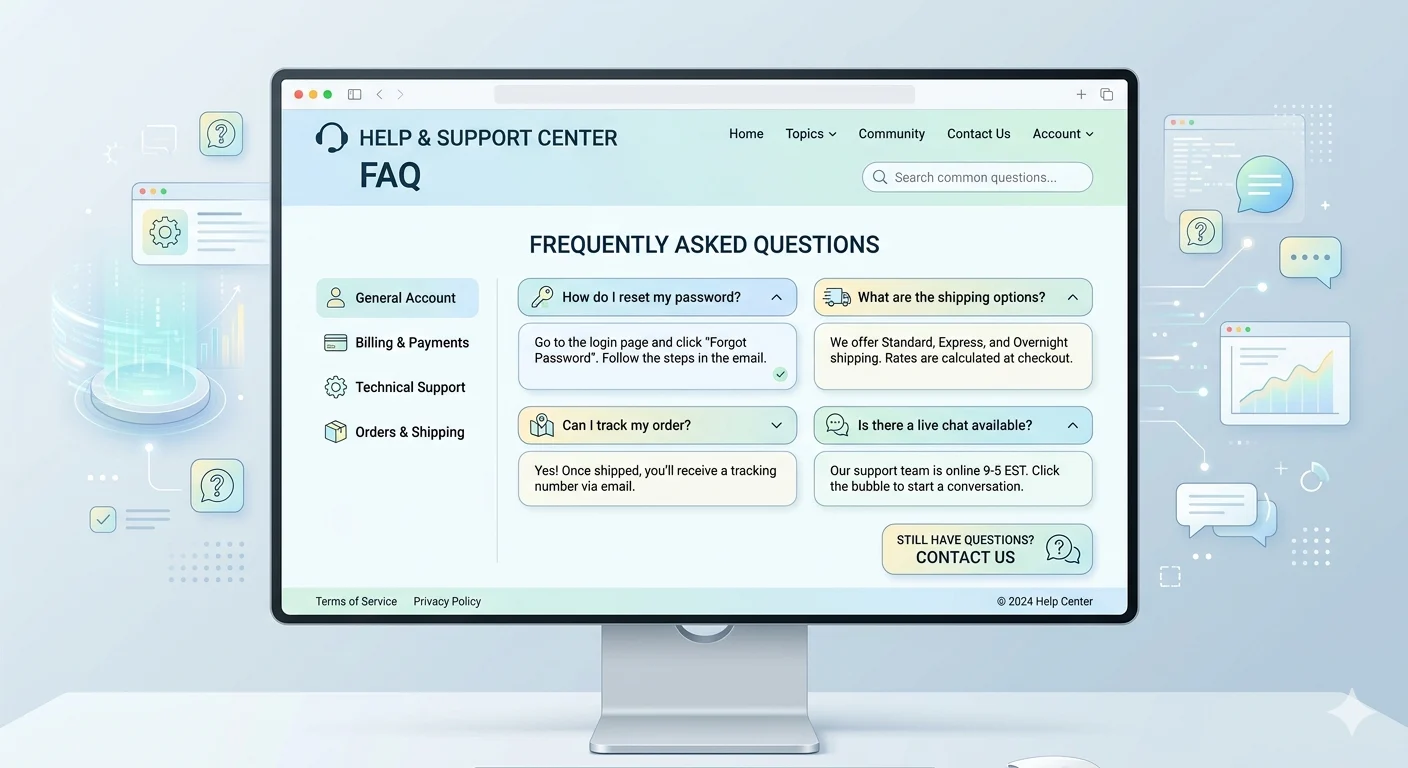
Meaning: FAQ means a list of common questions and their answers.
Full form: Frequently Asked Questions.
Context: Websites, apps, customer support, online guides.
Tone: Neutral, helpful, informational.
Introduction
When browsing websites, signing up for apps, or shopping online, you have probably come across the term “FAQ.” Many people search for “FAQ meaning” because they see it often but are not fully sure what it stands for or how it works.
At first, it may look like a technical or confusing term, especially for beginners who are new to online platforms. However, the concept behind FAQ is actually very simple and useful in everyday digital life. FAQ stands for “Frequently Asked Questions,” and it is designed to help users quickly find answers to common queries without needing extra help.
Whether it is about payments, delivery, account issues, or general information, FAQ sections are created to save time and provide clear guidance. They are widely used by businesses, websites, and service providers to improve user experience and reduce repeated questions. Understanding what FAQ means and how it is used can make your online experience much smoother. In this guide, you will learn the meaning, usage, and importance of FAQ in a clear and easy way.
What does FAQ mean?
FAQ stands for “Frequently Asked Questions.” It refers to a collection of common questions that people usually ask about a topic, product, or service, along with their answers.
In simple words, an FAQ is a shortcut. Instead of answering the same question again and again, companies or creators write those answers in one place.
For example, if many people ask, “How do I return a product?” the company will include that question in their FAQ section with a clear answer.
The main purpose of FAQs is to save time and make information easy to find. It helps both users and businesses. Users get quick answers, and businesses reduce repeated questions.
What does FAQ mean in texting / slang / social media?
FAQ is not really a slang term. It is mostly a formal or semi-formal term used for information purposes.
However, sometimes people may casually use it in chats or social media. For example, someone might say, “Check the FAQ on their website,” or “They already answered that in the FAQ.”
In this case, it still keeps its original meaning. It does not change like typical internet slang.
So, while FAQ can appear in casual conversation, it is not a Gen Z slang word or an emotional expression. It stays practical and informative.
Other meanings of FAQ
FAQ almost always means “Frequently Asked Questions.” This is its primary and widely accepted meaning.
In rare cases, people may use it jokingly or creatively, but those uses are not common or standard.
So, if you see “FAQ” anywhere, you can safely assume it refers to a list of common questions and answers.
How FAQ is used in real conversations
FAQ is mostly used in digital environments. You will commonly see it in:
- Websites (FAQ pages)
- Online stores (product FAQs)
- Apps and software help sections
- Customer support centers
- Blogs and tutorials
People may also mention it in conversation when guiding others. For example, if someone asks a repeated question, the answer might be, “It’s already explained in the FAQ.”
Businesses rely on FAQs to reduce support workload. Instead of answering the same question many times, they direct users to the FAQ section.
Examples
Here are some natural examples of how FAQ is used:
- “Before contacting support, check the FAQ page.”
- “The answer to your question is in the FAQ section.”
- “They have a detailed FAQ for new users.”
- “I found everything I needed in their FAQ.”
- “Can you add this question to the FAQ?”
- “Their FAQ helped me understand how the app works.”
- “Look at the FAQ before asking again.”
These examples show that FAQ is mostly used in an informative and helpful way.
Tone and intent
The tone of FAQ is neutral and helpful. It is not emotional, funny, or sarcastic by default.
Its main intent is to provide clarity and guidance. It helps people understand things quickly without confusion.
There is no hidden meaning behind it. When someone refers to an FAQ, they are simply pointing to useful information.
Origin or background
The term FAQ became popular in the early days of the internet. It started in online forums and discussion groups.
In those spaces, new users would ask the same questions again and again. To solve this, experienced users created FAQ lists to answer common questions in advance.
Over time, this idea spread to websites, businesses, and digital platforms. Today, almost every major website has an FAQ section.
It has become a standard part of online communication and user support.
Is it rude or inappropriate?
FAQ is completely safe and appropriate to use. It is not rude or offensive in any way.
However, tone can depend on how it is used. For example, saying “Read the FAQ” in a harsh way might sound dismissive. But the term itself is neutral.
In general, it is always considered professional and helpful.
When NOT to use it
You should avoid using FAQ in situations where it does not fit naturally.
For example:
- In casual texting where it feels too formal
- In conversations where no shared questions exist
- When talking to someone who may not understand the term
Also, avoid using “FAQ” as if it were slang. It is not meant to express emotions or reactions.
Use it only when referring to actual questions and answers.
Similar and related slang terms
While FAQ is not slang, it has related terms that serve similar purposes:
- Help Center
- Q&A (Questions and Answers)
- Knowledge Base
- Support Page
- User Guide
These terms all focus on providing information, but they may differ slightly in structure and detail.
FAQ vs related terms
FAQ is usually a short list of common questions. Other terms may go deeper or cover broader topics.
For example, a Help Center may include articles, guides, and tutorials, while an FAQ focuses only on common questions.
Q&A is often used in interviews or live sessions, while FAQ is pre-written.
Understanding these differences helps you choose the right term in the right situation.
Comparison Table
| Term | Meaning | Usage | Key Difference |
|---|---|---|---|
| FAQ | Frequently Asked Questions | Websites, support pages | Focus on common repeated questions |
| Help Center | Full support section | Apps, websites | More detailed and broad |
| Q&A | Questions and answers session/list | Interviews, forums | Can be live or informal |
| Knowledge Base | Organized information system | Companies, software | More structured and technical |
| Support Page | Customer help area | Businesses | Covers multiple support options |
Common misunderstandings
Many people misunderstand FAQ in a few ways:
- Thinking it is slang or texting language
- Believing it has multiple meanings
- Using it randomly in casual chat
- Not understanding its purpose
The truth is simple. FAQ is just a helpful tool for answering common questions.
FAQ Section
1. What does FAQ stand for?
It stands for Frequently Asked Questions.
2. Is FAQ slang?
No, it is not slang. It is an informational term.
3. Where are FAQs used?
They are used on websites, apps, and support pages.
4. Can I use FAQ in a sentence?
Yes. Example: “Check the FAQ for more details.”
5. Is FAQ formal or informal?
It is neutral and can be used in both contexts.
6. Why are FAQs important?
They save time and provide quick answers.
7. Can FAQs be used in conversations?
Yes, but mostly when referring to a website or guide.
8. Is FAQ always written in capital letters?
Usually yes, but “faq” may also appear informally.
conclusion
FAQ is a simple but powerful term that stands for “Frequently Asked Questions.” It is used to provide quick answers to common queries in one place.
It is not slang, not emotional, and not confusing once you understand it. You will mostly see it on websites, apps, and support pages.
Whenever you come across an FAQ section, think of it as a helpful shortcut. It is there to guide you, save time, and make things easier.
Understanding FAQ helps you navigate the internet more confidently and use information more efficiently.
4 thoughts on “FAQ Meaning: Full Form, Uses, Examples, and How It Works Online”