
Quick Answer: What Does COA Mean?
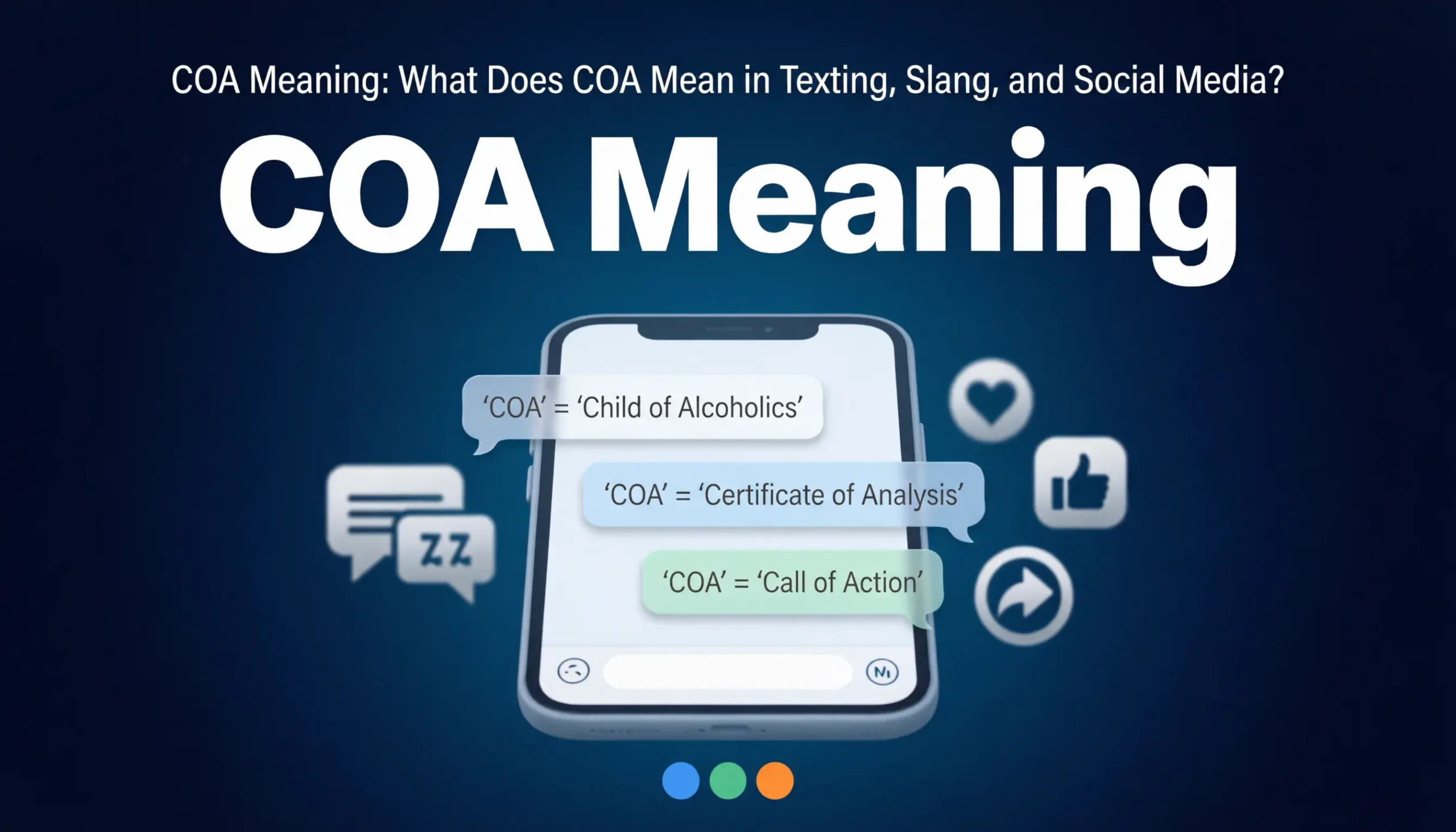
COA most commonly means “Course of Action” when it appears in texting, online discussions, or conversations about decisions and plans. It refers to a choice, plan, or set of steps someone can take in a particular situation. Some slang and abbreviation sources also list “Certificate of Authenticity” as another common meaning.
| Meaning | Context | Tone |
|---|---|---|
| Course of Action | Texting, work, planning, discussions | Neutral |
| Certificate of Authenticity | Art, collectibles, products, software | Neutral/Formal |
| Change of Address | Mailing, personal information, administration | Formal |
| Center of Attention | Informal slang/social situations | Casual |
The important thing to remember is that COA does not have one universal meaning. Its meaning depends on the conversation around it.
If you have seen COA in a text message, social media post, comment, gaming conversation, or online discussion, you may have wondered what the abbreviation means. Short terms like this can be confusing because the same three letters can represent completely different phrases.
In texting, one commonly listed meaning of COA is “Course of Action.” In this sense, someone uses COA when talking about what should happen next or which plan should be followed. For example, a person might ask, “What’s our COA?” meaning, “What’s our course of action?”
However, COA is not limited to texting. It can also mean “Certificate of Authenticity,” especially when people are discussing artwork, collectibles, products, or other items whose authenticity needs to be verified.
You may also encounter COA as “Change of Address” or “Coenzyme A,” among many other specialized meanings.
That is why context matters. The words surrounding COA usually tell you which meaning the writer intended.
What Does COA Mean?
The most relevant meaning of COA in texting and casual online communication is “Course of Action.”
A course of action is simply a plan for what to do next.
For example:
“We need to decide on a COA before tomorrow.”
Here, COA means course of action. The person is talking about deciding what steps to take.
You might see the abbreviation when people are:
- Making a plan
- Solving a problem
- Discussing a decision
- Talking about work
- Discussing a difficult situation
- Planning what to do next
- Comparing different possible solutions
The phrase “course of action” is not slang by itself. It is an ordinary English expression. COA is simply a shortened form of it.
Because the abbreviation is short, people sometimes use it when they want to communicate quickly without writing the full phrase.
What Does COA Mean in Texting, Slang, or Social Media?
In texting, COA can mean “Course of Action.” Slang and texting references list this as a common interpretation, although it is not one of the most universally recognized texting abbreviations.
For example:
“What’s the COA?”
means:
“What’s the course of action?”
In other words, the person is asking what the group or individual plans to do.
You might see it in a group chat where friends are trying to make plans:
“The concert is sold out. What’s our COA?”
The speaker wants to know what everyone should do next.
Is COA Gen Z slang?
Not particularly. COA should not be treated as a uniquely Gen Z expression.
Unlike terms such as “sus,” “rizz,” or “FR,” COA is better described as an abbreviation or acronym that can appear in practical conversations. Its use may depend more on the community, profession, or situation than on age.
Someone working in business, planning, military-related discussions, or other structured environments may be more familiar with “course of action” and therefore more likely to understand COA immediately.
COA on social media
On social media, COA can have different meanings depending on the topic.
A post discussing plans might use COA to mean Course of Action. A post about artwork or collectibles might use it to mean Certificate of Authenticity.
Therefore, you should not automatically assume that every social media use of COA refers to texting slang.
Other Meanings of COA
COA has several meanings outside ordinary texting.
1. Certificate of Authenticity
Certificate of Authenticity is another important meaning of COA.
A Certificate of Authenticity is a document or certificate used to support the authenticity of an item. It may be associated with artwork, collectibles, memorabilia, software, or other products.
For example:
“Does this painting come with a COA?”
Here, COA means Certificate of Authenticity, not Course of Action.
This meaning is especially relevant when discussing valuable or collectible items.
2. Change of Address
COA can also mean “Change of Address.”
This meaning is commonly associated with administrative or mailing situations. Dictionaries list COA as an abbreviation for change of address in American English.
For example:
“I submitted my COA last week.”
The person may be saying that they submitted a change-of-address request.
3. Coenzyme A
In biology and biochemistry, CoA can mean coenzyme A. It is an important molecule involved in metabolic reactions.
For example:
“Acetyl-CoA plays an important role in metabolism.”
This is a scientific use, not internet slang.
4. Other professional meanings
COA can represent many other phrases in business, education, government, technology, and other fields. Abbreviation databases list meanings such as Cost of Acquisition, Cost of Attendance, Chart of Accounts, Course of Action, Council on Aging, and others.
This is why the surrounding conversation is essential when interpreting COA.
How COA Is Used in Real Conversations
COA is most useful when the meaning of “course of action” is already clear from the discussion.
Imagine a group of coworkers trying to solve a problem:
Person 1: “The client rejected the first proposal.”
Person 2: “Okay, what’s our COA?”
Here, Person 2 is asking what the team should do next.
Another example could involve friends:
“The restaurant is closed. What’s the COA?”
Again, the speaker means:
“What should we do now?”
The abbreviation can also appear in online discussions, workplace messages, gaming communities, or planning conversations.
However, because COA has several meanings, it is always better to look at the topic before deciding what it means.
COA Examples in Texting and Online Conversations
Here are some natural examples:
- “What’s our COA if the weather gets worse?”
Meaning: What is our course of action? - “We need a new COA before the meeting.”
Meaning: We need a new plan. - “Let’s discuss the best COA before making a decision.”
Meaning: Let’s discuss the best course of action. - “The seller says the painting has a COA.”
Meaning: The painting has a Certificate of Authenticity. - “Did you submit your COA after moving?”
Meaning: Did you submit your Change of Address? - “What’s the COA here? Should we wait or leave?”
Meaning: What should we do? - “This collectible is expensive because it comes with a COA.”
Meaning: It comes with a Certificate of Authenticity.
These examples show why simply knowing the letters “COA” is not enough. You need to understand the subject of the conversation.
Tone and Intent of COA
COA itself does not have a strongly positive or negative emotional tone.
When it means Course of Action, it is generally neutral and practical.
For example:
“What’s our COA?”
does not automatically sound angry, excited, sarcastic, or friendly. The tone depends on the rest of the conversation.
It could be serious:
“We have a major problem. What’s our COA?”
Or casual:
“The movie is sold out. What’s the COA?”
The second example may simply mean, “What should we do now?”
Can COA be sarcastic?
Yes, but the sarcasm comes from the sentence or situation rather than from the abbreviation itself.
For example:
“Great, the car broke down again. What’s our COA now?”
The speaker may be frustrated or sarcastic, but COA still means course of action.
Origin and Background of COA
COA is better understood as an abbreviation rather than a modern slang word with one specific origin.
The full phrase “course of action” has long been used in ordinary English, particularly when people discuss plans, decisions, strategies, or possible solutions.
Over time, abbreviations became common in workplaces, online communities, messaging, and specialized fields. COA is one of the many abbreviations that can represent different phrases depending on the context.
The multiple meanings developed because organizations and communities often shorten frequently used phrases into the same initials.
That explains why COA can mean “Course of Action” in one conversation and “Certificate of Authenticity” in another.
Is COA Rude or Inappropriate?
Generally, COA is not rude or offensive when it means Course of Action, Certificate of Authenticity, or Change of Address.
It is normally a neutral abbreviation.
However, some user-generated slang databases list additional meanings that may be vulgar or inappropriate. These meanings are not the standard interpretation and should not be assumed without strong contextual evidence.
If you see COA in a normal conversation about planning, the safest interpretation is usually Course of Action.
If the conversation is about art or collectibles, Certificate of Authenticity may be more appropriate.
When NOT to Use COA
Although COA can save a few characters, it is not always the clearest choice.
Avoid using it when:
- The reader may not know what it means.
- You are writing a formal document.
- You are communicating with a new audience.
- The abbreviation has multiple possible interpretations.
- The subject is sensitive or important.
- You need to avoid any possibility of confusion.
For example, instead of writing:
“Please provide the COA.”
you could write:
“Please provide the Certificate of Authenticity.”
That is much clearer when speaking to someone who may not recognize the abbreviation.
Similarly, in a formal report, spelling out course of action the first time can make the document easier to understand.
Similar and Related Slang Terms
COA belongs to a large group of abbreviations used to shorten longer phrases.
Some familiar examples include:
- IMO — In My Opinion
- IMHO — In My Humble Opinion
- FYI — For Your Information
- ASAP — As Soon As Possible
- BTW — By The Way
- IDK — I Don’t Know
- TBH — To Be Honest
- WDYT — What Do You Think?
These terms are not synonyms for COA. They simply demonstrate how online communication often turns longer phrases into shorter forms.
COA is somewhat different because it can have multiple unrelated meanings.
COA vs Related Terms
It is easy to confuse abbreviations when they have only two or three letters.
COA vs FYI:
FYI means “For Your Information,” while COA can mean “Course of Action.” FYI provides information; COA generally refers to a plan or next step.
COA vs Plan:
A plan is a general word for something you intend to do. A course of action emphasizes the specific approach or steps chosen for a situation.
COA vs Strategy:
A strategy is usually a broader approach toward achieving a goal. A course of action can refer to a particular option or set of steps being considered.
COA vs Certificate of Authenticity:
These are completely different meanings. One concerns a plan or decision, while the other concerns proof or documentation of authenticity.
COA Comparison Table
| Term | Meaning | Usage | Key Difference |
|---|---|---|---|
| COA | Course of Action | Planning, texting, discussions | Refers to a plan or next step |
| COA | Certificate of Authenticity | Art, collectibles, products | Verifies or documents authenticity |
| COA | Change of Address | Mailing, administration | Refers to an address change |
| FYI | For Your Information | Texting, email, work | Gives information |
| Plan | Intended course or method | Everyday conversation | General word for an intended action |
| Strategy | Overall approach | Business, games, planning | Usually broader than a single action |
| IMO | In My Opinion | Texting, social media | Introduces someone’s opinion |
Common Misunderstandings About COA
One of the biggest misunderstandings is assuming that COA always means the same thing.
It does not.
If someone writes:
“What’s the COA?”
the intended meaning is likely Course of Action, particularly if the conversation is about solving a problem or deciding what to do next.
But if someone says:
“Does it have a COA?”
and they are discussing a collectible, painting, autograph, or valuable item, they may mean Certificate of Authenticity.
Another common mistake is assuming that COA is always slang. It is more accurate to call it an abbreviation or acronym, because many of its meanings are used in professional or formal contexts.
The best approach is simple: look at the words around COA and identify the topic of the conversation.
FAQs
What does COA mean in texting?
In texting, COA can mean “Course of Action.” It refers to a plan or decision about what to do next.
Is COA a slang word?
COA is better described as an abbreviation than a traditional slang word. It can appear in casual texting, but it also has many formal and professional meanings.
What does COA stand for in a conversation?
If someone is discussing plans or decisions, COA most likely means Course of Action.
What does COA mean when talking about art?
In art, collectibles, or memorabilia, COA commonly means Certificate of Authenticity.
Is COA rude?
No. COA is generally neutral. However, because some informal sources list other interpretations, context should always be considered.
Does COA mean “Center of Attention”?
Some user-generated slang sources list Center of Attention as a possible informal meaning. However, it is not the main meaning you should automatically assume.
What does CoA mean in science?
In biology and biochemistry, CoA can mean coenzyme A, a molecule involved in metabolic reactions.
What does COA mean in American English?
Depending on context, dictionaries list COA as “change of address,” while CoA can refer to coenzyme A.
How do I know which meaning of COA someone intends?
Look at the surrounding words and topic. Planning discussions usually point toward Course of Action, while art and collectibles often point toward Certificate of Authenticity.
Conclusion
The meaning of COA depends heavily on context. In texting and online conversations about decisions, plans, or problems, COA commonly means “Course of Action.” It is essentially a short way of asking about a plan or what should happen next.
However, COA can also mean Certificate of Authenticity, Change of Address, Coenzyme A, and many other terms in specialized settings.
So, if you see COA in a message, don’t rely on the letters alone. Check the conversation around them.
A simple rule works well:
If the topic is planning, COA probably means “Course of Action.” If the topic is an item or collectible, it may mean “Certificate of Authenticity.”
Context is the key to understanding COA correctly.