
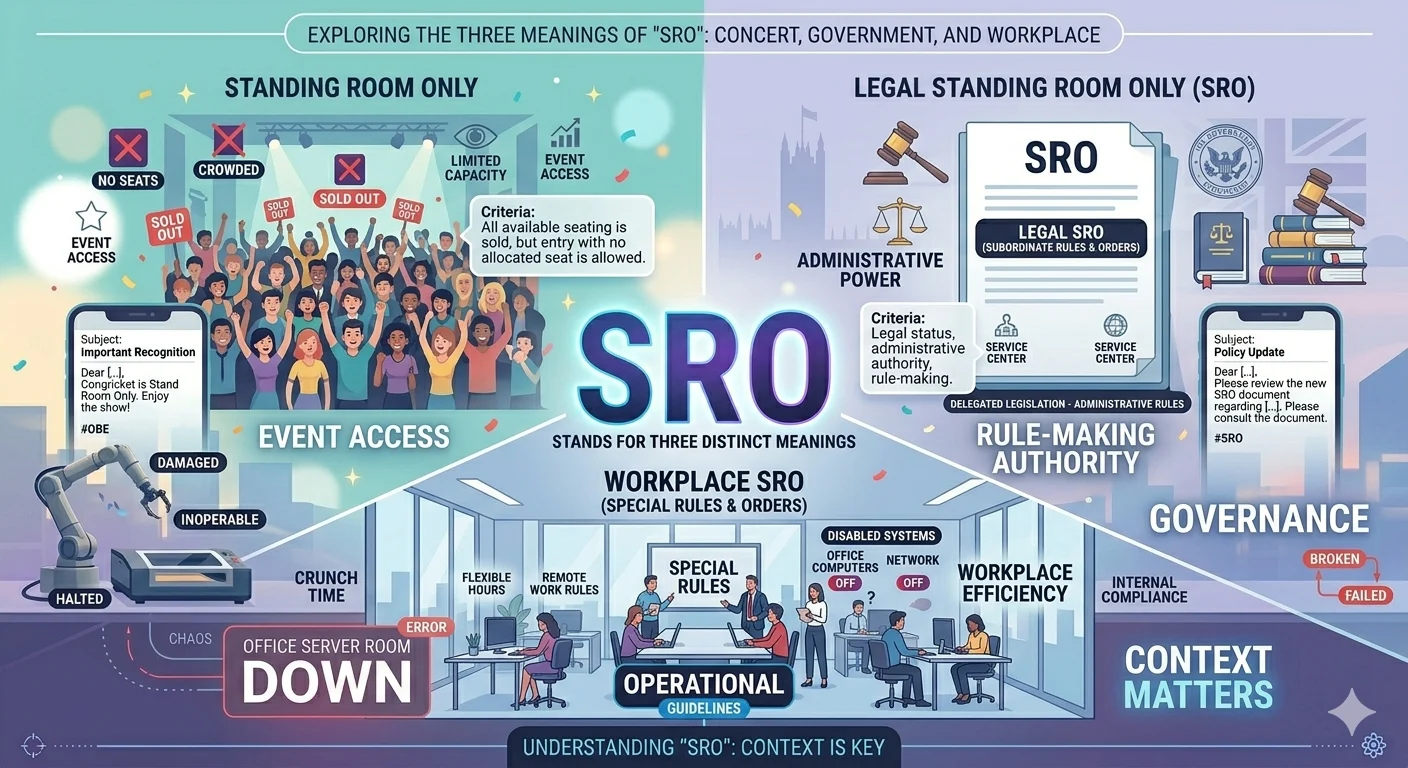
- Meaning: SRO has multiple meanings depending on context
- Full form: Most commonly “Standing Room Only” or “Statutory Regulatory Order”
- Context: Events, government/legal documents, workplace communication, sometimes texting
- Tone: Neutral; can be formal or informal depending on usage
If you’ve searched for “SRO meaning,” you’re probably confused by how the same short term shows up in completely different places. You might see it in a text message, a government notification, or even on an event ticket.
That’s where the confusion starts. SRO is not a single-meaning slang term. It changes its meaning based on context. In casual situations, it may refer to event seating. In official settings, especially in countries like Pakistan or India, it often relates to legal or government orders.
Because it appears in both everyday conversation and formal communication, many people misunderstand it or assume it has only one meaning. This article clears that confusion in a simple way. You’ll learn what SRO means, how it’s used in different contexts, and how to avoid misusing it.
What does SRO mean?
At its core, SRO is an abbreviation. The meaning depends on where and how it is used. The two most common meanings are “Standing Room Only” and “Statutory Regulatory Order.”
“Standing Room Only” is used when an event or venue is full, and only standing space is available. For example, concerts, buses, or cinemas sometimes use this term.
“Statutory Regulatory Order” is used in official or legal contexts. It refers to a government-issued notification or rule, often used in taxation, policies, or regulations.
In simple terms, SRO is not a slang word by default. It is a flexible abbreviation with multiple meanings. You must look at the situation to understand it correctly.
What does SRO mean in texting / slang / social media?
In texting or social media, SRO is not as popular as other slang terms like “LOL” or “BRB.” However, it can still appear. When it does, it usually keeps its original meaning rather than becoming a new slang expression.
For example, someone might text, “The concert is SRO,” meaning there are no seats left. In this case, it’s still short for “Standing Room Only.”
It is rarely used by Gen Z as a casual slang shortcut. Most young users prefer simpler or trendier abbreviations. So if you see SRO in a chat, it’s usually tied to a specific situation rather than being used as general slang.
Other meanings of SRO
SRO has several meanings across different fields. Here are the most common ones:
- Standing Room Only: Used in events or transport when seats are full
- Statutory Regulatory Order: Common in legal and government systems, especially in South Asia
- Senior Responsible Owner: Used in project management and corporate environments
- Single Room Occupancy: Refers to a type of housing or accommodation
- Shop Replace Order: Used in retail or inventory systems
Each meaning serves a specific purpose. That’s why context matters more than the abbreviation itself.
How SRO is used in real conversations
SRO appears in different types of conversations depending on the setting. In event discussions, it describes availability. For example, people may say an event is already full and only standing space remains.
In government or legal discussions, SRO is used when referring to official documents. For instance, someone might mention a new SRO related to taxes or import rules.
In workplaces, especially in corporate environments, SRO can refer to a responsible person managing a project.
In casual chats, it appears occasionally but usually keeps its original meaning. The key is always to understand the situation before interpreting it.
Examples
Here are some natural examples to help you understand how SRO is used:
- “We reached late, so it was SRO at the concert.”
- “Did you read the new SRO about tax changes?”
- “The hall is SRO, so come early next time.”
- “Our manager is the SRO for this project.”
- “The event went SRO within an hour of opening.”
- “This bus is SRO during rush hours.”
- “A new SRO was issued by the government yesterday.”
Each example shows a different context. That’s how the meaning shifts.
Tone and intent
SRO is generally neutral. It does not carry emotion like happiness, anger, or sarcasm. Its tone depends on where it is used.
In formal settings like legal documents, it sounds official and technical. In casual conversations, it remains straightforward and informational.
It is not used for humor or emotional expression. Instead, it is used to share clear and specific information.
Origin or background
The term “Standing Room Only” comes from theaters and public events. When all seats were taken, people could still enter but had to stand. This phrase was shortened to SRO for convenience.
“Statutory Regulatory Order” comes from legal systems, especially in countries like Pakistan and India. Governments use SROs to issue rules, updates, or policies without passing a full law.
Over time, both meanings became widely recognized in their respective areas. That’s why SRO now has multiple interpretations.
Is it rude or inappropriate?
SRO is completely safe to use. It is not rude, offensive, or inappropriate. It does not contain any harmful or sensitive meaning.
However, confusion can happen if the listener does not understand the context. So while it is safe, it is always better to use it clearly.
When NOT to use it
You should avoid using SRO in situations where clarity is important and the audience may not understand abbreviations.
For example, in formal writing or presentations, it’s better to write the full form first. After that, you can use SRO if needed.
Also, avoid using it in casual chats with people who may not be familiar with the term. It can create unnecessary confusion.
Similar and related slang terms
Although SRO is not typical slang, it is often grouped with other abbreviations like:
- RSVP (please respond)
- ETA (estimated time of arrival)
- FYI (for your information)
- TBD (to be decided)
These terms are also context-based and used for quick communication.
SRO vs related terms
SRO is different from most internet slang because it is not emotion-based. Instead, it provides specific information.
For example, “FYI” shares information, while “SRO” describes a situation. “ETA” talks about time, while SRO may describe capacity or official rules.
Understanding these differences helps you use each term correctly.
Comparison Table
| Term | Meaning | Usage | Key Difference |
|---|---|---|---|
| SRO | Standing Room Only / Statutory Regulatory Order | Events, legal, workplace | Multiple meanings based on context |
| RSVP | Please respond | Invitations | Focuses on response |
| ETA | Estimated time of arrival | Travel, delivery | Time-related |
| FYI | For your information | Informational messages | General sharing |
| TBD | To be decided | Planning | Indicates uncertainty |
Common misunderstandings
One common mistake is assuming SRO has only one meaning. Many people think it only refers to events, while others think it is only a legal term.
Another misunderstanding is treating it as internet slang. While it can appear in chats, it is not primarily a slang word.
People also misinterpret it in official documents if they are not familiar with legal terms. This can lead to confusion about rules or policies.
FAQ Section
1. What does SRO mean in simple words?
It is an abbreviation that can mean “Standing Room Only” or “Statutory Regulatory Order,” depending on context.
2. Is SRO a slang term?
Not really. It is mainly an abbreviation, not true slang.
3. Where is SRO commonly used?
In events, government documents, and sometimes workplace communication.
4. What does SRO mean in Pakistan?
It usually refers to “Statutory Regulatory Order” in legal or tax-related contexts.
5. Can SRO have multiple meanings?
Yes, and the meaning depends on the situation.
6. Is SRO formal or informal?
It can be both. Formal in legal use, informal in event discussions.
7. Should I use SRO in texting?
Only if the other person understands it. Otherwise, it may confuse them.
8. Is SRO safe to use?
Yes, it is completely safe and neutral.
Conclusion
SRO is a short but powerful abbreviation with multiple meanings. It can refer to event capacity, government regulations, or workplace roles. The key to understanding it is context. Instead of guessing, always look at where and how it is used. Once you do that, the meaning becomes clear.