
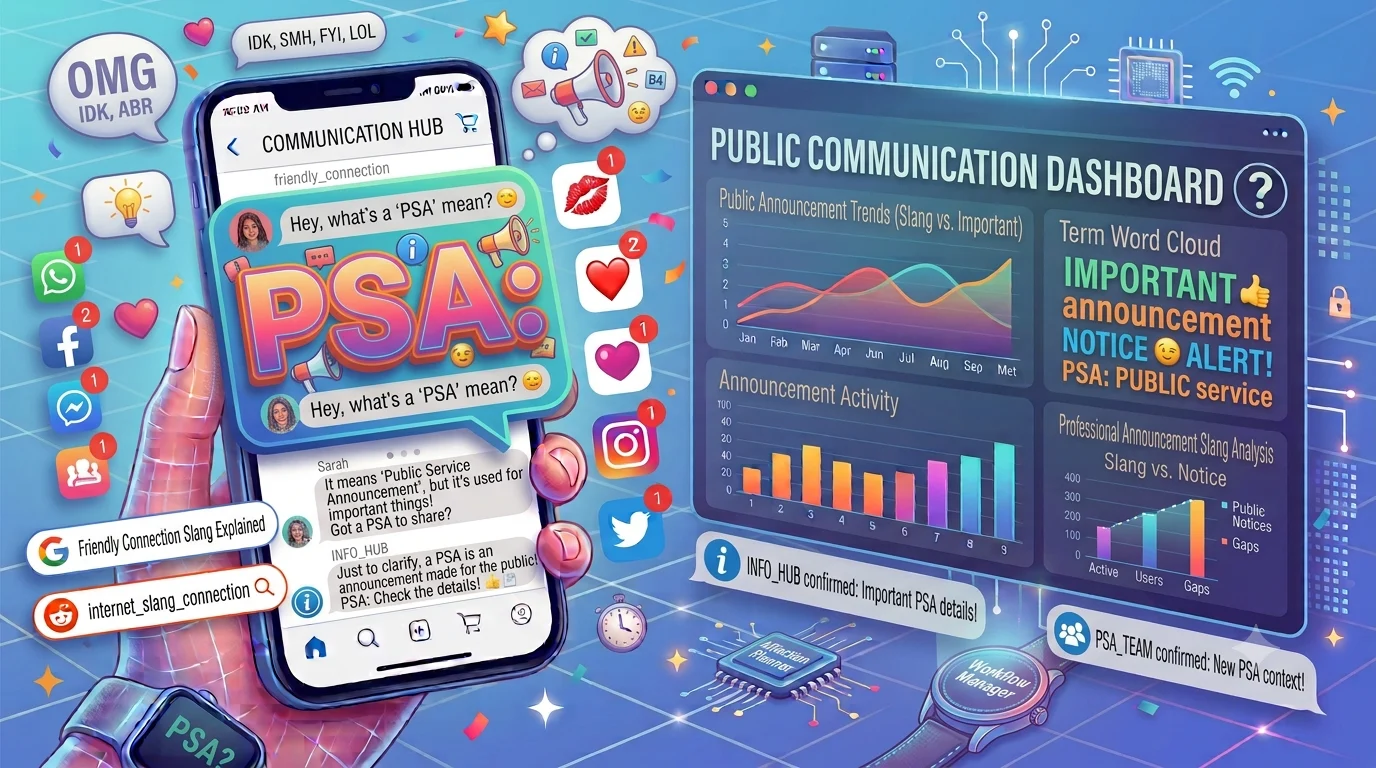
Meaning: PSA usually stands for Public Service Announcement. In texting and social media, it is often used before sharing important information, advice, or a reminder that others should know.
Full Form: PSA = Public Service Announcement
Context: You may see PSA in text messages, Instagram captions, TikTok videos, Reddit posts, Facebook updates, X posts, emails, and online forums.
Tone: Usually helpful, informative, or serious. In some online conversations, PSA is also used humorously or sarcastically.
If you’ve come across the abbreviation PSA in a text message, social media post, or online discussion, you may be wondering what it means. While many internet abbreviations are used only in casual chats, PSA has a broader meaning that extends beyond social media.
The most common PSA meaning in texting is Public Service Announcement. People use it to grab attention before sharing useful information, reminders, warnings, or advice. It tells readers that the following message is important and worth noticing.
For example, someone might write:
PSA: Don’t forget to back up your phone before installing the latest update.
In this case, PSA introduces a helpful reminder rather than an official announcement.
Although Public Service Announcement is the most recognized meaning, PSA can also refer to medical terms and other industry-specific abbreviations. The correct interpretation depends entirely on the context.
This guide explains what PSA means in texting, slang, and social media, explores its other meanings, provides real-life examples, compares it with similar expressions, and shows you when to use it correctly.
What Does PSA Mean?
PSA means Public Service Announcement.
Traditionally, a Public Service Announcement is a message created to inform or educate the public about an important issue. Governments, nonprofit organizations, schools, and media outlets often use PSAs to spread awareness about topics such as public safety, health, or community events.
In everyday online communication, however, the meaning has become more casual.
Instead of making an official announcement, people often use PSA to introduce useful information, personal advice, or reminders.
For example:
PSA: Bring water if you’re hiking this weekend.
The person is simply sharing helpful advice with others.
Because PSA is widely recognized, many people use it to make their message stand out.
What Does PSA Mean in Texting, Slang, and Social Media?
PSA in Text Messages
In texting, PSA usually appears at the beginning of a message to highlight important information.
Examples:
PSA: The meeting starts at 9 a.m. tomorrow.
PSA: Don’t forget your umbrella today.
It helps signal that the message deserves attention.
Friends also use PSA casually.
Example:
PSA: That new pizza place is amazing.
Here, PSA introduces a recommendation rather than an official announcement.
PSA on Social Media
On Instagram, TikTok, Facebook, Reddit, and X, PSA is commonly used before sharing:
- Helpful tips
- Safety reminders
- Product recommendations
- Travel advice
- Life hacks
- Personal experiences
Examples include:
PSA: Always save your work before updating your computer.
PSA: Wear sunscreen even on cloudy days.
Many creators use PSA because it immediately tells followers that useful information is coming.
PSA in Gen Z and Internet Culture
Gen Z and younger internet users often use PSA in a humorous or exaggerated way.
For example:
PSA: Fries taste better when someone else pays for them.
This isn’t a real public announcement. It’s simply a funny opinion presented as if it were important news.
Memes and social media have helped turn PSA into a playful internet expression.
Other Meanings of PSA
Although Public Service Announcement is the most common meaning, PSA has several other definitions depending on the topic.
Public Service Announcement
This is the traditional and most widely recognized meaning.
Public service announcements are designed to educate or inform the public.
Examples include campaigns about:
- Road safety
- Health awareness
- Environmental protection
- Emergency preparedness
Prostate-Specific Antigen
In medicine, PSA stands for Prostate-Specific Antigen.
It is a protein produced by the prostate gland, and doctors may measure PSA levels through a blood test to help evaluate prostate health.
If you see PSA in a medical article or health report, it almost always refers to this medical meaning rather than texting slang.
Other Professional Meanings
Different industries may use PSA for organization names, project titles, educational programs, or technical terms.
For example, PSA may appear in:
- Business documents
- Government agencies
- Scientific research
- Educational institutions
Always use the surrounding context to identify the intended meaning.
How PSA Is Used in Real Conversations
People use PSA whenever they want others to pay attention to a message.
Casual Conversations
Example:
PSA: The coffee shop closes early today.
Meaning:
A helpful reminder for friends.
Group Chats
Example:
PSA: Please RSVP before Friday.
Meaning:
An announcement to everyone in the group.
Workplace Communication
Example:
PSA: The office network will be unavailable tonight.
Meaning:
A workplace notice.
Social Media
Example:
PSA: Remember to drink enough water during the heatwave.
Meaning:
Sharing useful advice with followers.
Examples of PSA in Conversations
Example 1:
Person A:
PSA: The concert tickets go on sale tomorrow.
Meaning:
Sharing important information.
Example 2:
Person A:
PSA: Charge your phone before traveling.
Meaning:
Offering practical advice.
Example 3:
Person A:
PSA: That restaurant gets crowded after 7 p.m.
Meaning:
Giving a helpful tip.
Example 4:
Person A:
PSA: Be careful driving in the rain today.
Meaning:
A safety reminder.
Example 5:
Person A:
PSA: This movie has a surprise ending, avoid spoilers.
Meaning:
Helping others enjoy the movie.
Example 6:
Person A:
PSA: Stretch before working out.
Meaning:
Fitness advice.
Example 7:
Person A:
PSA: Always double-check your travel documents.
Meaning:
General reminder.
Tone and Intent Behind PSA
PSA usually has a positive and helpful tone.
Informative
Most PSA messages simply provide useful information.
Example:
PSA: The library is closed on Monday.
Helpful
Many people use PSA to help others avoid problems.
Example:
PSA: Save your files frequently.
Serious
Some PSA messages involve health or safety.
Example:
PSA: Never ignore severe weather warnings.
Funny
Social media users often write playful PSA posts.
Example:
PSA: Ice cream is always a good idea.
Although humorous, the format remains the same.
Sarcastic
Sometimes PSA introduces an exaggerated joke.
Example:
PSA: Mondays should only have two hours.
The humor comes from the sentence rather than the abbreviation itself.
Origin and Background
The phrase Public Service Announcement originated long before the internet.
Radio stations and television networks used PSAs to broadcast messages that benefited the public. These announcements often focused on safety, education, public health, and community awareness.
As online communication grew, internet users adopted PSA as a quick way to introduce useful information.
Today, PSA appears in:
- Social media posts
- Text messages
- Forums
- Blogs
- Emails
- Online communities
Its meaning has expanded from official announcements to everyday advice and even jokes.
Is PSA Rude or Inappropriate?
No. PSA is generally respectful and appropriate.
It is commonly used to help others or share useful information.
However, the tone depends on the message.
A sarcastic PSA may sound humorous among friends but could confuse readers in formal settings.
Always consider your audience before using internet slang.
When Not to Use PSA
Although PSA is widely understood, there are situations where writing the full phrase is better.
Avoid using PSA in:
- Legal documents
- Academic papers
- Formal business reports
- Official government communication
- Professional writing for unfamiliar audiences
Using complete language helps prevent misunderstandings.
Similar and Related Slang Terms
FYI
FYI means For Your Information.
It shares information without necessarily emphasizing urgency.
Heads Up
“Heads up” warns someone about something important or upcoming.
Example:
Heads up, traffic is heavy today.
Reminder
A reminder asks people not to forget something.
Example:
Reminder: Submit your assignment before Friday.
Notice
A notice is usually more formal and often appears in workplaces or official communications.
PSA vs Related Terms
IT vs FYI
- PSA: Highlights an important announcement or tip.
- FYI: Simply shares information.
PSA vs Heads Up
- PSA: General announcement.
- Heads Up: Usually warns about something happening soon.
ITvs Reminder
- PSA: Can introduce new information.
- Reminder: Refers to something already expected or previously mentioned.
Comparison Table
| Term | Meaning | Usage | Key Difference |
|---|---|---|---|
| PSA | Public Service Announcement | Advice, reminders, announcements | Highlights useful or important information |
| FYI | For Your Information | Sharing information | Less emphasis on urgency |
| Heads Up | Advance warning | Alerts | Focuses on upcoming events |
| Reminder | Memory prompt | Tasks and deadlines | Helps people avoid forgetting |
| Notice | Official announcement | Formal communication | More professional and official |
Common Misunderstandings
One common mistake is assuming PSA always refers to an official government announcement.
In reality, many people use PSA casually to introduce everyday advice or opinions.
Another misunderstanding occurs when readers confuse the texting meaning with the medical meaning of Prostate-Specific Antigen.
Context is the easiest way to determine which meaning is correct.
If the discussion is about health, PSA probably refers to the medical test.
If the discussion is happening on social media or in a group chat, it almost always means Public Service Announcement.
Frequently Asked Questions (FAQs)
What does PSA mean in texting?
PSA usually means Public Service Announcement and introduces important information, reminders, or advice.
What does PSA stand for?
The most common full form is Public Service Announcement.
What does PSA mean on social media?
On social media, PSA is often used before sharing useful tips, opinions, warnings, or recommendations.
Is PSA slang?
Not exactly. PSA began as an official term but is now widely used as internet slang in casual conversations.
Is PSA always serious?
No. Many people use PSA humorously or sarcastically to introduce funny opinions or jokes.
What is the medical meaning of PSA?
In medicine, PSA stands for Prostate-Specific Antigen, a protein measured through a blood test to help evaluate prostate health.
Can PSA be funny?
Yes. Social media users often write humorous PSA posts for entertainment.
How do you use PSA in a sentence?
Example:
PSA: Always back up your important files before updating your computer.
Is PSA appropriate in professional communication?
Yes, if your audience understands the abbreviation. Otherwise, writing Public Service Announcement in full may be clearer.
Does PSA have multiple meanings?
Yes. While Public Service Announcement is the most common meaning, PSA also has medical and industry-specific definitions.
conclusion
PSA most commonly means Public Service Announcement. In texting, social media, and online conversations, it introduces useful information, reminders, warnings, recommendations, or even humorous observations.
Although PSA has other meanings, including Prostate-Specific Antigen in medicine, the surrounding context usually makes the intended definition clear.
Whether you’re sharing an important tip, reminding friends about an event, or posting a funny social media update, using PSA correctly helps your message grab attention and communicate clearly.
