
| Term | Meaning |
|---|---|
| OTR | On the Road / Off the Record |
| Full Forms | On the Road, Off the Record |
| Used In | Text messages, social media, online chats, workplace conversations |
| Tone | Neutral, casual, or private depending on context |
If you’ve received a message saying “OTR” or spotted it in a social media post, you may have wondered what it actually means. Like many internet abbreviations, OTR has more than one definition, and the correct meaning depends entirely on the conversation.
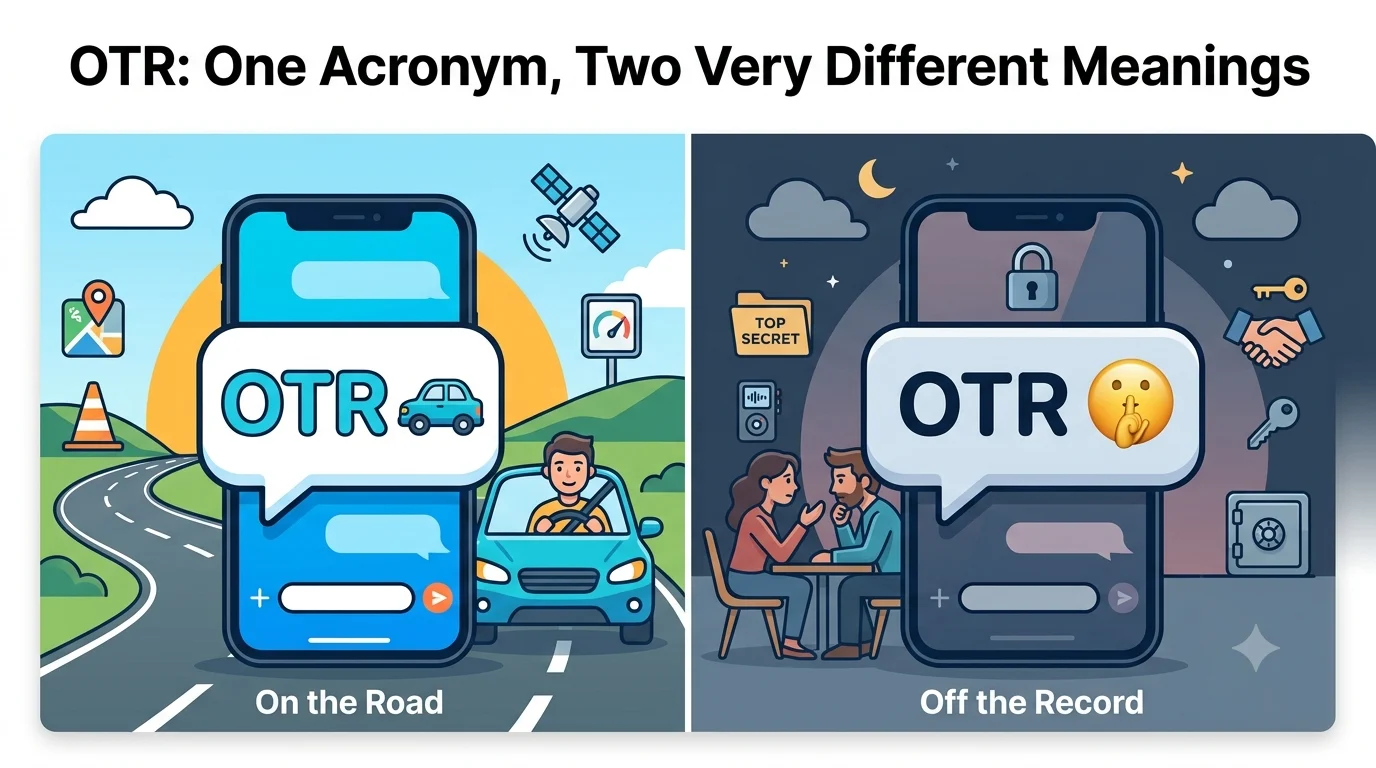
In texting, OTR most commonly means “On the Road,” letting others know that someone is traveling or driving. In other situations, especially professional or private conversations, OTR stands for “Off the Record,” meaning the information should remain confidential and not be shared publicly.
Because both meanings are widely used online, it’s easy to misunderstand the abbreviation if you ignore the context. This guide explains every common meaning of OTR, how it’s used in texting and social media, real-life examples, comparisons with similar slang, and when you should—or shouldn’t—use it.
What does OTR mean?
OTR is an abbreviation with two primary meanings.
The first and most common meaning is “On the Road.” People use it to let friends, family, or coworkers know they are traveling. It could mean they are driving to work, heading home, or taking a long trip.
The second meaning is “Off the Record.” This phrase tells someone that what follows is private, unofficial, or shouldn’t be repeated to others.
Although both meanings share the same abbreviation, they serve completely different purposes. One communicates travel status, while the other communicates confidentiality.
What does OTR mean in texting, slang, and social media?
In texting, OTR usually means “On the Road.” It is a quick way to update someone without typing a full sentence.
For example:
- “Leaving now. OTR.”
- “I’ll call you when I’m home. OTR.”
Friends often use it while commuting or traveling.
On social media, OTR may appear in travel updates, road trip photos, or captions announcing a journey.
However, in workplace chats or private discussions, OTR often means “Off the Record.” Someone might use it before sharing an opinion or sensitive information that isn’t meant for wider distribution.
Although Gen Z uses many internet abbreviations, OTR isn’t limited to one age group. It’s understood by many people who regularly communicate online.
Other meanings of OTR
Besides its two main meanings, OTR occasionally appears in other industries or communities.
Some less common meanings include:
- On the Road
- Off the Record
- Over the Road (used in trucking for long-distance drivers)
- Operational Test Report (technical fields)
- Other organization-specific abbreviations
These alternative definitions are much less common in everyday texting. For most internet users, “On the Road” and “Off the Record” are the meanings you’ll encounter most often.
How OTR is used in real conversations
OTR fits naturally into many different conversations.
When someone is traveling, they might send a quick message:
“OTR now. Should be there in two hours.”
Parents often text children:
“I’m OTR. See you soon.”
Friends planning a meetup may say:
“Running late. OTR now.”
In workplace messaging apps, the meaning changes.
Someone might write:
“OTR, I don’t think management will approve this idea.”
Here, they’re signaling that the comment is unofficial and shouldn’t be shared publicly.
The surrounding conversation almost always makes the intended meaning clear.
Examples of OTR in sentences
Here are some natural examples of OTR in everyday conversations.
- “Just left the house. OTR now.”
- “I’m OTR. Traffic is heavier than expected.”
- “OTR—don’t tell anyone I mentioned this.”
- “Can we talk OTR for a minute?”
- “Finally OTR after finishing work.”
- “The family is OTR for our vacation.”
- “OTR, I think they’ll change the plan next week.”
- “I’ll text you again once I’m no longer OTR.”
Notice how some examples relate to traveling while others involve confidential conversations.
Tone and intent behind OTR
OTR is generally a neutral abbreviation.
When it means “On the Road,” it simply provides a travel update. It doesn’t carry any emotional meaning.
When it means “Off the Record,” the tone becomes more private and confidential. It suggests trust between the people involved.
Unlike many internet slang terms, OTR isn’t used to express excitement, anger, sarcasm, or humor. Its purpose is mainly practical.
Origin or background
The phrase “Off the Record” has existed for many decades in journalism and media. Reporters use it when a source shares information that should not be published or officially quoted.
As digital communication grew, people began shortening it to OTR in emails, instant messaging, and workplace chats.
The abbreviation “On the Road” became popular through texting culture, where users wanted a fast way to tell others they were traveling.
Today, both meanings are widely recognized across messaging apps, online communities, and social media.
Is OTR rude or inappropriate?
No. OTR is not considered rude or offensive.
“On the Road” is simply a travel update.
“Off the Record” is also polite when used appropriately. It simply tells someone that the following information is intended to remain private.
However, avoid using “Off the Record” to encourage gossip or share confidential information that should remain protected. Always respect privacy and professional boundaries.
When NOT to use OTR
Although OTR is useful in casual communication, there are situations where you should avoid it.
Don’t use OTR when:
- Writing formal business documents.
- Communicating with people unfamiliar with internet abbreviations.
- Preparing academic papers.
- Writing legal or official correspondence.
- Clarity is more important than brevity.
In these cases, writing the full phrase prevents misunderstandings.
Similar and related slang terms
Several abbreviations are similar to OTR because they communicate status or provide quick updates.
- OMW — On My Way
- BRB — Be Right Back
- FYI — For Your Information
- IMO — In My Opinion
- ETA — Estimated Time of Arrival
Each serves a different purpose, but all help shorten everyday conversations.
OTR vs related terms
OTR and similar abbreviations are easy to confuse.
IT vs OMW
OMW means you’re currently heading somewhere. OTR simply indicates you’re already traveling.
OTR vs BRB
BRB tells someone you’ll return shortly to a conversation. OTR provides travel status or indicates a private discussion.
IT vs Off the Record
OTR is simply the abbreviated version of the full phrase “Off the Record.”
Understanding these differences helps you choose the right abbreviation in different conversations.
Comparison Table
| Term | Meaning | Common Usage | Key Difference |
|---|---|---|---|
| OTR | On the Road / Off the Record | Travel updates or private conversations | Two completely different meanings depending on context |
| OMW | On My Way | Heading somewhere | Focuses on the journey to a destination |
| BRB | Be Right Back | Chat conversations | Indicates a temporary absence |
| FYI | For Your Information | Sharing information | Used to inform rather than update travel status |
Common misunderstandings
Many people assume OTR always means “On the Road.”
Others think it always means “Off the Record.”
Both assumptions are incorrect because context determines the meaning.
Another common mistake is using OTR in professional documents where readers may not recognize the abbreviation. Writing the complete phrase is often clearer in formal communication.
Frequently Asked Questions
What does OTR mean in texting?
Most commonly, it means “On the Road.”
Does OTR always mean On the Road?
No. It can also mean “Off the Record.”
What does OTR mean in chat?
It usually refers to traveling or sharing private information, depending on the conversation.
Is OTR internet slang?
Yes. It is a widely recognized internet abbreviation used in texting and online communication.
What does OTR mean on social media?
It often refers to traveling, road trips, or occasionally confidential discussions.
Is OTR the same as OMW?
No. OMW means “On My Way,” while OTR generally means you’re already traveling or refers to a private conversation.
Can OTR mean Off the Record?
Yes. This is one of its most common meanings, especially in workplace or professional conversations.
Is OTR appropriate in professional conversations?
Yes, if everyone understands the abbreviation. Otherwise, writing the full phrase is usually better.
conclusion
OTR is a versatile abbreviation with two widely recognized meanings: “On the Road” and “Off the Record.” In texting, it usually lets others know you’re traveling. In professional or private conversations, it signals that information is confidential and shouldn’t be repeated. Since both meanings are common, always pay attention to the surrounding conversation before deciding what OTR means. Understanding the context ensures you’ll interpret—and use—OTR correctly in messages, social media, and everyday online communication.
