
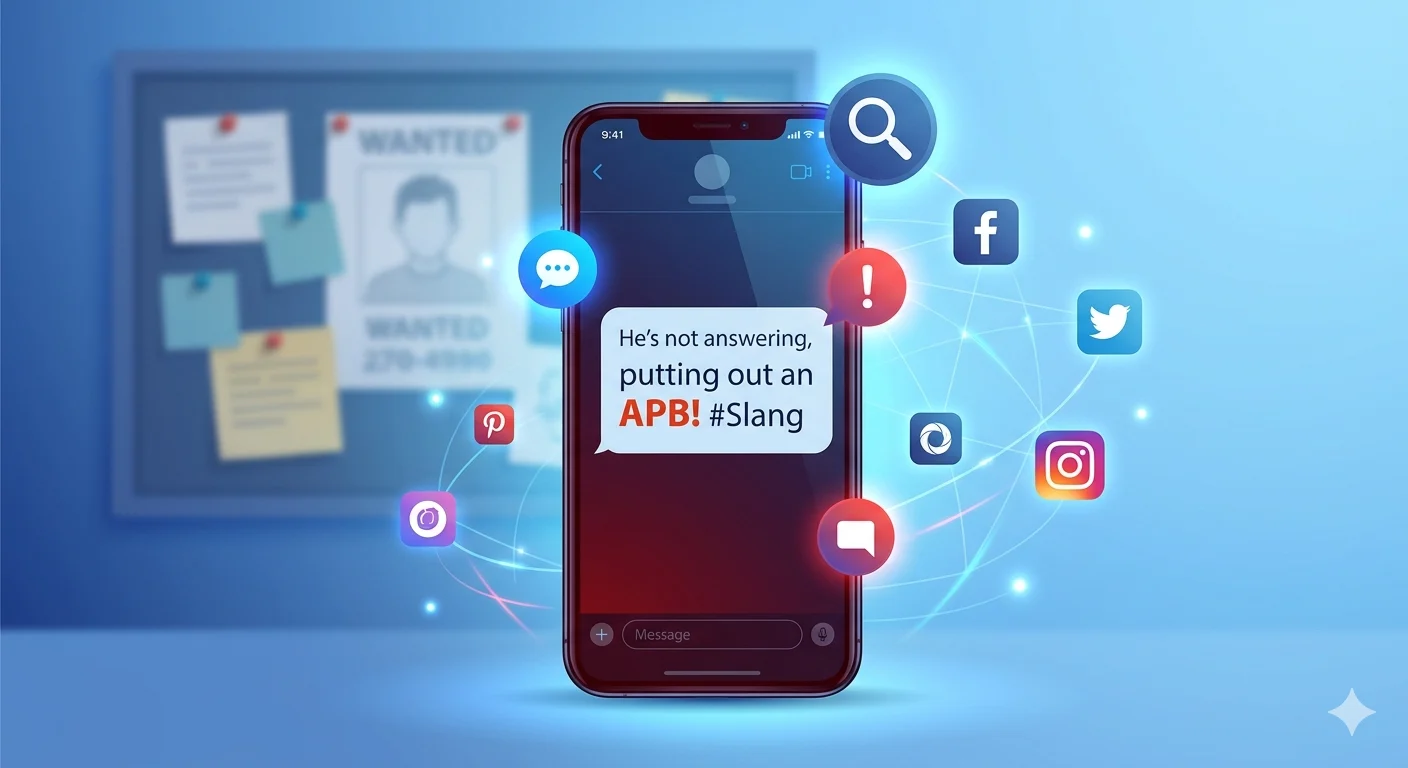
Meaning: A request or alert asking people to look for someone, something, or information.
Full Form: All Points Bulletin
Context: Law enforcement, texting, social media, online communities, and casual conversations.
Tone: Serious, urgent, informative, or playful depending on context.
If you’ve come across the term APB in a text message, social media post, movie, television show, or online discussion, you may be wondering what it means. Many people search for the APB meaning because the abbreviation appears in several different contexts and can be confusing to those unfamiliar with it.
Traditionally, APB stands for All Points Bulletin, a law enforcement term used to alert officers about a wanted person, missing individual, vehicle, or important case information. Over time, the phrase moved beyond police communication and became part of everyday language.
Today, people often use APB in texting, social media, and online communities as a humorous or dramatic way to ask for help finding someone or something. For example, someone might post, “APB on my missing charger” or “Putting out an APB for the friend who never replies.”
Understanding APB is useful because its meaning can shift depending on the situation. In this guide, you’ll learn what APB means, how it’s used in texting and social media, where it came from, and how it compares to similar terms and abbreviations.
What Does APB Mean?
The most common meaning of APB is All Points Bulletin.
In law enforcement, an APB is a message distributed to police officers and agencies that contains important information about a suspect, missing person, stolen vehicle, or ongoing investigation.
The purpose is simple: spread information quickly so others can help locate the person or item being sought.
In everyday language, APB has evolved into a broader expression that means:
- Looking for someone
- Searching for something
- Requesting information
- Alerting others about an issue
- Asking a community for help
In simple terms, an APB is a public request for assistance or information.
What Does APB Mean in Texting, Slang, and Social Media?
In modern texting and internet slang, APB is often used in a much lighter way than its law enforcement origin.
Chat Meaning
In text conversations, APB usually means someone is trying to find a person, object, or answer.
Examples:
- “APB on my headphones. Has anyone seen them?”
- “Putting out an APB for my motivation today.”
The term often adds humor or exaggeration to a simple request.
Social Media Usage
On social media, APB is commonly used in:
- Facebook posts
- X posts
- Instagram captions
- Community groups
- Online forums
Examples include:
- “APB: Looking for the best pizza place in town.”
- “APB for whoever borrowed my hoodie.”
Many users employ the phrase playfully to attract attention.
Gen Z Context
Younger internet users often use APB sarcastically or humorously.
For example:
- “APB on my weekend energy.”
- “APB for the person who ate my snacks.”
In these situations, nobody expects an official search. The phrase simply adds humor and emphasis.
Other Meanings of APB
Although All Points Bulletin is the most recognized definition, APB can have other meanings depending on industry and context.
All Points Bulletin
The original law enforcement meaning.
General Alert
Some organizations use APB informally to mean a widespread notice or announcement.
Online Search Request
Internet users may use APB when seeking recommendations, answers, or assistance.
Business and Industry Meanings
Certain companies and industries use APB as an internal abbreviation, though these meanings vary widely and are much less common.
Because APB is context-dependent, understanding the conversation usually reveals its intended meaning.
How APB Is Used in Real Conversations
APB appears in both serious and casual communication.
Personal Conversations
Friends often use APB jokingly.
Example:
“APB for my missing sunglasses.”
Text Messages
People use APB to ask for help locating items or people.
Example:
“APB on Jake. Has anyone heard from him?”
Social Media Discussions
Online communities frequently use APB to crowdsource information.
Example:
“APB for the best coffee shop near downtown.”
Workplace Situations
In informal work chats, employees may use APB when seeking information.
Example:
“APB for the latest sales report.”
Examples of APB in Real-Life Use
- “APB on my wallet. I can’t find it anywhere.”
- “Putting out an APB for anyone who knows a good mechanic.”
- “APB for my missing house keys.”
- “Has anyone seen Sarah? APB on her.”
- “APB: Looking for recommendations for a new laptop.”
- “APB on whoever finished the last donut.”
- “APB for my weekend motivation.”
- “The police issued an APB for the stolen vehicle.”
These examples show how APB can be both serious and playful.
Tone and Intent
The tone of APB depends heavily on context.
Serious Tone
Used in police work or actual missing-person situations.
Example:
“Authorities issued an APB for the suspect.”
Playful Tone
Common in casual conversations.
Example:
“APB on my lost remote control.”
Urgent Tone
Used when quick assistance is needed.
Example:
“APB for anyone who can help right now.”
Neutral Tone
Sometimes used simply to request information.
Example:
“APB for restaurant suggestions.”
Origin or Background
APB originated within law enforcement communications.
The abbreviation stands for All Points Bulletin, a notice distributed to officers across multiple locations.
Historically, police departments used APBs to:
- Share suspect descriptions
- Report stolen vehicles
- Locate missing persons
- Coordinate investigations
As police dramas, crime shows, and movies became popular, the phrase entered everyday language.
Eventually, internet users adopted APB as a humorous way to describe searching for people, items, or information.
Today, many people know APB from both its official and casual uses.
Is It Rude or Inappropriate?
Generally, no.
APB is not considered rude or offensive.
However, context matters.
Using APB jokingly in situations involving real emergencies or missing persons may seem insensitive.
Most casual uses are harmless and understood as humorous exaggeration.
When NOT to Use It
Formal Documents
Avoid unexplained abbreviations in official writing.
Professional Communication
Use clear language if the audience may not recognize APB.
Sensitive Situations
Avoid joking about APBs involving serious incidents.
International Audiences
Some people outside North America may not immediately understand the term.
In these situations, clarity is usually better than slang.
Similar and Related Slang Terms
Several expressions serve similar purposes.
FYI
Used to share information.
PSA
Public Service Announcement.
BOLO
Be On the Lookout.
Alert
General warning or notice.
Heads Up
Casual warning or advance notice.
Notice
Formal announcement or update.
Each term has a slightly different level of urgency and formality.
APB vs Related Terms
APB vs BOLO
Both involve searching for someone or something.
BOLO specifically means “Be On the Lookout,” while APB refers to the bulletin itself.
APB vs PSA
A PSA shares public information, while an APB seeks information or assistance.
APB vs FYI
FYI simply provides information. APB actively requests help.
APB vs Heads Up
A heads-up is usually a warning, while APB focuses on locating or finding something.
Comparison Table
| Term | Meaning | Usage | Key Difference |
|---|---|---|---|
| APB | All Points Bulletin | Searches and alerts | Requests assistance or information |
| BOLO | Be On the Lookout | Law enforcement and alerts | Focuses on watching for someone |
| PSA | Public Service Announcement | Public information | Educational or informative |
| FYI | For Your Information | Sharing facts | No request involved |
| Alert | Warning or notice | Broad communication | Can cover many situations |
| Heads Up | Advance warning | Casual communication | Warns rather than searches |
Common Misunderstandings
Assuming APB Is Only a Police Term
While it originated in law enforcement, APB is widely used in everyday conversations today.
Thinking APB Always Indicates Danger
Many social media uses are completely harmless and humorous.
Confusing APB With BOLO
The two terms are related but not identical.
Believing Everyone Understands APB
Some audiences may not recognize the abbreviation, especially outside North America.
Frequently Asked Questions
What does APB mean in texting?
It usually means a request for help finding someone, something, or information.
What does APB stand for?
APB stands for All Points Bulletin.
What does APB mean on social media?
It is often a humorous way of asking for assistance or recommendations.
Is APB a police term?
Yes. It originally came from law enforcement communication.
Can APB be used casually?
Absolutely. Many people use it jokingly online.
Is APB still used today?
Yes. It remains common in both police work and internet culture.
What is the difference between APB and BOLO?
BOLO means “Be On the Lookout,” while APB refers to the broader bulletin or alert.
Is APB rude?
No. It is generally neutral and acceptable.
How do you use APB in a sentence?
Example: “APB on my missing backpack.”
Why do people say APB online?
It adds humor and urgency when asking others for help or information.
conclusion
The APB meaning is most commonly All Points Bulletin, a term that originated in law enforcement as a way to distribute important information about people, vehicles, or investigations. Today, APB is also widely used in texting, social media, and casual conversations as a playful or dramatic way to ask for help finding someone, something, or useful information. Whether used seriously or humorously, understanding APB helps you interpret online conversations and communicate more effectively in modern digital culture.
