
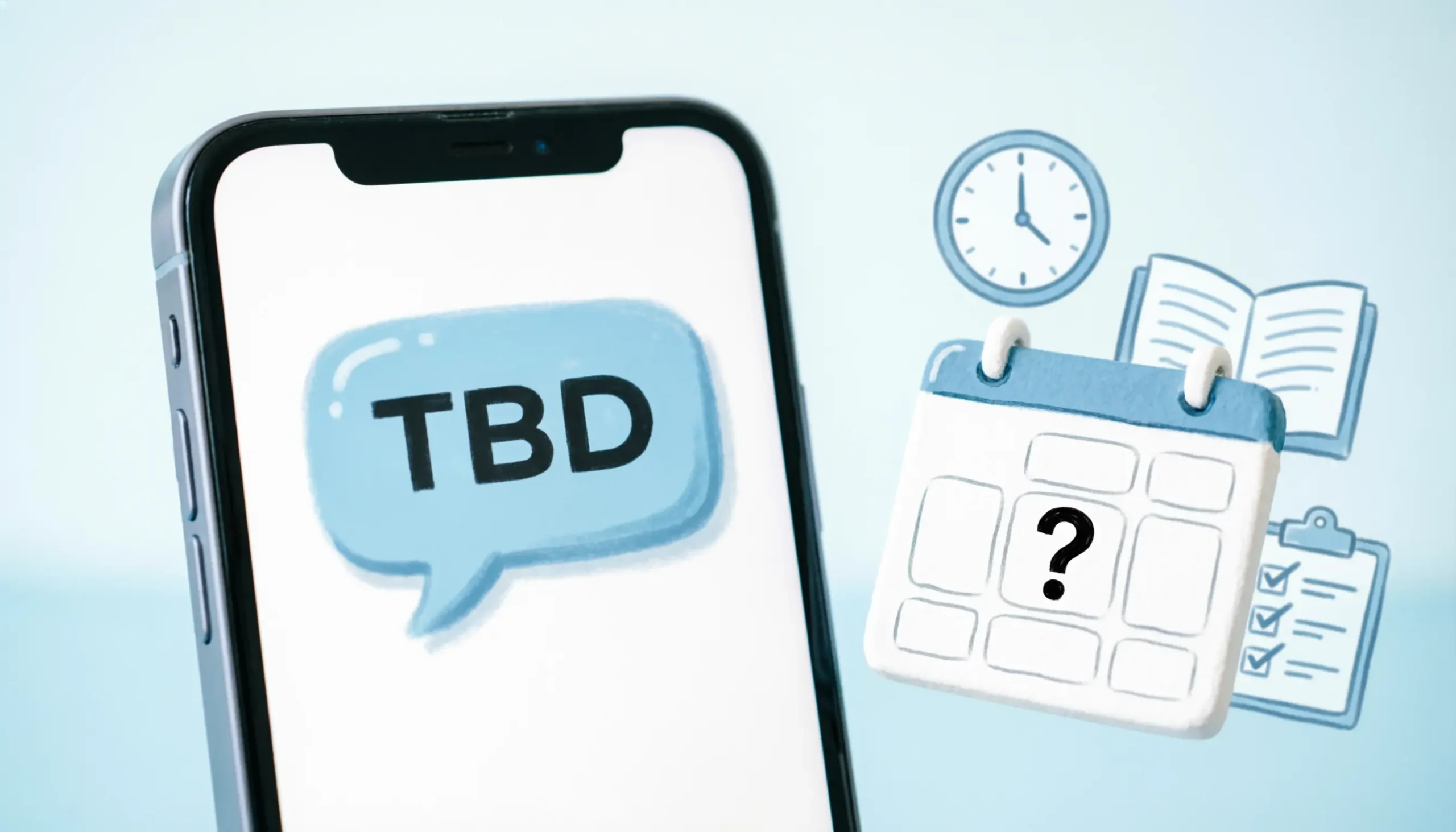
Meaning: TBD means something is not decided yet.
Full form: To Be Decided or To Be Determined
Context: Texting, business, planning, emails, social media, schedules
Tone: Neutral and informational
Many people see the term TBD in messages, emails, event schedules, or social media posts and feel confused about what it really means. It looks simple, but its meaning depends on context. Sometimes it appears in work emails. Sometimes it shows up in school schedules, meeting plans, or online announcements. Because it is short and commonly used in professional and casual communication, people often search for its exact meaning in texting and slang.
The term TBD is widely used in daily communication, especially when information is not finalized. You might see it in a meeting schedule, a project plan, a sports event announcement, or even a casual chat. It helps people communicate uncertainty in a clear and short way without writing long explanations. Understanding this term helps you read messages correctly and use it properly in conversations, emails, and online platforms.
What Does TBD Mean?
TBD stands for To Be Decided or To Be Determined. It simply means that something has not been finalized yet and will be decided later.
In simple words, TBD tells people that information is currently unknown or pending. It acts like a placeholder in communication. Instead of giving wrong or incomplete information, people use TBD to show that the final decision will come later.
For example, if a meeting time is not confirmed, someone may write “Meeting time: TBD.” This means the meeting will happen, but the exact time will be announced later. The term helps keep communication clear and organized without confusion.
It is commonly used in planning, scheduling, and decision-making situations. Businesses, schools, organizations, and even individuals use it to show that a detail is still under discussion. The purpose is to avoid misinformation and keep everyone informed that a decision is still in progress.
What Does TBD Mean in Texting, Slang, and Social Media?
In texting and social media, TBD keeps the same meaning but feels more casual and flexible. People use it in chats when they are not sure about plans or details.
TBD in Texting
In texting, TBD usually means a plan or decision is not final yet. Friends may use it while discussing meeting times, travel plans, or events. It saves time and avoids long explanations. Instead of writing a full sentence, people simply write TBD to show uncertainty.
For example, someone may text, “Dinner time TBD.” This tells the other person that the dinner will happen, but the exact time will be decided later.
TBD in Social Media
On social media, TBD is often used in announcements, event promotions, and updates. You may see it in captions, posters, or event details. It helps creators or organizers share early information even if everything is not confirmed.
For example, an event post may say, “Venue: TBD.” This means the location will be announced soon.
Gen Z and Internet Usage
Gen Z and internet users also use TBD in casual conversations. It appears in group chats, online communities, and planning discussions. The meaning stays neutral and practical. It is not emotional or slang-heavy, but rather a simple planning term used in modern digital communication.
Other Meanings of TBD
Although TBD mainly means To Be Decided or To Be Determined, it can sometimes have slightly different meanings depending on context.
- To Be Decided – final decision is pending
- To Be Determined – details will be confirmed later
- To Be Done – task is still pending
- To Be Discussed – topic needs discussion in meetings
- Project placeholder – information not finalized in business documents
These meanings are closely related and usually point to the same idea: something is not finalized yet.
How TBD Is Used in Real Conversations
TBD is commonly used in real-life communication across different platforms and situations. It helps people manage planning and expectations clearly.
In emails, professionals use TBD to show incomplete details in schedules or project plans. In school, teachers or students may use it for assignment deadlines or event timing. In workplaces, managers use it in meetings, presentations, and planning documents. In daily texting, friends use it for meetups and plans.
For example, a team email may include TBD for meeting time. A school event notice may include TBD for venue. A group chat may include TBD for weekend plans. In each case, the purpose is the same: information is coming later.
Examples of TBD in Sentences
Here are natural and real-life examples of TBD in use:
- The meeting time is TBD until the manager confirms the schedule.
- Our trip date is TBD because everyone is checking their availability.
- Venue for the event is TBD and will be announced soon.
- Assignment deadline is TBD for now.
- We will decide the dinner location later, so it is TBD.
- Project launch date remains TBD until final approval.
- Match schedule is TBD due to weather conditions.
- The interview time is TBD and will be shared by email.
These examples show how TBD works in everyday communication.
Tone and Intent
TBD has a neutral and informational tone. It does not carry emotional meaning. It simply communicates uncertainty or pending decisions.
The intent is usually professional or practical. It tells people that something is still under planning and should not be considered final. In business and formal communication, it sounds organized and clear. In casual texting, it feels simple and convenient.
TBD is not sarcastic or emotional. It is straightforward and used to avoid confusion. The tone stays calm, clear, and informative in most situations.
Origin or Background of TBD
TBD comes from business and scheduling language. It was originally used in corporate documents, meeting schedules, and planning sheets. Organizations needed a quick way to mark incomplete information, so abbreviations like TBD became common.
Over time, the term spread to schools, sports schedules, and event planning. As digital communication grew, people started using it in emails and online platforms. Eventually, it became part of internet and texting language.
Today, TBD is used worldwide in both professional and casual communication. Its meaning has stayed consistent, which makes it easy to understand across different industries and platforms.
Is TBD Rude or Inappropriate?
TBD is not rude or inappropriate. It is a safe and professional term used in communication.
It is commonly used in business emails, event announcements, and planning documents. Because it simply shows that information is pending, it does not offend anyone. However, overusing TBD without providing updates can feel unprofessional or unclear.
For example, writing TBD in an important schedule without later updates may confuse people. But using it properly in planning communication is completely acceptable and normal.
When NOT to Use TBD
There are some situations where TBD should be avoided.
In legal documents, final information must be clear and confirmed. In formal contracts, TBD may create confusion. In official announcements, people expect finalized details. In academic submissions, incomplete information may look careless.
It is also not suitable in urgent communication where immediate decisions are required. Using TBD in such cases may delay action or cause misunderstanding. Therefore, it should only be used when information is genuinely pending.
Similar and Related Slang Terms
Several similar abbreviations are used along with TBD in planning and communication.
TBA means To Be Announced and is used when information will be shared later. TBC means To Be Confirmed and shows that details are almost finalized but need confirmation. TBAA means To Be Announced Again and is less common but used in updates.
These terms are closely related and often appear in schedules, announcements, and event planning. Understanding them helps avoid confusion in communication.
TBD vs Related Terms
TBD vs TBA
TBD means the decision is not made yet, while TBA means the decision is made but not announced.
TBD vs TBC
TBD shows uncertainty, while TBC shows confirmation is pending.
TBD vs TBAA
TBD is about decision-making, while TBAA focuses on announcement updates.
Comparison Table
| Term | Meaning | Usage | Key Difference |
|---|---|---|---|
| TBD | To Be Decided or Determined | Planning, schedules, texting | Decision not made yet |
| TBA | To Be Announced | Events, announcements | Decision made but not shared |
| TBC | To Be Confirmed | Meetings, schedules | Waiting for confirmation |
| TBAA | To Be Announced Again | Updates, announcements | Information will be repeated |
Common Misunderstandings
Many people misunderstand TBD and use it incorrectly. Some think it is only internet slang, but it is actually a professional abbreviation. Others confuse it with TBA and assume both mean the same thing. Some people also think TBD means cancellation, which is not true.
Another common mistake is using TBD even after the decision is made. This creates confusion and delays communication. The correct use is to replace TBD once final information is available.
Understanding these points helps avoid communication errors.
FAQ Section
What does TBD mean in texting?
It means the decision or detail is not finalized yet and will be decided later.
Is TBD professional?
Yes, it is commonly used in business and workplace communication.
Does TBD mean unknown?
Yes, it indicates that information is currently unknown but will be decided later.
What is the difference between TBD and TBA?
TBD means not decided, while TBA means not announced yet.
Can TBD be used in emails?
Yes, it is widely used in professional emails and planning communication.
Is TBD formal or informal?
It can be both, depending on the situation.
What does TBD mean in business?
It shows pending decisions in schedules, meetings, and projects.
Is TBD commonly used online?
Yes, it is commonly used in social media, texting, and event announcements.
Conclusion
TBD is a simple and widely used abbreviation that means To Be Decided or To Be Determined. It helps people communicate that information is not finalized yet. The term is common in business, texting, social media, and everyday planning. It has a neutral tone and is safe to use in both professional and casual communication. Understanding TBD helps avoid confusion and improves clarity in messages, schedules, and announcements.
4 thoughts on “TBD Meaning in Text, Slang, and Social Media With Examples And Explanatio”