
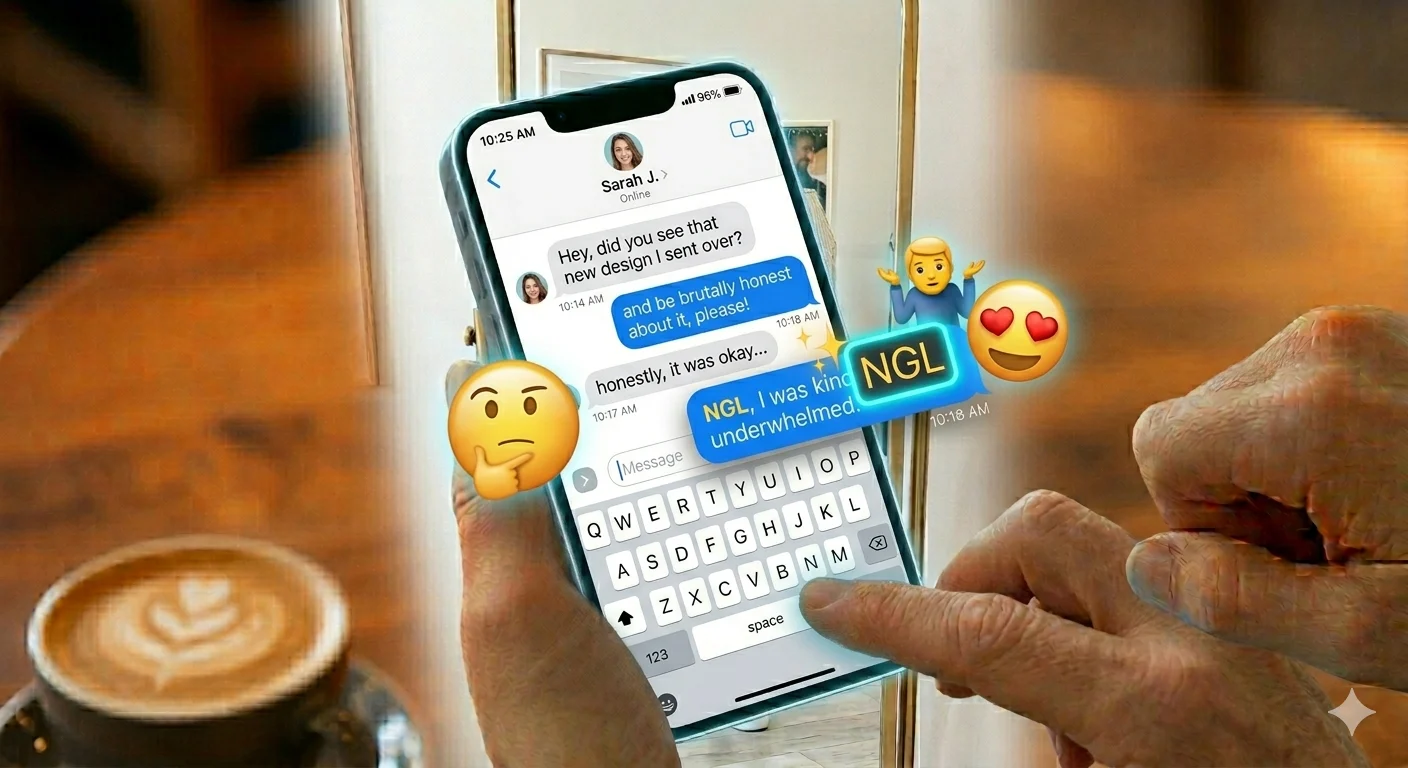
Meaning: A way to express honesty or a real opinion.
Full Form: Not Gonna Lie.
Context: Texting, social media, online chats, comments.
Tone: Casual, honest, sometimes slightly blunt.
If you spend time chatting online or scrolling through social media, you have probably seen the term “NGL” used in messages or captions. Many people search for “NGL meaning in texting” because it shows up often but is not always clearly understood, especially for beginners.
NGL is a simple abbreviation that helps people express honesty in a quick and natural way. It is commonly used when someone wants to share a real thought, reaction, or opinion. In digital communication, tone can easily be misunderstood. NGL helps signal that the speaker is being open and direct.
You will see NGL in texts, comments, memes, and even short replies. It is often used before or after a statement to make it feel more genuine. Whether someone is praising something or giving criticism, adding NGL makes the message sound more real.
Understanding how NGL works can make your conversations clearer and more natural. It helps you connect better with others by showing honesty without needing long explanations. Once you know its meaning, you will notice it everywhere online.
What does NGL mean?
NGL stands for “Not Gonna Lie.” It is used to show that someone is being honest about what they are saying.
For example, instead of just saying, “That movie was good,” someone might say, “NGL, that movie was good.” This adds a sense of honesty and emphasis.
In simple terms, NGL is a way to introduce a real opinion or feeling. It makes the statement sound more personal and genuine.
What does NGL mean in texting / slang / social media?
Texting meaning
In texting, NGL is used to make a message feel honest and direct. It can appear at the beginning or end of a sentence.
For example, “NGL, I’m tired today,” shows that the person is being open about how they feel.
It is commonly used in casual conversations with friends.
Social media usage
On social media, NGL is very popular. People use it in captions, comments, and reactions.
For example, “This outfit looks great, ngl,” adds a sense of sincerity to the compliment.
It is also used in memes to highlight relatable thoughts.
Gen Z context
Among Gen Z users, NGL is widely used and understood. It fits well with quick and expressive communication styles.
It is often combined with other slang terms to make messages more engaging.
Other meanings of NGL
NGL mainly means “Not Gonna Lie” in texting and online communication.
There are no widely used alternative meanings in everyday conversation. In most cases, if you see NGL, it refers to honesty or a real opinion.
How NGL is used in real conversations
NGL is used in many types of conversations where people want to express their true thoughts.
It is common in:
- Casual chats with friends
- Social media comments
- Reactions to content
- Sharing opinions or feedback
For example:
- “NGL, that was fun.”
- “I didn’t like it, ngl.”
- “NGL, you did a great job.”
It works in both positive and negative statements.
Examples
Here are some natural examples of NGL:
- “NGL, that food was amazing.”
- “I’m tired, ngl.”
- “NGL, this game is addictive.”
- “That was boring, ngl.”
- “NGL, I didn’t expect that.”
- “You look great, ngl.”
- “NGL, I miss those days.”
These examples show how flexible the term is.
Tone and intent
NGL has an honest and casual tone. It signals that the speaker is sharing a real thought or feeling.
It can be positive, negative, or neutral depending on the sentence.
Sometimes, it can sound slightly blunt, especially if the opinion is critical. However, it is usually not meant to offend.
Origin or background
NGL comes from internet and texting culture. As people started using abbreviations to communicate faster, phrases like “Not Gonna Lie” were shortened to NGL.
It became popular in online chats, forums, and later on social media platforms.
Today, it is a common part of everyday digital language.
Is it rude or inappropriate?
NGL is not rude by itself. It is a neutral expression used to show honesty.
However, the message that follows matters. If the statement is harsh, adding NGL does not make it completely polite.
In most cases, it is safe to use in casual conversations.
When NOT to use it
You should avoid using NGL in formal communication, such as work emails, academic writing, or professional messages.
It may also not be suitable in sensitive situations where direct honesty could hurt someone.
In these cases, it is better to use more careful language.
Similar and related slang terms
Some related terms include:
- TBH (To Be Honest)
- IMO (In My Opinion)
- FR (For Real)
Each of these terms helps express thoughts in a slightly different way.
NGL vs related terms
NGL vs TBH:
Both mean honesty, but TBH is slightly softer, while NGL can feel more direct.
it vs IMO:
IMO expresses opinion, while NGL emphasizes honesty.
NGL vs FR:
FR shows agreement or seriousness, while NGL introduces a statement.
Comparison Table
| Term | Meaning | Usage | Key Difference |
|---|---|---|---|
| NGL | Not Gonna Lie | Honest statements | Emphasizes honesty |
| TBH | To Be Honest | Honest opinions | Softer tone |
| IMO | In My Opinion | Personal views | Focus on opinion |
| FR | For Real | Agreement | Shows seriousness |
Common misunderstandings
Some people think NGL always sounds rude. In reality, it depends on the message.
Others confuse it with similar abbreviations like TBH or IMO.
Another mistake is using it in formal settings where it does not fit.
FAQ Section
1. What does NGL mean in texting?
It means “Not Gonna Lie.”
2. Is NGL positive or negative?
It can be both, depending on the sentence.
3. Can I use NGL on social media?
Yes, it is very common.
4. Is NGL formal?
No, it is informal slang.
5. What is the difference between NGL and TBH?
Both show honesty, but TBH is softer.
6. Can NGL be rude?
It depends on the statement used with it.
7. Why do people use NGL?
To sound honest and real in conversations.
conclusion
NGL is a popular slang term that stands for “Not Gonna Lie.” It is used to express honesty in a simple and direct way.
It works well in texting, social media, and casual conversations and It helps make messages feel more real and personal.
While it is easy to use, it should be avoided in formal situations. Understanding its meaning and tone will help you communicate more naturally and confidently online.