
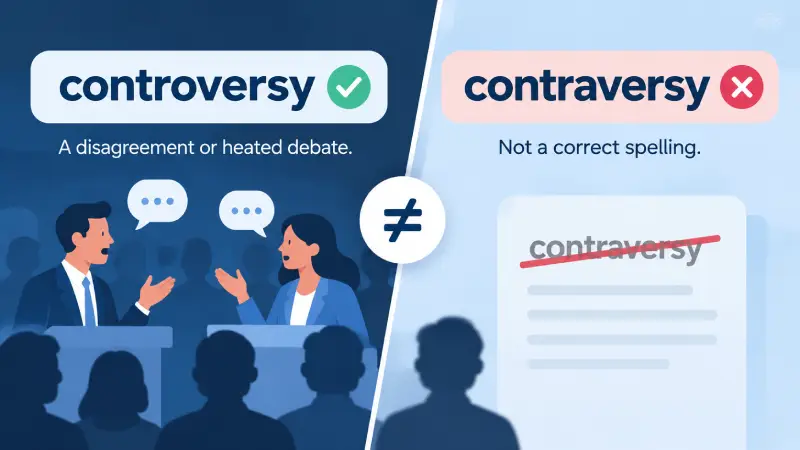
Controversy vs. contraversy is a common spelling confusion because the two forms look and sound very similar. If you are wondering which spelling is correct, the answer is simple: controversy is the correct spelling, while contraversy is a misspelling.
The word controversy means a situation, issue, or subject that causes disagreement, debate, or conflicting opinions. It is commonly used in American English in news, business, education, entertainment, sports, and everyday writing.
The confusion often comes from the way the word sounds when spoken. However, the correct spelling is controversy, with contro at the beginning, not contra. In this guide, you will learn the key spelling differences, meaning, pronunciation, examples, common mistakes, related word forms, and easy ways to remember controversy vs. contraversy.
Quick Answer: Controversy or Contraversy?
Controversy is the correct spelling.
Contraversy is incorrect and is considered a misspelling.
Correct:
The decision caused a major controversy.
Incorrect:
The decision caused a major contraversy.
Controversy is a noun meaning a disagreement, disputed issue, or situation that attracts conflicting opinions.
At a Glance
| Spelling | Correct? | Meaning | Example |
|---|---|---|---|
| Controversy | ✅ Yes | A disputed issue or public disagreement | The decision caused controversy. |
| Contraversy | ❌ No | Common misspelling | Avoid this spelling. |
What Does Controversy Mean?
Controversy is a noun that describes a situation or issue involving disagreement, debate, or conflicting opinions.
A controversy may involve two people, a group, an organization, or a much larger public discussion.
Examples
- The new policy caused controversy.
- The decision sparked a public controversy.
- The company became involved in a controversy.
- The issue remains a source of controversy.
- The announcement created considerable controversy.
In simple English, controversy can be understood as:
A disputed issue that causes disagreement or debate.
What Does Contraversy Mean?
Contraversy is not the standard spelling of an English word meaning disagreement or dispute.
It is a common misspelling of controversy.
For example:
❌ The new rule caused a lot of contraversy.
✅ The new rule caused a lot of controversy.
If you are writing an article, essay, email, report, or other professional content, use controversy.
Controversy vs. Contraversy: 7 Clear Differences
1. Controversy Is the Correct Spelling
The most important difference is that controversy is the standard English spelling.
Contraversy is a spelling error.
The proposal generated controversy.
2. The Middle Spelling Is Different
The correct word contains:
controversy
The common misspelling contains:
contraversy
The easiest part to remember is contro at the beginning.
Think:
contro + versy = controversy
Not:
contra + versy = contraversy
3. Controversy Is a Noun
Controversy is a noun.
It names the disputed issue or disagreement.
Examples:
- The controversy continued for several weeks.
- The controversy attracted public attention.
- The committee discussed the controversy.
- The article examined the controversy.
4. Contraversy Is Not an Alternative Spelling
Some English words have accepted spelling variations, but contraversy is not a standard alternative spelling of controversy.
When you mean a disputed issue or disagreement, use controversy.
5. Controversy Is Used in Many Types of Writing
The correct word can appear in both everyday and formal contexts.
You may encounter controversy in:
- News writing
- Academic writing
- Business communication
- Sports articles
- Entertainment writing
- Social media
- School assignments
- Professional reports
- Everyday conversation
6. Controversy Has Related Word Forms
The correct spelling connects to several related forms, including:
- controversy
- controversies
- controversial
- controversially
Examples:
The issue caused a controversy.
Several controversies followed.
It was a controversial decision.
The policy was controversially introduced.
7. Contraversy Should Be Corrected in Formal Writing
Because contraversy is a misspelling, it should be corrected before publishing or submitting formal writing.
Use controversy in:
- Essays
- Resumes
- Reports
- Emails
- Articles
- Websites
- Presentations
- Business documents
Why Is Controversy Commonly Misspelled as Contraversy?
The spelling mistake is understandable because controversy does not always look exactly the way people expect it to sound.
When people hear the word, they may associate the beginning with contra-, leading them to write contraversy.
However, the correct spelling begins with:
contro-
not:
contra-
The Correct Pattern
CON-TRO-VER-SY
A useful memory strategy is to focus on the first part:
Controversy has contro at the beginning.
How to Spell Controversy Correctly
The correct spelling is:
C-O-N-T-R-O-V-E-R-S-Y
You can divide it into:
contro + versy
The most important spelling point is the o after contr.
Remember:
✅ controversy
❌ contraversy
If you remember contro, you are much less likely to make this spelling mistake.
How Do You Pronounce Controversy?
Controversy has established pronunciation differences across varieties of English. In American English, the word is commonly pronounced with the stress toward the beginning.
The spelling, however, remains the same:
controversy
When learning the word, it is better to memorize its written form rather than trying to spell it entirely from its pronunciation.
Controversy Meaning in Simple English
In simple English, controversy means:
A disagreement or disputed issue that attracts attention or debate.
For example, imagine a company introduces a new policy and many people disagree about whether it is fair. The disagreement surrounding the policy could become a controversy.
Common Phrases With Controversy
Several phrases commonly appear with controversy.
Cause controversy
The decision caused controversy.
Spark controversy
The announcement sparked controversy.
Create controversy
The statement created controversy.
Generate controversy
The proposal generated controversy.
Face controversy
The organization faced controversy after the announcement.
Avoid controversy
The company tried to avoid controversy.
At the center of controversy
The policy was at the center of controversy.
Surrounded by controversy
The project was surrounded by controversy.
Example Sentences With Controversy
Here are natural examples showing how the word works in different contexts:
- The new policy caused controversy among employees.
- The decision sparked a public controversy.
- The company faced controversy after the announcement.
- The issue became the subject of a national controversy.
- The proposal generated considerable controversy.
- The controversy continued for several months.
- The article discusses the controversy in detail.
- The organization tried to avoid further controversy.
- The decision remains a source of controversy.
- The public debate eventually developed into a larger controversy.
Controversy vs. Controversial
These two words are closely related, but they have different grammatical functions.
Controversy
Controversy is a noun.
The decision caused controversy.
Controversial
Controversial is an adjective.
The decision was controversial.
A simple way to remember the difference:
- Controversy = the disputed issue
- Controversial = describing something that causes disagreement
Compare:
The policy caused controversy.
The policy was controversial.
Both sentences are correct, but the words perform different grammatical roles.
Controversy vs. Disagreement
Controversy and disagreement are related but are not always interchangeable.
A disagreement can be small or private.
My brother and I had a disagreement about dinner.
A controversy often involves a more significant or publicly discussed disputed issue.
The new policy became a major controversy.
So, a controversy can involve disagreement, but not every disagreement becomes a controversy.
Controversy vs. Debate
A debate is a discussion in which different views or arguments are presented.
A controversy is the disputed issue or situation surrounding those conflicting views.
For example:
The proposal sparked controversy.
People may then have a:
debate about the proposal.
This distinction can help you choose the right word.
Common Mistakes With Controversy
Mistake 1: Writing Contraversy
❌ The decision caused contraversy.
✅ The decision caused controversy.
Mistake 2: Using the Wrong Beginning
❌ Contraversy
✅ Controversy
Remember that the correct word begins with contro.
Mistake 3: Misspelling the Plural
The plural of controversy is:
✅ controversies
Not:
❌ controversys
Example:
Several controversies surrounded the organization.
Mistake 4: Confusing the Noun and Adjective
❌ The policy was a controversial.
✅ The policy was controversial.
Or:
✅ The policy caused a controversy.
Controversy Word Family
| Word | Part of Speech | Example |
|---|---|---|
| controversy | Noun | The issue caused controversy. |
| controversies | Plural noun | Several controversies followed. |
| controversial | Adjective | It was a controversial decision. |
| controversially | Adverb | The policy was controversially introduced. |
Learning the whole word family can make the spelling of controversy easier to remember.
Is Contraversy Ever Correct?
No. Contraversy is not the standard spelling of the word meaning a disputed issue or disagreement.
The correct form is:
controversy
If you see contraversy in text, it is generally a spelling mistake unless someone is intentionally reproducing an incorrect spelling.
Controversy in American English
Controversy is a standard word in American English and is appropriate in casual, professional, academic, and formal writing.
Examples include:
The decision caused controversy among residents.
The company became involved in a controversy.
The controversial proposal received public attention.
The spelling contraversy is not an accepted American English alternative.
Easy Memory Trick for Controversy
Use this simple trick:
CONTROversy starts with CONTRO.
Think of the word as:
CONTRO + VERSY
The correct beginning is contro, not contra.
Quick Memory Rule
Controversy = correct
Contraversy = incorrect
Quick Comparison Table
| Feature | Controversy | Contraversy |
|---|---|---|
| Correct spelling | ✅ Yes | ❌ No |
| Standard English | ✅ Yes | ❌ No |
| Meaning | Disputed issue or disagreement | No standard meaning |
| Part of speech | Noun | Misspelling |
| American English | ✅ Standard | ❌ Incorrect |
| Formal writing | ✅ Appropriate | ❌ Avoid |
| Related adjective | Controversial | None |
Frequently Asked Questions
Is it controversy or contraversy?
Controversy is the correct spelling. Contraversy is a misspelling.
What does controversy mean?
Controversy means a disputed issue or situation involving disagreement, debate, or conflicting opinions.
Is contraversy a word?
Contraversy is not the standard spelling of the English word. The correct spelling is controversy.
How do you spell controversy?
The correct spelling is:
C-O-N-T-R-O-V-E-R-S-Y
A useful breakdown is contro + versy.
What is an example of controversy?
The new policy sparked controversy among community members.
Here, controversy refers to the disagreement surrounding the policy.
What is the plural of controversy?
The plural form is controversies.
Example:
Several controversies surrounded the organization.
What is the adjective form of controversy?
The adjective form is controversial.
Example:
The decision was highly controversial.
Can I use controversy in formal writing?
Yes. Controversy is appropriate in academic, professional, business, journalistic, and other formal writing.
How can I remember the spelling of controversy?
Remember that the word begins with contro, not contra.
Contro + versy = controversy.
Final Answer: Controversy vs. Contraversy
Controversy is the correct spelling.
Contraversy is a common misspelling and should be avoided in standard English writing.
Use:
The decision caused controversy.
Not:
❌ The decision caused contraversy.
The easiest rule to remember is:
Controversy = correct
Contraversy = incorrect